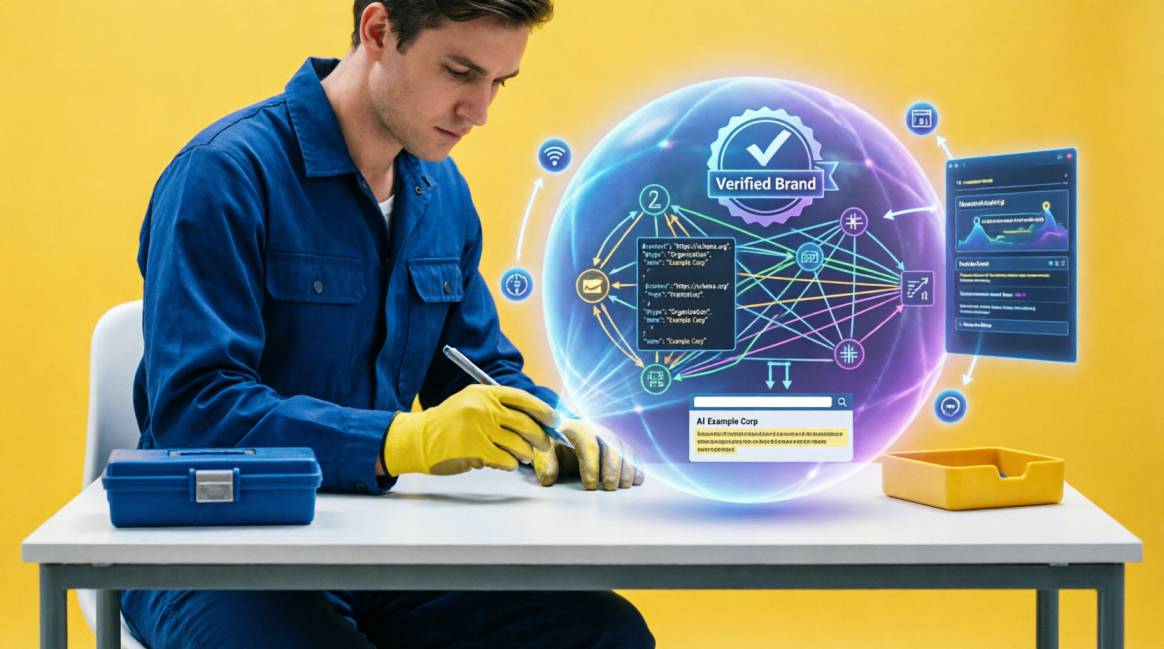
How to Get Your Business Into Google's Knowledge Panel: A Step-by-Step Guide for Non-Developers

| 3B+ Low-quality entities removed from Google's Knowledge Graph in June 2025 — the largest cleanup in history | 30+ Authoritative corroborating sources needed to reach the confidence score for panel creation | 3–12 Months realistic timeline from starting entity-building to Knowledge Panel appearance | ₦0 Legitimate cost of getting a Knowledge Panel — it cannot be bought, only earned |
Table of Contents
Table of Contents
Google's Most Visible Trust Signal — And Why Most Businesses Don't Have it
When someone searches your company name on Google and a panel appears on the right side of the results — showing your logo, description, website, social profiles, and contact details — they experience one of the most powerful trust signals in digital marketing. Without a word spoken, a question answered, or a link clicked, the Knowledge Panel communicates: this business is real, established, and recognised by Google.
Most businesses do not have one. And of those that do not, most believe they cannot get one because they are not famous enough, not large enough, or not Wikipedia-notable. All three assumptions are wrong.
A Google Knowledge Panel is not awarded to famous brands. It is earned by any entity that provides Google with sufficient, consistent, corroborated information to be recognised as a distinct, real-world thing worth displaying. A well-executed entity strategy from a Nigerian SME with no Wikipedia article and under ₦500 million in revenue can produce a Knowledge Panel. A multinational corporation with an inconsistent online presence and no structured data may not have one.
This guide is a step-by-step, non-technical walkthrough of exactly how to build the conditions that trigger a Knowledge Panel — from your Entity Home page structure to your Wikidata entry, from your corroboration sources to the claiming process once the panel appears. Every step is actionable without developer skills.
📌 What this guide covers:
- What a Knowledge Panel actually is — and what it is not
- The June 2025 Knowledge Graph cleanup and why it raised the bar for panel eligibility
- The nine corroborating sources that build Google's confidence in your entity
- Six steps to earn a Knowledge Panel: from Entity Home to claiming and managing
- A 12-week execution timeline with weekly action items
- The six most common Knowledge Panel problems and how to fix each one
- Why a Knowledge Panel is the foundation of AI Overview citation eligibility
What a Knowledge Panel is — and What it’s Not
A Google Knowledge Panel is an information box that appears in Google Search results — typically on the right side on desktop, or at the top on mobile — when someone searches for an entity that Google's Knowledge Graph recognises. It displays key facts about the entity: name, logo, description, website, social profiles, contact details, and for local businesses, the map location, hours, and reviews.
Critically: Knowledge Panels are generated automatically by Google's systems. You cannot pay for one. You cannot apply for one. You cannot request one through any Google interface. What you can do is build the conditions that cause Google's Knowledge Graph to recognise your brand as an entity worthy of a panel — and then claim the panel once it appears.
Knowledge Panel vs Google Business Profile — The Distinction That Confuses Most Businesses
These are two different features that look similar but operate through entirely different mechanisms:
| Google Business Profile (GBP) | Knowledge Panel |
|---|---|
| Created by you, manually, in business.google.com | Generated automatically by Google — cannot be created directly |
| Primarily for local search (Google Maps, local pack) | Appears in branded search results across Google Search globally |
| Directly editable by the business owner | Editable only through suggestions, feedback, and source corrections |
| Requires a physical address or service area | Does not require a physical address — online businesses qualify |
| Displays hours, reviews, directions, photos | Displays description, social profiles, key facts, and related entities |
| Confirms your local presence to Google | Confirms your brand's global entity status to Google's Knowledge Graph |
A fully optimised Google Business Profile contributes to Knowledge Panel creation but does not guarantee it. A Knowledge Panel can exist without a GBP (for online-only businesses). Having both is always more powerful than having either alone.
The June 2025 Knowledge Graph Cleanup — Why the Bar is Now Higher
In June 2025, Google executed its largest Knowledge Graph cleanup in history, removing over 3 billion low-quality entities from its database. This was three times larger than any previous cleanup and was driven specifically by the need to improve AI search accuracy — AI systems source from the Knowledge Graph, and a polluted graph produces unreliable AI answers.
The entities removed were primarily those with weak or inconsistent corroboration — brands that had a panel based on a single source, entities with contradictory information across their profiles, and businesses that had gamed their way into panel creation through low-quality citation building. The cleanup made surviving entities significantly more valuable and raised the bar for re-entry.
The practical implication for any business pursuing a Knowledge Panel in 2026: build your corroboration foundation on authoritative, consistent, genuinely informative sources. The era of quick-and-easy panel creation from a handful of directory submissions is over. The current threshold requires depth, consistency, and patience.
9 Sources That Build Google's Confidence in Your Entity
Knowledge Panel creation is fundamentally a corroboration problem. Google needs to see your brand described consistently, accurately, and authoritatively across multiple independent sources before it has enough confidence to display a panel. The following nine sources, ranked by their contribution to your entity's confidence score, are the foundation of any credible Knowledge Panel strategy:
| Source | Priority | Why It Matters | How to Use It |
|---|---|---|---|
| Official Website (Entity Home) | 🔴 Critical | Your homepage is your primary entity anchor — the page all other sources point to and the one Google evaluates most closely for entity signals. | Implement Organization schema with complete sameAs array. Include founding date, physical address, contact details, and logo. Page must be clearly about the organisation, not just the products or services. |
| Wikidata Entry | 🔴 Critical | Wikidata is the single highest-leverage structured source for Knowledge Panel creation. Google reads Wikidata directly and uses Q-IDs as entity disambiguation anchors. 30 minutes to create; persists indefinitely. | Go to wikidata.org → Create new item. Fill in: label (brand name), description (one sentence), official website URL, founding date, country, industry, logo image, social media links. Note your Q-ID and add it to your sameAs schema property. |
| Google Business Profile | 🔴 Critical | GBP is Google's own entity registration system for businesses. A fully verified, complete GBP signals to Google that a real business at a real location offers real services. | Claim or create GBP. Complete every field: categories, services, hours, photos, payment methods, attributes. Post twice weekly. Ensure business name matches your website exactly. |
| LinkedIn Company Page | 🟠 High | LinkedIn is one of the most trusted professional entity sources Google evaluates. It confirms your organisation exists, operates, and has verifiable employees. | Create/claim company page. Complete: logo, banner, description, founded year, industry, location, website URL. Ensure company name matches all other profiles exactly. |
| Crunchbase Organisation Profile | 🟠 High | Crunchbase is an authoritative business entity database that Google explicitly reads when building Knowledge Panels. Even a basic profile contributes meaningfully. | Create free profile at crunchbase.com. Complete: company name, website, founded date, HQ location, industry, description, social links. This is the minimum — add team members and funding rounds if applicable. |
| Wikipedia Article | 🟡 Medium (if eligible) | Wikipedia triggers Knowledge Panels on its own for eligible entities — it is the single most powerful source. However, strict notability criteria apply. Self-created articles about your own company are deleted. | Only pursue once you have 10+ independent third-party news mentions. Either wait for organic creation or engage an experienced Wikipedia editor to assess notability and draft the article for community review. |
| Major Nigerian Media Mentions | 🟡 Medium | Editorial mentions of your brand on BusinessDay, TechPoint.Africa, Nairametrics, or The Punch strengthen your entity's corroboration score significantly — especially for Knowledge Panels targeting Nigerian searches. | Pursue a media placement story angle (milestone, data, product launch, expert commentary). One article mentioning your brand name, website, and sector on a high-DA Nigerian outlet contributes meaningfully to the corroboration threshold. |
| Facebook Business Page | 🟡 Medium | Facebook pages are a sameAs anchor and contribute to Google's social presence confidence calculation. Especially significant for consumer-facing brands. | Create/claim page. Name must match your canonical brand name exactly. Include website URL, address, phone, hours, and a complete About section. |
| Industry Directories | 🟡 Medium | Mentions in industry-specific directories relevant to your sector — legal directories, health directories, fintech databases — contribute to corroboration score and topical entity association. | Identify the 3 most authoritative directories in your sector. Create or claim your listing on each with consistent NAP and a link back to your website. |
6 Steps to Earning a Knowledge Panel
The six steps below are sequenced in the order that produces the fastest path to Knowledge Panel creation — starting with the technical foundations that accelerate everything else, moving through structured source creation, and ending with the claiming and optimisation process once the panel appears.
Step 1: Build Your Entity Home Page
Your Entity Home is the single most authoritative webpage representing your business — the page all other sources point to and the one Google evaluates most closely when building your entity profile. For most businesses, this is your homepage. It must do four things simultaneously: clearly identify your organisation, provide complete contact and location information, implement Organization schema with a sameAs array, and link out to every external profile you want Google to associate with your entity.
Action Points:
- Ensure your homepage title includes your exact brand name (not just your tagline)
- Add a clear 'About' section that identifies what your business is, what it does, and where it operates — in one or two plain sentences
- Implement Organization schema with: @type, @id, name, url, logo, foundingDate, address, contactPoint, and sameAs array
- Add your sameAs array immediately: even if you only have 2–3 external profiles right now, include them. Expand the array as you create new profiles in subsequent steps.
- Validate schema using Google's Rich Results Test (search.google.com/test/rich-results) — zero errors required before moving to Step 2
Step 2: Create Your Wikidata Entry
Wikidata is the highest-leverage structured source available for Knowledge Panel creation. Google reads Wikidata directly and uses Q-IDs (unique entity identifiers) as anchors for disambiguation. Creating a Wikidata entry for your business takes approximately 30 minutes, requires no technical skills, is entirely free, and — once created — persists indefinitely. This is the single most impactful 30 minutes you will spend on entity authority building.
Action Points:
- Go to wikidata.org and create a free account
- Click 'Create a new item' and enter your brand name as the label (English) and a one-sentence description (e.g., 'Nigerian SEO and digital marketing agency based in Lagos')
- Add statements: instance of (Q4830453 for 'business'), official website (P856), country (P17), founded (P571), headquarters location (P159), logo image (P154), social media links using the appropriate properties
- Note your Q-ID (e.g., Q12345678) — this is your entity's permanent identifier
- Return to Step 1: add your Wikidata URL (wikidata.org/wiki/Q[your-ID]) to your sameAs schema array. This creates a bidirectional link between your website entity and your Wikidata entity.
Step 3: Build and Align Your Structured Source Library
With your Entity Home and Wikidata entry in place, build out the remaining structured sources that contribute to your corroboration score. Each source you create and complete adds to Google's confidence that your entity is real and consistently described. Aim to have all six primary sources created and aligned with identical brand information before expecting panel creation.
Action Points:
- Create or claim your Crunchbase organisation profile — complete: name, website, description, founded, HQ, industry, team members
- Create or claim your LinkedIn company page — name must match exactly. Complete all fields including founding year, website, and description
- Create or complete Facebook Business Page — exact brand name, website URL, address, phone, hours
- Verify all profiles use the exact same business name, address format, phone number, and description language — consistency is the corroboration signal, not just presence
- Once all profiles are live, update your sameAs schema array with every new profile URL and re-validate your schema
Step 4: Earn Media Corroboration
Structured profiles give Google facts about your entity. Media mentions give it independent verification. Every time an authoritative external website mentions your brand name alongside your website, your industry, and your location, it contributes to the corroboration score Google uses to evaluate Knowledge Panel eligibility. For Nigerian businesses, the primary corroboration sources are national business media and pan-African tech publications.
Action Points:
- Identify a newsworthy story angle: a business milestone, original data you have collected, a product launch, an expert opinion on a trending industry topic, or a community initiative
- Target: TechPoint.Africa, BusinessDay, Nairametrics, The Punch Business, Guardian Nigeria, Techcabal, or Ventures Africa. Even a brief mention in one of these outlets contributes meaningfully to your entity's corroboration score
- If formal media outreach is not immediately feasible: contribute a guest article to a relevant Nigerian industry blog, get listed in a professional association directory, or seek a podcast guest appearance with show notes that link to your website
- Track mentions: set up a free Google Alert for your brand name. Every new mention that appears is a corroboration data point entering Google's index.
Step 5: Monitor for Panel Appearance and Claim Immediately
Knowledge Panels appear without notification. Google does not alert you when your panel is created — it simply appears in search results one day. The only way to know is to check. Once your panel appears, claiming it immediately is essential: it gives you the ability to suggest edits, flag inaccuracies, and ensure your panel reflects accurate information about your brand.
Action Points:
- Search your exact brand name on Google daily — or set a Google Alert for your brand name to notify you of new results
- When a panel appears: scroll to the bottom and click 'Claim this knowledge panel' or 'Own this Knowledge Panel?'
- Sign in with a Google account connected to a verified Search Console property for your domain. This is the fastest verification path
- If you cannot verify via Search Console: Google allows verification through official social media accounts (LinkedIn, Facebook, Twitter/X) associated with the brand
- Once claimed: review every field in the panel for accuracy. Submit corrections via the panel's feedback button for any inaccurate information. Google reviews corrections against your source materials — ensure your corrections are supported by your Wikidata entry, website, and media mentions
Step 6: Optimise and Maintain Your Panel
Claiming your panel is not the end of the process. Knowledge Panels update algorithmically - approximately, monthly based on changes to their source data. If your website, Wikidata entry, or external sources change without corresponding panel updates, inaccuracies accumulate. Proactive maintenance keeps your panel accurate and prevents the entity confusion that can trigger panel removal.
Action Points:
- After any significant business change (new office, rebranding, new service, team change): update your Entity Home, Wikidata entry, and all external profiles first — then the panel will update in the next algorithmic cycle
- Submit feedback for any panel inaccuracy via the panel's feedback button. Support your submission with a link to the authoritative source containing the correct information
- Monitor your Wikidata entry monthly — it is publicly editable and can be updated by anyone. Check that all facts remain accurate
- Continue building corroborating sources quarterly: your goal is 30+ independent sources for panel stability. The June 2025 cleanup showed that entities with thin corroboration are most at risk in future cleanup events
GEO connection: your Knowledge Panel data feeds directly into Google AI Overviews and influences what AI systems say about your brand when asked. Ensure your panel description is the exact narrative you want AI systems to present about your business.
Our 12-Week Knowledge Panel Execution Timeline
The following timeline sequences all six steps into weekly sprints, prioritising the actions that have the most immediate impact on Google's entity confidence score. Following this sequence precisely — rather than working in parallel across all steps simultaneously — produces the fastest path to panel creation.
| Timeframe | Action | What You Are Building |
|---|---|---|
| Weeks 1–2 | Entity Home + Schema | Implement or update Organization schema on homepage with complete sameAs array. Verify using Rich Results Test. This is the signal Google uses to begin entity disambiguation. |
| Weeks 3–4 | Wikidata + Crunchbase | Create or update your Wikidata entry. Create or complete your Crunchbase profile. These two structured sources, combined with your schema, form the minimal viable corroboration base for panel creation. |
| Weeks 5–6 | GBP + Social Profile Alignment | Fully complete your Google Business Profile. Ensure LinkedIn, Facebook, and Twitter/X company pages use your exact canonical brand name. Check GSC Social Channels report — it should begin auto-populating. |
| Weeks 7–10 | Media Corroboration Sprint | Pursue 2–3 editorial mentions of your brand in Nigerian media or relevant industry publications. Each mention that names your brand and links to your website is a corroboration point toward the 30+ threshold. |
| Weeks 11–12 | Monitor + Check for Panel | Search your brand name on Google daily. When a panel appears, claim it immediately via the 'Claim this knowledge panel' link. Submit corrections for any inaccurate information. |
| Months 4–12 | Ongoing Corroboration | Continue building corroborating sources: additional directories, media mentions, author bylines, podcast appearances, industry association memberships. Each source strengthens panel stability and reduces susceptibility to Knowledge Graph cleanup events. |
Why Your Knowledge Panel is the Foundation of AI Visibility
A Knowledge Panel is not just a trust signal for human visitors. It is the primary mechanism through which Google's AI systems learn what your brand is — and what to say about it when users ask AI questions related to your industry.
When a user asks Google AI Mode 'What are the best digital marketing agencies in Lagos?' or asks ChatGPT 'Which SEO agency should I hire in Nigeria?', the AI systems synthesising those answers query their entity graphs to identify known, trustworthy entities in the relevant category. A brand with a Knowledge Panel has explicitly confirmed entity status — Google's structured assertion that this brand is real, categorised, and trustworthy. A brand without a panel is either absent from the entity graph or present only weakly, making consistent AI citation unlikely.
The panel description — the two to three sentences that appear below your brand name — is particularly critical for AI citation. This is the text that AI systems most commonly extract when generating brand summaries. If your panel description is generic or outdated, AI systems will summarise your brand generically or incorrectly. If it is specific, current, and accurate, AI systems will describe your brand precisely as you intend.
Optimising Your Panel Description for AI Citation
Once your panel is claimed, the description displayed is sourced from your most authoritative external profiles — typically your Wikidata description, your Crunchbase summary, or your Wikipedia introduction (if applicable).
To optimise this for AI citation:
- Keep your Wikidata description — the one-sentence summary — precise and specific: include what you do, where you operate, and what distinguishes you. 'Nigerian SEO and GEO agency based in Lagos, specialising in AI visibility and ethical digital marketing for African businesses' is more AI-citable than 'digital marketing company.'
- Align your Crunchbase company description with the exact framing you want AI systems to use when describing your brand — these two descriptions are the most commonly sourced by AI systems.
- If your panel description is incorrect or overly generic: submit a correction via the panel's feedback button, citing your Wikidata description as the preferred source. Include the exact text you want displayed.
- Ensure your panel's 'People also search for' section contains the right entity associations — if competitors appear there, it indicates Google's entity graph considers your brand closely related to them, which can influence AI comparison responses.
Knowledge Panel Troubleshooting — Six Common Problems and Their Fixes
| Problem | Likely Cause | The Fix |
|---|---|---|
| Panel appeared then disappeared | Most common cause: Google's June 2025 Knowledge Graph cleanup removed 3B+ low-quality entities. Your entity lacked sufficient corroboration depth to survive the quality filter. | Build corroboration across 30+ authoritative sources before expecting panel stability. Focus on Wikidata, Crunchbase, media mentions, and consistent schema. Do not rely on a single strong source. |
| Panel shows wrong information | Google sourced the information from an older or incorrect external source — often an outdated Crunchbase entry, stale press release, or incorrect directory listing. | Identify which source Google is pulling from (search your brand name — Google often displays the source at the bottom of the panel). Update that source directly. Then submit a correction via the panel's feedback button. Corrections take 2–6 weeks to reflect. |
| Panel exists for a different business with the same name | Entity disambiguation failure — Google cannot confidently separate your entity from another with the same name. | Add a disambiguation line to your Entity Home page: 'Semola Digital is a Lagos-based SEO and GEO agency — not affiliated with [other entity].' Strengthen your sameAs links with precise geographic and industry identifiers. Ensure your Wikidata entry includes location and founding date to differentiate from the other entity. |
| Panel shows but cannot be claimed | Your email domain may not match the domain Google associates with the panel, or the panel was generated before you had a verified GSC property. | Ensure the Google account you use to claim the panel is connected to a Search Console property for your domain with Verified Owner status. If domain mismatch persists, use the 'Claim this knowledge panel' alternative flow and verify via social media accounts associated with the brand. |
| Strong branded search but no panel | Your brand has search demand but insufficient entity corroboration — Google recognises demand but lacks confidence in the entity's attributes. | Tighten your Entity Home page (complete Organization schema, sameAs array). Remove any conflicting or duplicate entity profiles. Add 5+ new corroborating sources in the next 30 days. Most panels appear within 60–90 days of this intervention. |
| No branded search, no panel | Your brand is not yet searched for directly by name — the behavioural demand signal that contributes to panel creation is absent. | Panel creation is premature at this stage. Invest in brand awareness: media mentions, social media presence, PR, and email marketing that drives people to search your name. Panel eligibility follows entity recognition, which follows brand awareness. |
The Knowledge Panel Readiness Checklist
| ENTITY FOUNDATION — COMPLETE ALL BEFORE EXPECTING A PANEL | |
|---|---|
| ☐ | Organization schema implemented on homepage with @type, @id, name, url, logo, foundingDate, address, contactPoint — validated via Rich Results Test with zero errors |
| ☐ | sameAs array populated with at least 4 external profile URLs (Wikidata, LinkedIn, Facebook, Crunchbase minimum) |
| ☐ | Wikidata entry created with Q-ID noted and added to sameAs array |
| ☐ | Crunchbase profile created and complete: name, website, description, founding date, HQ, industry |
| ☐ | Google Business Profile fully verified and complete (if applicable to your business type) |
| ☐ | LinkedIn company page with exact canonical brand name, website URL, and complete description |
| ☐ | NAP (Name, Address, Phone) identical across your website, GBP, all social profiles, and all directories — no variations |
| ☐ | At least 2 Nigerian media mentions of your brand in the last 12 months (linked or unlinked) |
| ☐ | Google Alert set for your brand name — you will be notified when panel appears |
| ☐ | Minimum corroboration target before expecting a panel: 10+ consistent, authoritative mentions of your brand across independent sources. Aim for 30+ for panel stability post-cleanup. |
| CLAIMING AND OPTIMISATION — COMPLETE WITHIN 48 HOURS OF PANEL APPEARANCE | |
|---|---|
| ☐ | Search brand name daily (or via Google Alert) to detect panel creation |
| ☐ | Click 'Claim this knowledge panel' immediately — verify via Search Console property or social media |
| ☐ | Review every data field in the panel for accuracy |
| ☐ | Submit corrections for any inaccurate information via the panel's feedback button — attach source links |
| ☐ | Check panel description: does it accurately represent your brand the way you want AI systems to summarise you? |
| ☐ | Verify panel social links point to your current, active profiles |
| ☐ | Add any missing social profiles to your sameAs array and allow 2–4 weeks for panel to update |
| ☐ | Set monthly reminder to check panel for accuracy and update any outdated information |
Wrapping it up…
You Don’t Buy a Knowledge Panel. You Build it.
The Google Knowledge Panel is the most visible trust signal on the internet's most visited platform. It signals to every prospective customer, investor, partner, and journalist who searches your brand name that Google has done the background check and found your entity real, established, and credible. And in 2026, it is also the foundation of AI search visibility — the structured, verified brand data that AI systems draw from when generating answers about companies in your sector.
The June 2025 Knowledge Graph cleanup raised the bar. Superficial corroboration is no longer sufficient. Panel stability now requires 30+ authoritative, consistent, independent sources — a foundation that takes months to build correctly and that, once built, is significantly more resilient than anything produced through shortcuts.
But the bar is not impossibly high. A Nigerian SME that implements Organization schema correctly, creates a Wikidata entry, builds out its structured source library, earns 2–3 media mentions from Nigerian business publications, and aligns its NAP consistently across every platform has done the substantive work. The panel follows. For most businesses starting from a clean baseline, that work takes 60 to 90 days to execute and 30 to 60 additional days to be reflected in a panel.
Start with Step 1 from this guide today: build your Entity Home, implement your schema, and validate it. Everything else builds from that foundation. Building an entity is a 100% white-hat SEO strategy.
📋Article Summary: How to Get a Google Knowledge Panel
- Knowledge Panels are generated automatically by Google — they cannot be bought or requested.
- They are earned through consistent entity recognition signals across authoritative sources.
The June 2025 Knowledge Graph cleanup removed 3B+ entities. - Panels now require 30+ corroborating sources for stability.
- Thin corroboration produces a panel that disappears at the next cleanup.
- The nine corroboration sources: Entity Home + schema, Wikidata entry, Google Business Profile, LinkedIn, Crunchbase, Wikipedia (if eligible), Nigerian media mentions, Facebook, and industry directories.
- The six-step process: (1) Build Entity Home + schema, (2) Create Wikidata entry, (3) Align structured source library, (4) Earn media corroboration, (5) Monitor and claim when panel appears, (6) Maintain and optimise.
- The 12-week timeline: schema + Wikidata (Weeks 1–2), Crunchbase + GBP + social alignment (Weeks 3–6), media corroboration sprint (Weeks 7–10), monitoring and claiming (Weeks 11–12).
- Your panel description is the text AI systems use when summarising your brand. Optimise it via your Wikidata description and Crunchbase summary — the two sources AI systems reference most frequently.
- Realistic timeline: 3–12 months from starting entity-building to panel appearance. Businesses with an existing online presence but missing key signals (Wikidata, schema) typically see panels within 60–90 days.
Frequently Asked Questions
Questions readers ask about this topic
The FAQs below are pulled directly from this article's structured content and are designed to help readers quickly find answers to common questions related to the topic.
Can I pay someone to get me a Knowledge Panel?
My business has been operating for 10 years. Why do we not have a Knowledge Panel?
How long does it take for corrections to appear on my panel?
Does having a Knowledge Panel affect our AI search visibility?
What happens to our Knowledge Panel if we rebrand?

Founder, Technical Analyst
Oladoyin Falana is a certified digital growth strategist and full-stack web professional with over five years of hands-on experience at the intersection of SEO, web design & development. His journey into the digital world began as a content writer — a foundation that gave him a deep, instinctive understanding of how keywords, content and intent drive organic visibility. While honing his craft in content, he simultaneously taught himself the building blocks of the modern web: HTML, CSS, and React.js — a pursuit that would eventually evolve into full-stack Web Development and a Technical SEO Analyst.
Follow me on LinkedIn →