What is a Content Strategy? How to Build One That Actually Drives Traffic to Your Business

Table of Contents
Table of Contents
Publishing is Not a Strategy
Every week, businesses publish blog posts. Articles go live. Social captions get written. Newsletters go out. The collective output of this effort, measured in hours of writing time and months of publishing frequency, is enormous.
Most of it generates no meaningful traffic, no leads, and no compounding authority. Not because the writing is bad. Because there was no systematic approach underneath it deciding which topics to cover, which searches those topics should capture, which pages should link to which others, or how a reader at the end of one article should be guided to the next thing that serves their need.
That system is a content strategy that determines whether content compounds over time or accumulates as a folder of orphaned articles that each generate twelve visits per month from people who found them by accident.
The distinction between publishing and strategy is not sophistication. It is intent.
Strategy begins with a question: what does this content need to do for the business, and what does a specific person need to be searching for in order to find it? Publishing begins with: we need to put something out this week.
This guide builds the system from the ground up. By the end, you will have a complete framework for building a content strategy that grows organic traffic, attracts the right audience, and converts readers into clients or customers at predictable rates.
What Content Strategy Actually Means
The phrase ‘content strategy’ is used to mean different things in different contexts. In some agencies, it means just an editorial calendar. In others, it means a brand voice document. In content marketing circles, it covers everything from social media to video scripts.
For the purposes of SEO and organic growth — which is the context that drives measurable business results for most businesses — content strategy has a precise definition: it is the system that connects what your potential customers are searching for to the content your website publishes, such that Google routes those searchers to your pages at the moment of their intent, and those pages convert a meaningful percentage of that traffic into business outcomes.
That definition contains four components, each of which must be present for a strategy to function. Remove any one of them and the system breaks.
The four components
1. What your potential customers are searching for: This requires keyword research — not guessing, but data. It requires understanding the volume of searches for specific queries, the intent behind those queries (informational, commercial, transactional), and the competitive landscape for ranking.
2. The content your website publishes: Content must exist for Google to have something to rank. But it must exist in the right form: the right format (guide, checklist, comparison, case study) for the query intent, the right depth (comprehensive enough to be the best result for the query), and the right structure (technically correct for indexation, human-readable for engagement).
3. A system that drives searchers to your pages: This is Google’s decision, but it is influenced by your site architecture, your internal linking structure, your technical SEO health, and the authority signals your domain has accumulated.
A piece of content published in isolation, with no internal links from related pages and no place in a broader topic cluster, starts accumulating authority from zero with no reinforcement from the rest of the site.
4. Pages that convert traffic into business outcomes: Content that attracts traffic but does not connect that traffic to a business outcome is not an asset. Every piece of strategic content should have a clear next step: a related service page, a lead magnet, a contact form, a related article that deepens the relationship and understanding. Without this, you are building an audience for someone else’s benefit.

Content Strategy vs Content Marketing vs Blogging
Before building a strategy, it helps to be precise about what it is not, because the vocabulary in this space is used loosely and the confusions are expensive.
| Approach | What It Involves | What It Produces | What It Misses |
|---|---|---|---|
| Blogging | Publishing articles on topics that seem relevant or interesting | Content exists on the site | No keyword targeting, no cluster architecture, no measurement |
| Content Marketing | Creating content to attract and retain an audience, often across channels | Audience engagement; brand awareness | Often not search-optimised; misses organic discovery channel |
| Content Strategy | A planned system: audience intelligence → keywords / semantics analysis→ cluster mapping → execution → measurement | Compounding organic traffic; attributable leads; topical authority | Nothing, if built correctly — this is the complete system |
| SEO Content Strategy | Everything in Content strategy + technical SEO, search intent alignment, and structured data built in from brief to publication | Rankings, rich results eligibility, AI citation, organic revenue | Requires more upfront work but produces compounding returns |
The differentiation that matters most for organic growth: blogging produces content. Content marketing produces an audience. SEO content strategy produces compounding search visibility. For most businesses, the third is the one worth building, and the first two are subsets of it done without the system.
The compounding argument: A well-optimised article published today is an asset that generates traffic every month for years, at zero ongoing cost per visitor.
An Instagram post published today generates traffic for approximately 48 hours. This is not an argument against social media, which serves different functions. It is an argument for why content strategy — specifically SEO content strategy — produces the best return on content investment for most businesses over a 24–36 month horizon.
Step-by-Step — How to Build a Content Strategy That Drives Traffic

Cluster articles answer specific sub-questions. Internal links in both directions pass authority through the entire cluster. Google indexes the whole cluster as topically authoritative.
Define What Traffic Needs to Produce
Start with business outcomes, not topics. What does organic traffic need to do for your business? Generate enquiry form submissions? Direct phone calls? Product purchases? E-book downloads that lead to email sequences?
Define the specific conversion events that make organic traffic valuable, because every content decision downstream flows from this.
A content strategy built to generate informational traffic is fundamentally different from one built to generate transactional leads — and you cannot optimise for both with the same approach.
Build Your Audience Intelligence Map
Identify the two or three specific people who represent your ideal organic searcher. Not demographic generalisations but search behaviour profiles: what are they typing into Google when they have the problem your business solves?
What stage of the buying journey does that search suggest — are they learning about the problem, evaluating solutions, or ready to hire? What do they need to see in a piece of content to trust the source? This profile determines everything from the format of your content to the language of your headlines to the call to action at the end of each article.
Conduct Keyword Research
Keyword research for content strategy is not a list of phrases you want to rank for. It is a map of what your audience actually types, organised by intent and volume. Start with the broad topic territory your business operates in.
Use Google Keyword Planner, Ubersuggest, or Ahrefs to find related queries and their monthly search volumes. Classify each search query by intent: informational (how to, what is, guide), commercial (best, top, comparison, agency), or transactional (hire, buy, book, quote). Then filter by relevance and realism — a 50,000-monthly-search query is not useful to a new site that cannot yet compete for it.
Map Keywords to the Buyer Journey
Not every keyword belongs at the same stage of the funnel. Informational queries (‘what is content strategy’) attract people learning about a problem. Commercial queries (‘best content strategy agency Lagos’) attract people evaluating options. Transactional queries (‘hire content strategist Lagos’) attract people ready to act.
A complete content strategy covers all three stages: top-of-funnel content builds awareness and earns informational traffic; middle-of-funnel content positions your expertise against alternatives; bottom-of-funnel content converts qualified prospects. Map each keyword to a funnel stage before assigning it to a content piece.
Architect the Content Clusters
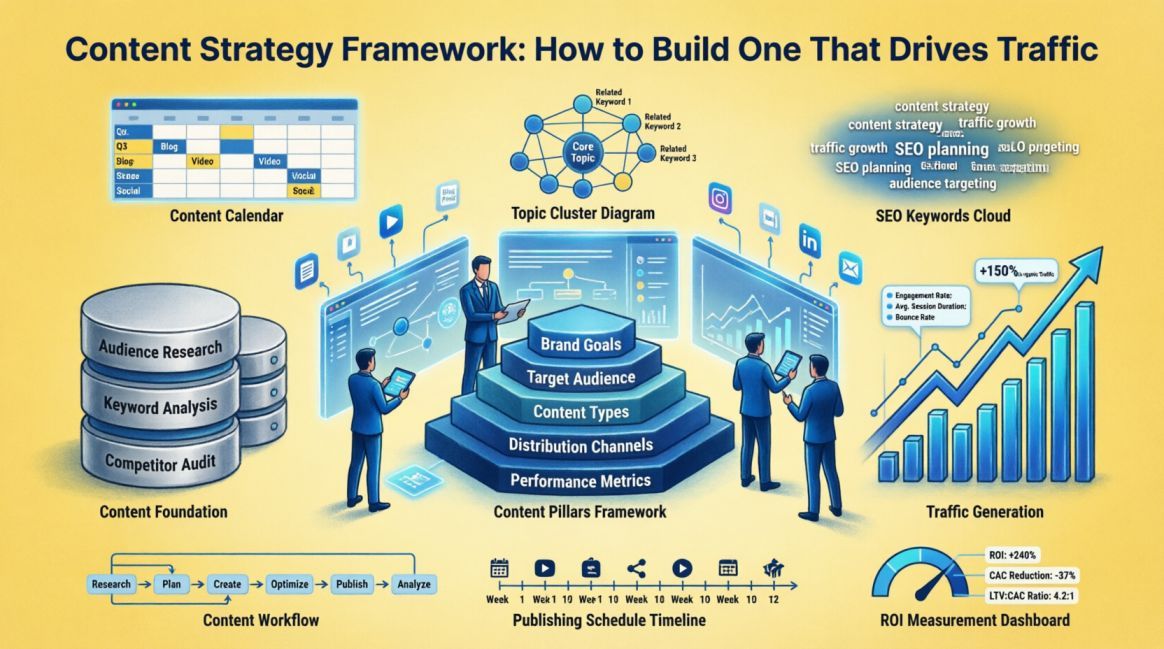
The content cluster is the structural unit of a modern SEO content strategy. Each cluster consists of a pillar page — a comprehensive, long-form piece covering a broad topic — surrounded by cluster articles that answer specific sub-questions within that topic.
The pillar page links to every cluster article. Each cluster article links back to the pillar. This bidirectional internal linking creates a topic authority signal that Google recognises: this site covers this subject in full, not in fragments. A site with three well-built content clusters consistently outranks a site with thirty isolated blog posts on a broader range of subjects.
Write Content Briefs Before Anything Else
A content brief is the document that exists between keyword research and writing. It specifies: the target keyword, the primary intent, the recommended format and approximate word count, the recommended H2 structure, the related keywords (semantics terms) to include naturally, the internal links to existing pages, the call to action, and the specific questions the article must answer to satisfy the search intent.
Writing without a brief produces articles that serve the writer’s perspective rather than the searcher’s need. Every piece of content that performs consistently in organic search was briefed to a standard before a word was written.
Publish Consistently and Link Internally
Consistency is not a productivity concept in content strategy. It is a compounding mechanism. Google’s crawl budget allocates more frequent re-crawls to sites that publish regularly. A site that publishes two pieces per month for twelve months accumulates more topical authority than a site that publishes twenty pieces in two months and nothing for ten.
The frequency is less important than the regularity. One article per month, every month, reliably, outperforms sporadic bursts of output. And every new article must be connected to the existing cluster via internal links before publication — an isolated article starts from zero, every time.
Measure What Matters
The measurement of content strategy is not page views or social shares. It is organic sessions from non-branded queries, engagement rate on organic landing pages, conversion rate from organic traffic, and the growth of target keyword positions over three, six, and twelve months.
Configure Google Analytics 4 conversion events from the first day of your strategy so that no organic lead goes uncounted. Review Google Search Console monthly for the CTR opportunity report — pages that rank in positions 4 to 10 but have below-average click-through rates are your fastest wins, achievable by rewriting title tags and meta descriptions rather than creating new content.
The Content Calendar — Planning Before Publishing
The content calendar is where strategy becomes operational. A good content calendar does not just list publication dates. It records the business rationale for each piece: the target keyword, the funnel stage, the cluster it belongs to (or a new pillar content), the call to action it carries, and the person responsible for writing, reviewing, and publishing it.

The discipline of the content calendar is the discipline of decision-making before execution. A blank calendar slot filled at the last minute by whatever seems topical that week is not a strategic publication. A slot with a target keyword, a brief, and a clear call to action is. The calendar converts the strategy from a document into a practice.
At Semola Digital, every client content calendar is built quarterly and reviewed monthly. Each piece must pass a simple four-question filter before it is added to the schedule:
- Is there a measurable audience searching for this topic? (Verified by keyword research, not assumed)
- Does it belong to an existing cluster or start a new one? (Isolated content is deprioritised)
- Does it serve a specific stage in the buyer journey? (Top, middle, or bottom of funnel, not ‘general’)
- Is there a clear next step for the reader? (Internal link to a related piece or service page, not a dead end)
The content calendar mistake:
The most common failure mode in content calendars is filling them with topics the business finds interesting rather than topics the audience is actively searching for. Internal expertise and search demand overlap — but they are not identical. The overlap is where strategic content lives.
A piece written about a topic only the business cares about is a press release. A piece written about a topic only the audience searches for, without the business’s expertise, is generic. The intersection is the only place worth publishing.
The Mistakes That Kill Content Strategies
Content strategies fail in predictable ways. Understanding the failure patterns before you encounter them is the most efficient way to avoid them.
1. Writing for Google instead of people
Google’s algorithm has become very good at recognising content produced to satisfy ranking signals rather than human needs.
The Helpful Content update explicitly rewards pages where there is evidence of first-hand experience, genuine expertise, and real utility to the reader.
Thin content that lists correct keywords without delivering genuine insight will be deindexed or suppressed over time, regardless of how technically well-optimised it is. Write what you would want to read if you were your own ideal customer.
2. Publishing without building topic clusters
A site with forty blog posts covering forty different topics is a site with forty pages of thin authority. A site with four well-built content clusters of ten articles each is a site with four areas of concentrated topical expertise that Google can recognise, reward, and route relevant traffic to.
Depth outperforms breadth in modern SEO. If you are building a content strategy from scratch, choose two or three topics you can genuinely own and build comprehensively before expanding.
3. Measuring too early
Content strategy is a compound interest investment. A piece of content published today may not reach its ranking potential for three to six months.
A cluster built over twelve months may not produce the majority of its traffic until month eighteen. Evaluating the strategy in month two based on traffic numbers produces false negatives: most of what has been published is not yet mature enough to rank competitively.
The correct measurement window for evaluating content strategy is twelve months minimum, with monthly tracking of leading indicators (impressions growth, keyword position trends, engagement rate improvements) rather than immediate traffic volume.
4. No internal linking discipline
Every piece of content published without an internal link to the pillar page of its cluster, and without links from existing cluster articles to it, is starting from zero.
Internal linking is the mechanism through which a well-established page on your site transfers part of its accumulated authority to a new one. It costs nothing, takes five minutes per article, and is the single most consistently neglected element in content execution.
Make it a non-negotiable part of your publication checklist: no article goes live without at least two contextual internal links — one to the pillar page, one from an existing related article.
4. Ignoring content refreshment
Content decays. Search intent evolves. Competitors improve their pages. Statistics become outdated. An article that ranked in position two in 2023 may rank in position eight in 2026 not because it was penalised but because it became less comprehensive relative to what is now available on the query.
A content refresh — updating statistics, expanding coverage, improving structured data, adding a current year to the title tag, updating the dateModified in schema — can recover a declining page’s ranking at a fraction of the cost of creating a new one.
Content Strategy for Nigerian & African Businesses
Global content strategy advice is almost exclusively written for markets in the US, UK, and Western Europe. The keyword volumes, the search intent patterns, and the competitive landscapes discussed in most SEO content strategy frameworks do not translate directly to Nigerian or West African markets. There are specific adaptations that produce significantly better results in this context.
The low-competition advantage
For most topic areas relevant to Nigerian businesses — law, finance, logistics, healthcare, real estate, professional services — the competitive content landscape is thin.
A well-researched, well-structured piece of 1,500 words targeting a specific Nigerian market query can reach position one within weeks rather than months, because there are very few other sites publishing this type of content for this audience.
The strategic implication: the content opportunity in the Nigerian market is not about competing with established global sites on global queries. It is about owning local and market-specific queries that global sites will never target.
Writing for the Nigerian search vocabulary
Your audience types in their own language, not in the language of your industry. A solicitor’s firm whose potential clients search ‘how to buy land in Lagos without being scammed’ needs content targeting that exact phrase, not a piece titled ‘Real Property Acquisition Due Diligence in Nigeria.’ Both are about the same topic. Only one of them is what people actually type.
The discipline of writing for the searcher’s vocabulary rather than the practitioner’s vocabulary is one of the most consistent sources of underperformance in Nigerian business content.
The Local SEO integration
For businesses serving specific Lagos or Nigerian cities and regions, content strategy and local SEO are not separate disciplines. Location-specific landing pages (‘our services in Lekki’, ‘accounting firm Ikeja’) are content strategy decisions with direct local search consequences.
Every service you offer in every location you operate should have its own page with unique content, not a template with the city name swapped. That specificity is what earns local rankings and Google Business Profile map pack appearances.
Where to Start
The easiest way to build a content strategy is to start smaller than feels right. Choose one cluster. Pick the five questions your ideal client asks most often about the problem your business solves. Keyword-validate those questions with Google Keyword Planner. Write the pillar page. Write the first three cluster articles. Link them all together.
Measure the results at ninety days.
That is not the whole strategy. It is the first iteration of it. Strategy is built through cycles of plan, execute, and measure — not in a single workshop that produces a fifty-page document nobody returns to.
The businesses that build organic traffic consistently over two, three, and five years are not the ones that had the best strategy document. They are the ones that built a simple system, held themselves to consistent execution, and accumulate the results of each cycle into the next one.
The content that earns the best rankings is the content written by people who know what their audience needs and built a system that delivers it repeatedly. That is all a content strategy is. Build the system. Then work it up.
Need a content strategy built for your business? hello@semoladigital.com
Semola Digital builds content strategies as standalone deliverables and as the Month 1 foundation of our SEO retainer engagements. Every strategy includes: audience intelligence mapping, full keyword architecture, a content cluster map, a 12-month editorial calendar, and briefing templates for every piece. Contact us to discuss your market and your goals.

Founder, Technical Analyst
Oladoyin Falana is a certified digital growth strategist and full-stack web professional with over five years of hands-on experience at the intersection of SEO, web design & development. His journey into the digital world began as a content writer — a foundation that gave him a deep, instinctive understanding of how keywords, content and intent drive organic visibility. While honing his craft in content, he simultaneously taught himself the building blocks of the modern web: HTML, CSS, and React.js — a pursuit that would eventually evolve into full-stack Web Development and a Technical SEO Analyst.
Follow me on LinkedIn →