Search Intent Mismatch: The Real Reason Your Rankings Aren’t Converting

Table of Contents
Table of Contents
The Metric Combination That Signals a Strategic Problem
Rankings and bounce rate exist in different reports, measured by different tools, at different points in the user journey. This separation is part of why their relationship is so frequently misread.
Google Search Console tells you what queries are reaching your pages and at what position. Google Analytics 4 tells you what users do once they arrive. Most teams look at each report in isolation: the SEO team celebrates the ranking, the marketing team worries about the bounce rate, and neither connects the two data points into the diagnosis they form together.
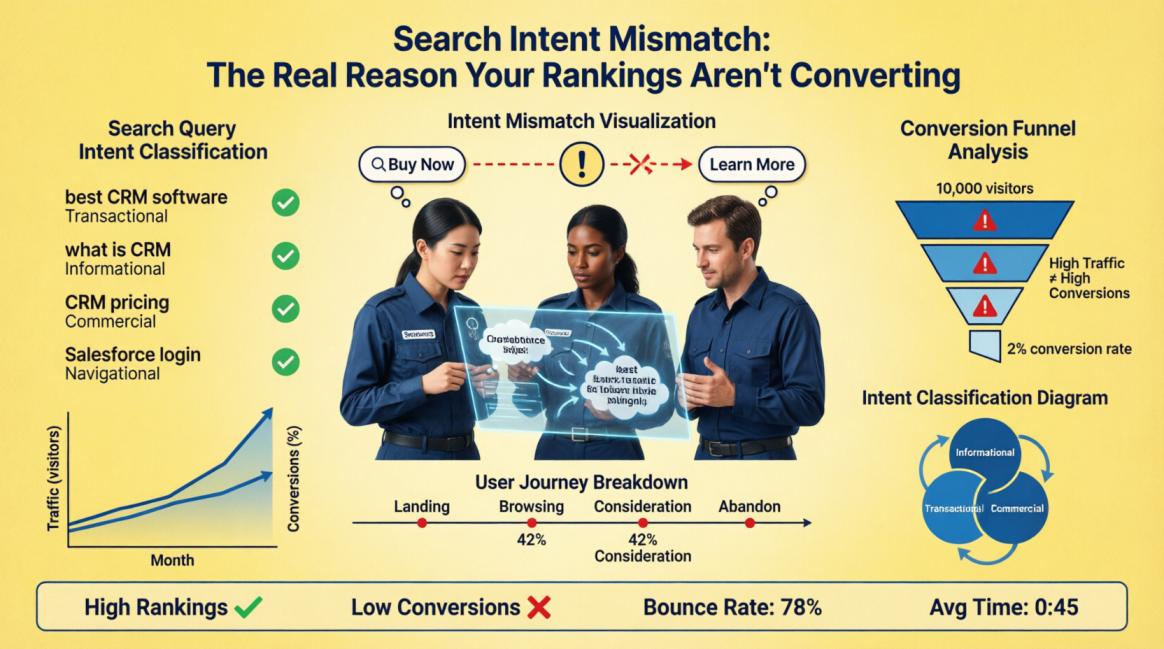
Together, they tell a precise story. A page with a strong average position (3–6) and a high bounce rate (70%+) and a low average engagement time (under 45 seconds) is not a page with a performance problem. It is a page with an intent problem. It is reaching the right audience at the right moment in their search journey — and then failing them, because what they were looking for and what the page offers are not the same thing.
This article explains the mechanics of search intent, how to diagnose a mismatch using freely available data, and how to resolve it without sacrificing the rankings you’ve already earned.
What Search Intent Actually Means
Search intent is the underlying goal behind a search query. It is not the topic of the query — it is the reason the person is searching. Two queries can be about the same topic but express completely different intents, and they require completely different pages to satisfy them.
The query “what is technical SEO” and the query “hire technical SEO consultant Lagos” are both about technical SEO. But the first user wants to understand a concept. The second wants to engage a service provider. Sending both users to a service page is correct for the second and wrong for the first. Sending both to a blog post is correct for the first and wrong for the second.
Search intent is conventionally categorised into four types. Understanding them is the foundation of any intent alignment strategy.

1. Informational intent
The user wants to learn. The query typically includes words like what, how, why, guide, explain, or difference between. The expected content format is an article, guide, tutorial, or explainer. A user with informational intent who lands on a service page with a contact form and a list of pricing packages has not had their need met. They will leave.
Informational queries are the most common type on the web and the most commonly mismatched. They drive enormous search volume, which makes them attractive to target, but they require a content investment — a well-written, genuinely helpful article — that service pages cannot substitute for.
2. Navigational intent
The user wants to find a specific page or website. The query typically includes a brand name, a product name, or a page type (“login”, “pricing”, “documentation”). The expected destination is the specific page they named. Navigational queries are the easiest to satisfy — they just require the correct page to exist and to rank for its own name — but they are regularly mishandled by sites that send branded navigational queries to the homepage instead of the specific page the user was looking for.
3. Commercial investigation intent
The user is researching before making a decision. The query typically includes words like best, vs, compare, review, top, or alternatives. They are not ready to convert. They are building a shortlist. The expected content format is a comparison, a review, a case study, or a curated list. Sending a user with commercial investigation intent directly to a purchase or contact page is jumping a step in their decision process and they will bounce — not because the page is bad, but because they are not ready for it.
4. Transactional intent
The user wants to complete an action: buy, hire, download, sign up, book. The query typically includes words like hire, get, buy, book, or download. This is the intent that service and product pages are built to serve. A user with transactional intent who lands on a service page and finds a clear value proposition, a contact form, and relevant social proof is in the right place. They convert at the highest rates of any intent type — when they are on the right page.
How the Mismatch Erodes Rankings Over Time
Search intent mismatch is not only a conversion problem. It is a rankings problem, because Google uses engagement signals to assess whether a page is genuinely satisfying the users it reaches. A page that consistently fails to satisfy users generates a pattern of signals that Google interprets as a quality indicator.

Pogo-sticking: the clearest negative signal
Pogo-sticking is the pattern where a user clicks a search result, spends a very short time on the page, and returns to the search results page to click a different result. It is the behavioural signature of a page that failed to satisfy a searcher. The user communicated, through their behaviour, that the first result did not answer their question.
Google does not confirm that pogo-sticking directly causes ranking changes, but the evidence from industry studies and ranking behaviour observations strongly suggests that pages with persistent pogo-sticking patterns lose rankings over time, particularly in competitive niches where several pages are competing within a narrow quality band. The mechanism may be indirect — through engagement rate and session duration signals fed into Google’s ranking models — but the outcome is consistent: pages that satisfy searchers maintain and improve rankings; pages that do not, decline.
Engagement rate as a quality signal
GA4’s engagement rate measures the percentage of sessions that are engaged: those lasting longer than 10 seconds, viewing more than one page, or triggering a conversion event. A low engagement rate is a direct indicator that a high proportion of users are arriving, finding insufficient reason to stay, and leaving.
For a page ranking in positions 1–5 for competitive queries, the expected engagement rate from organic search traffic varies by intent type. Transactional pages typically see engagement rates of 40–60%: users arrive, evaluate, and either convert or leave after meaningful consideration. Informational pages that match their query intent typically see 50–70% engagement rates: users read, scroll, and often explore related content. Pages with significant intent mismatch regularly show engagement rates below 25%, reflecting the rapid exit of users whose needs the page did not meet.
The scroll depth signal
Scroll depth — how far down a page users scroll before leaving — is one of the most direct indicators of content relevance to the incoming query. A user who searches for an informational query and arrives on a service page will typically scroll far enough to understand that the page is not what they were looking for, then leave. On most service pages, that decision is made within the first viewport.
A median scroll depth below 30% on a page with good rankings and high traffic is almost always a sign of intent mismatch. The page’s above-the-fold content — its headline, its opening paragraph, its primary CTA — does not reflect what the ranking queries promised. Users scan, decide the page is not for them, and exit.
Diagnosing the Mismatch
The intent mismatch diagnosis requires combining data from two tools: Google Search Console (which shows which queries are reaching a page) and Google Analytics 4 (which shows what users do when they arrive). Neither tool alone gives the full picture.

Step 1: Pull the query list from Search Console
In Google Search Console, navigate to Performance > Search Results. Filter by page to look at a specific URL you are concerned about. Review the queries that are driving impressions and clicks to that page.
For each high-impression query, ask: what does a user typing this query actually want?
Group the queries by intent type. Most pages will show a mixed query set — some transactional, some informational, some commercial investigation.
The question is: what is the page built for? If it is a service page built for transactional intent but the majority of its impression volume comes from informational queries, you have identified the mismatch.
# GSC + GA4 diagnostic workflow

# Step 1: GSC — identify queries by intent type
# Search Console > Performance > Pages > [select URL]
# Review 'Queries' tab — sort by Impressions descending
# For each top query, classify: informational / navigational /
#   commercial investigation / transactional

# Step 2: GA4 — pull engagement metrics for the same page
# GA4 > Reports > Engagement > Landing Pages
# Filter by landing page = [your URL]
# Record: Bounce rate, Avg engagement time, Engaged sessions %
# Also check: Sessions > Organic Search to isolate search traffic
# Step 3: Cross-reference
# High impressions from informational queries + high bounce rate
# = strong indicator of intent mismatch on that page

# Red flags to look for:
# - Avg engagement time < 30 seconds from organic search
# - Bounce rate > 65% from organic search on a service page
# - Scroll depth < 30% median (check via GA4 scroll events)
# - Many queries include 'what is', 'how to', 'why' prefixes
# - Position 3-8 but CTR below expected (~5-10% for those positions)
Step 2: Assess the above-fold content
Open the page as a first-time visitor and read only the first screen: the headline, the subheading, the first paragraph, and the primary CTA. Ask: if I had just searched “what is technical SEO” and this is what I see, would I stay? Assuming this is what you’re searching for.
For most service pages, the honest answer to an informational query is no. The headline announces a service. The subheading names a benefit. The first paragraph describes the company. The CTA says “Get a free audit.” None of this answers the informational query. The page is optimised for conversion, not for the question that drove the click.
This is not a criticism of the page. It is the correct design for a transactional landing page. The problem is asking it to also serve informational traffic, which is a structural mismatch, not a copy problem.
Step 3: Check SERP format for the ranking queries
Google the queries that are driving impressions to the misfiring page. Look at the SERP layout for each query. If the top results are predominantly long-form articles, guides, and how-to content — and your page is a service page — Google is telling you what content format this intent requires. The algorithm has correctly identified the query as informational. The reason your service page ranks at all is likely domain authority or topical proximity, not intent alignment. That position will be unstable.
The Intent-Format Alignment Reference
The table below maps each search intent type to the content format required to satisfy it, the page type that should serve as the landing destination, and the conversion strategy appropriate to each. It is designed to be used when auditing existing pages and when planning content strategy for new topics.
| Search Intent | User Goal | Content Format Needed | Page Type to Send To |
|---|---|---|---|
| Informational | Understand a concept or process | Long-form article, guide, how-to, explainer | Blog post or resource page with internal CTAs to related services |
| Navigational | Find a specific page or resource | The exact page they searched for | The named page itself — no redirect, no homepage |
| Commercial | Research options before deciding | Comparison, review, case study, list | Comparison page or pillar content with links to service pages |
| Transactional | Complete an action or purchase | Clear service/product page with CTA | Service or product page with form, pricing, and proof elements |
Fixing the Mismatch
There are three resolution paths for an intent mismatch, and the correct choice depends on the query volume at stake, the current performance of the page, and the site’s content infrastructure.
Option 1: Create a dedicated page for the mismatched intent
This is the cleanest solution and produces the best long-term outcome. If a service page is ranking for high-volume informational queries, create a dedicated article that satisfies those queries — a proper, detailed, answer-first piece of content that addresses the question directly. Internally link the article to the service page for users who have moved to transactional intent after reading it.
The practical effect: the new article begins to rank for the informational queries, satisfying users who want to learn. The service page is freed to target transactional queries exclusively, where it will convert at much higher rates. Both pages perform better in their correct role than the service page was performing in the mismatched role.
Option 2: Restructure the existing page to serve dual intent
For some pages, particularly those with moderate rather than severe mismatch, it is possible to restructure the content to acknowledge the informational need before pivoting to the service offer. This means leading with a concise, genuinely useful answer to the query question — a short educational section before the service pitch — rather than leading directly with the service CTA.
This approach reduces bounce from informational visitors without abandoning the conversion function of the page. Its limitation is that it never serves the informational intent as well as a dedicated article would, and it can create a page that feels awkward: part educational content, part sales pitch. For highly competitive informational queries, a hybrid page will lose to a dedicated article every time.
Option 3: Rewrite the above-fold content to filter intent
The simplest and quickest intervention is to rewrite the headline and first paragraph of the page to explicitly signal what the page is for — and what it is not for. A headline that says “Semola Digital: Technical SEO Services for Growth-Stage Businesses” immediately signals to an informational visitor that this is a commercial page, and they will self-select out before generating a meaningful bounce signal. This reduces the mismatch-driven bounces without requiring new content creation.
The trade-off: the page may lose some of the informational query rankings if the content no longer partially satisfies the informational intent. For pages where those informational rankings are high-value, a dedicated article (Option 1) remains the better long-term approach.
Recommended Reading: How to Align SEO Intent with Landing Page Design: A Practical CRO Framework
Symptom Reference Table
The following table maps the most common metric combinations to their likely diagnosis and the recommended resolution path.
| Symptom | What It Means | Primary Cause | Fix |
|---|---|---|---|
| High rank, high bounce, low engagement time | Page satisfies crawler but not searcher | Search intent mismatch | Create dedicated content for the ranking query intent |
| Good position, low CTR | Title/meta doesn’t match query expectation | SERP mismatch (promise vs. page) | Rewrite title tag + meta description to reflect content accurately |
| Ranks for informational queries, service page | Algorithm ranks by topic; users reject by intent | Content format mismatch | Create a blog article for informational queries; leave service page for transactional |
| High traffic, low conversion, good engagement | Users genuinely read but don’t convert | Commercial intent mismatch or weak CTA | Add contextual internal links to service pages; audit CTA strength |
| Good engagement, position declining | Competing content better matches intent | Competitive intent alignment gap | Audit top 3 ranking pages; align content depth and format to winner pattern |
| High bounce on mobile only | Page satisfies desktop intent but fails mobile UX | Responsive intent delivery failure | Audit above-fold mobile experience; ensure key content is not below fold |
Rankings Are the Beginning, Not the End
A ranking is an opportunity. It is Google’s assessment that your page is relevant enough to a query to be shown to the people who searched it. What happens next — whether those people stay, engage, convert, or leave immediately — is determined not by the algorithm but by the alignment between what the query promised and what the page delivers.
High bounce rate on a high-ranking page is not a UX failure or a technical failure. It is a strategic signal. It means the page is reaching people it was not built to serve. The resolution is not a faster page or a cleaner design. It is a content strategy decision: create the right page for the incoming intent, and let each page do the job it was designed for.
The two metrics belong in the same report, read together. A ranking without an engagement story is an incomplete analysis. When you build the habit of reading Search Console and GA4 in parallel — query intent on one side, user behaviour on the other — the mismatch becomes obvious, the fix becomes clear, and the site stops wasting the rankings it worked to earn.

Founder, Technical Analyst
Oladoyin Falana is a certified digital growth strategist and full-stack web professional with over five years of hands-on experience at the intersection of SEO, web design & development. His journey into the digital world began as a content writer — a foundation that gave him a deep, instinctive understanding of how keywords, content and intent drive organic visibility. While honing his craft in content, he simultaneously taught himself the building blocks of the modern web: HTML, CSS, and React.js — a pursuit that would eventually evolve into full-stack Web Development and a Technical SEO Analyst.
Follow me on LinkedIn →