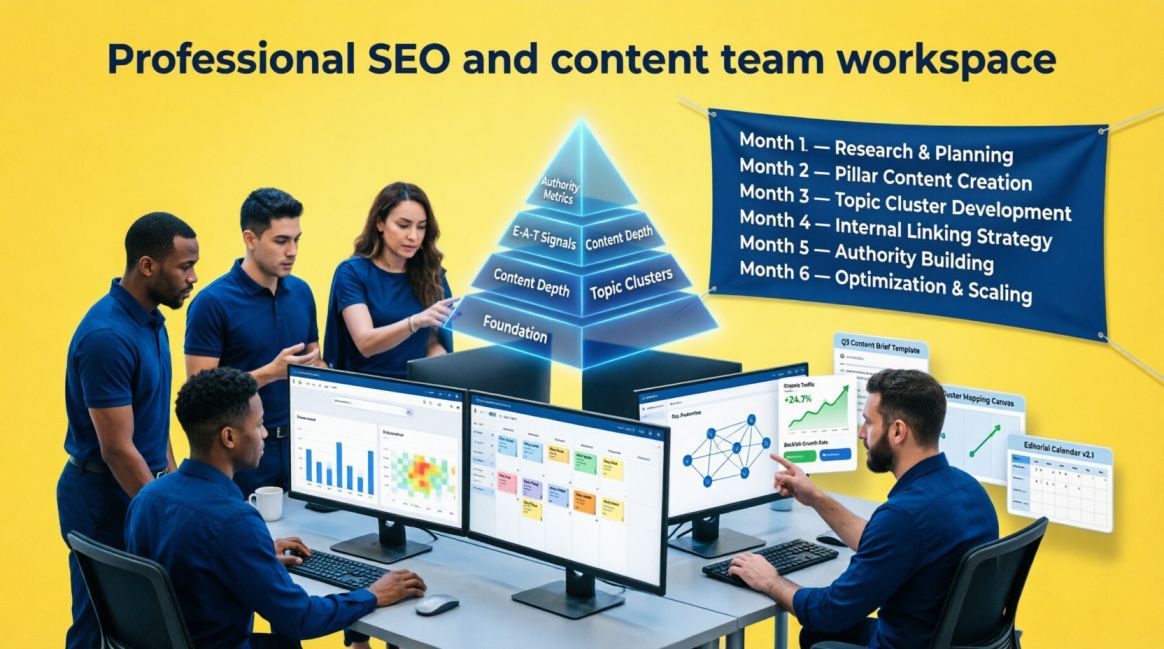
How to Build Topical Authority from Zero: A 6-Month Roadmap for New Websites

| 40% Higher organic traffic from sustained cluster publishing vs single-page strategies (12+ months) | 2.7× Higher AI citation probability with bidirectional internal linking vs one-directional (Yext, Jan 2026) | 2.5× Longer rankings durability for cluster content vs standalone posts | 60–90 Days to first measurable ranking movement from a complete cluster |
Table of Contents
Table of Contents
Why Topical Authority is the Only Durable SEO Strategy for New Sites in 2026
A new website competing for organic traffic faces a structural problem: domain authority takes time to build, and without it, individual pages struggle to rank for competitive keywords regardless of their content quality. The temptation is to chase individual keywords — publish one page per keyword, hope something ranks, repeat. This strategy produces sporadic results, vulnerable rankings, and a content library that gives Google no coherent signal about what your site is actually about.
Topical authority is the alternative. Instead of competing page-by-page, you build cluster-by-cluster — publishing a structured network of interconnected content that covers one subject from every meaningful angle. When Google's systems evaluate a site that has comprehensively answered every important question on a topic, it does not just rank individual pages. It begins to trust the entire site as a credible source — and that trust produces rankings for queries you never explicitly targeted, faster indexation for new content, and AI citation eligibility across the full cluster.
This guide is a six-month execution roadmap. No theory. No generalised advice. Month by month, with specific deliverables, measurable KPIs, and the precise architecture decisions that separate clusters that compound from clusters that stagnate.
📌 What You’ll Have After 6 Months
- Month 1: Your strategic foundation — one topic selected, keyword universe mapped, site architecture designed
- Month 2: Your first complete content cluster — pillar page + four core cluster pages + internal linking live
- Month 3: First cluster expanded + E-E-A-T infrastructure built + first authority signals earned
- Month 4: Second cluster launched + cross-cluster linking architecture in place
- Month 5: Content gap analysis run + mid-programme quality audit + GEO optimisation layer added
- Month 6: Performance assessment + third cluster launched + 12-month scaling plan defined
- Outcome: A topical authority signal strong enough to rank for head terms, attract AI citations, and compound without starting over.
Before Month 1: Understanding Cluster Architecture
Every cluster consists of four page types arranged in a hierarchy. Understanding this architecture before you write a single word prevents the two most common errors: pillar pages that are too broad to rank for anything, and cluster pages that are too similar to each other to justify separate URLs.
| Page Type | Target Length | Purpose and Linking Role | Quantity per Cluster |
|---|---|---|---|
| Pillar Page | 3,000–5,000 words | Full topic overview, all subtopics introduced, links to all cluster pages. The canonical authority page Google will rank for broad head terms. | 1 per cluster |
| Core Cluster Pages | 1,200–2,000 words | Deep dive into one specific subtopic. Answers one primary intent question comprehensively. Links back to pillar + 2–3 sibling cluster pages. | 4–8 per cluster |
| Supporting Pages | 600–1,200 words | Highly specific long-tail subtopics. FAQ pages, comparison pages, 'how to' pages that address intent fragments the core cluster does not. | 3–6 per cluster |
| Conversion Page | 400–800 words | Service or product page linked from the cluster — the commercial endpoint of the topical journey. Not a blog post; a page with a CTA. | 1–2 per cluster |
The goal of the cluster is complete topic coverage: no important question about the subject should require leaving your site to find an answer. When your cluster satisfies that standard, Google classifies your site as a topical authority — and begins routing queries across the full topic to your content, not just to the pages you optimised individually.
The 6-Month Roadmap
M1: Strategic Foundation — Topic Selection, Keyword Universe, Site Architecture
- Select your primary cluster topic using the Topic Selection Matrix below — one topic only. Breadth is the enemy of topical authority at the start.
- Map your full keyword universe: use Google Autocomplete, People Also Ask (3–4 levels deep), and Google Keyword Planner. For every query in your topic area, document the question, search volume, intent type (to avoid search intent mismatch), and the competing page currently ranking position 1–3.
- Group all keywords into subtopics — these subtopics become your cluster page titles. Each subtopic must represent a distinct, clearly separable intent. If two subtopics could be served by the same page, merge them.
- Design your site architecture: your pillar URL (/services/topic/ or /blog/topic-complete-guide/) and the URL structure for all cluster pages under it. Consistency matters — all cluster pages should share a logical URL prefix.
- Set up Google Search Console, Google Analytics 4, and Bing Webmaster Tools before publishing any content. Bing's index powers major AI engines like Microsoft Copilot and ChatGPT's web search. You cannot measure what you build without a comprehensive, multi-engine baseline from Day 1.
- Do not start writing yet. This month is entirely planning. A cluster built without a keyword map produces content that competes with itself and misses the intent architecture that makes topical authority work.
| ✓ KPI | Complete keyword universe documented (minimum 40 distinct queries). All subtopics grouped and named. Site architecture finalised. GSC and GA4 live. Pillar page brief written. |
The Topic Selection Matrix — One Decision That Defines Everything
| Topic Profile | Decision | Rationale |
|---|---|---|
| High Volume + Low Competition + Strong Brand Fit | 🟢 LAUNCH FIRST | This is your first cluster. High search demand, winnable without domain authority, directly aligned to what you sell. Build the pillar and first 4 cluster pages here in Month 1–2. |
| Low Volume + Low Competition + Strong Brand Fit | 🔵 BUILD SECOND | Niche long-tail cluster that positions you as a specialist. Wins quickly due to low competition. Builds the authority base that helps you compete for higher-volume terms later. |
| High Volume + High Competition + Strong Brand Fit | 🟡 BUILD IN MONTH 4+ | You need some domain authority before competing here. Add this cluster once you have established momentum in Clusters 1 and 2. Your existing topical signals help you compete for adjacent terms. |
| Any Volume + Any Competition + Weak Brand Fit | 🔴 DO NOT BUILD | Off-topic content dilutes your topical authority, wastes crawl budget, and confuses Google's entity model for your site. Every cluster must directly serve your core commercial purpose. |
M2: First Cluster Launch — Pillar + Four Core Cluster Pages
- Write and publish your pillar page (3,000–5,000 words): comprehensive overview of the topic, internal links to each cluster page placeholder (you will update these as pages publish), FAQPage schema, Article schema with author byline and datePublished.
- Write and publish your first four core cluster pages (1,200–2,000 words each): one per priority subtopic, each targeting a distinct intent query, each linking back to the pillar with keyword-rich anchor text.
- Implement bidirectional internal linking immediately: pillar links to all four cluster pages, every cluster page links back to the pillar, and each cluster page links to 1–2 sibling cluster pages where the semantic relationship is genuine.
- Add FAQPage schema to every cluster page — 4 questions minimum per page, answering the specific queries your target readers type. This is your primary AI citation signal from Month 2 onward.
- Submit all five URLs for indexing via Google Search Console URL Inspection to establish your baseline. While new domains can sometimes take several weeks to be fully crawled and evaluated, this manual submission ensures Google is aware of your architecture as quickly as possible. Do not wait for organic crawl — accelerate the first evaluation cycle.
- Publish one conversion-intent page (service or product page) and link to it contextually from the most relevant cluster page. The cluster must end somewhere commercial.
| ✓ KPI | 5 pages live (1 pillar + 4 cluster). All bidirectional internal links active. FAQPage schema passing validation on all pages. Submit all five URLs for indexing via Google Search Console URL Inspection to establish your baseline. While new domains can sometimes take several weeks to be fully crawled and evaluated, this manual submission ensures Google is aware of your architecture as quickly as possible. |
M3: Cluster Expansion + E-E-A-T Infrastructure + First Authority Signals
- Add 3–4 supporting pages to your first cluster: these are the long-tail, highly specific pages targeting query fragments the core cluster did not cover. Think 'how-to' variations, comparison pages, 'is X right for me?' pages, and deep FAQ hubs.
- Build your E-E-A-T infrastructure — the signals Google uses to evaluate whether a real expert produced this content: author bio page with credentials and LinkedIn link, named author attribution on every article, About page with company history and verifiable trust markers, and Organization schema on your homepage.
- Execute your first targeted link-building campaign: Identify 15 to 20 external websites in your topic area that have published relevant resources. Produce one piece of highly referential original content (a data table, a framework, a custom infographic) that gives these sites a genuine reason to link to you. Begin your outreach. While conversion rates for cold outreach are often low (typically 2–5%), earning just one backlink to your pillar page from a credible external source in Month 3 is worth more than 50 low-quality directory submissions.
- Check GSC Crawl Stats: is Google crawling your site more frequently than in Month 2? Increasing crawl rate after cluster launch is one of the earliest signals that your quality assessment is improving.
- Do not start Cluster 2 yet. Expanding your first cluster to full coverage before adding a second topic produces a stronger topical signal than launching two thin clusters simultaneously.
| ✓ KPI | 8–9 pages live across the first cluster. E-E-A-T infrastructure complete (author page, About page, Organization schema). At least 1 external backlink to the pillar. Increasing GSC crawl rate confirmed. |
The Internal Linking Rules — Built Into Your Publishing Workflow
Internal linking is not a cleanup task run quarterly. It is a publishing requirement enforced on every article at the moment of publication. Here are the five rules that govern every link decision in a topical authority strategy:
| Link Type | Rule and Rationale | Timing |
|---|---|---|
| Pillar → All Cluster Pages | Every cluster page is linked from the pillar using descriptive anchor text. The pillar is the hub — it must reach every spoke. | Required at launch. Update each time a new cluster page is added. |
| Cluster → Pillar (bidirectional) | Every cluster page links back to the pillar with keyword-rich anchor text. Bidirectional linking increases AI citation probability by 2.7× (Yext, Jan 2026). | Required on every cluster page, without exception. |
| Cluster → Sibling Clusters | Where a genuine semantic relationship exists, cluster pages cross-link to each other. Creates a denser topical graph Google can map. | 2–3 per cluster page where naturally relevant. Never forced. |
| New Content → Existing Content | Every new page published must link to at least 3 existing pages on related topics. Every new page must receive links from at least 3 existing pages within 48 hours of publication. | Built into your publication workflow. Orphan pages rarely rank well and waste your site's crawl budget. Ensure every new page is integrated into your site architecture to pass authority and establish semantic relevance |
| Conversion Page from Cluster | Each cluster should include at least one contextual link to a relevant service or product page — the commercial endpoint the content cluster is designed to support. | 1–2 per cluster. Placed at the natural point of highest intent in the reading journey. |
M4: Second Cluster Launch + Cross-Cluster Architecture
- Select your second cluster topic: use the Topic Selection Matrix. Choose a topic that is semantically adjacent to Cluster 1 — close enough that a reader who finished Cluster 1 would naturally want Cluster 2, but distinct enough that the two pillars target different head terms.
- Write and publish your Cluster 2 pillar page and first four core cluster pages following the identical architecture from Month 2.
- Add cross-cluster internal links: identify 2–3 places in Cluster 1 where a reference to a Cluster 2 page is genuinely useful to the reader. Link across clusters using descriptive anchor text. These cross-cluster links begin building the entity graph that makes your site's topical authority signal multi-dimensional.
- Update your Cluster 1 pillar page: add any supporting pages published in Month 3, update statistics if any data points have changed, and add a 'Related guides' section linking to the Cluster 2 pillar.
- Assess Cluster 1 performance: which pages have the most Search Console impressions? Which queries are driving traffic that you did not explicitly target? These signals tell you which topics Google is beginning to associate your site with — and they inform which supporting pages to prioritise next.
| ✓ KPI | Second cluster launched (pillar + 4 cluster pages). Cross-cluster internal links active between clusters 1 and 2. Cluster 1 pillar updated with fresh data and new links. Search Console showing Cluster 1 ranking for queries beyond the pages' primary keywords. |
M5: Content Gap Analysis + GEO Optimisation Layer
- Run a formal content gap audit: for each cluster, search Google for your primary pillar keyword and analyse the top 5 competing pages. What questions do they answer that your cluster does not? Document every gap. These gaps are your highest-priority content strategic additions for the second half of the roadmap.
- Add GEO optimisation to every existing page: review all published pages and verify each has a FAQ block with FAQPage schema, an Article schema with current datePublished and dateModified, a named author with a linked bio, and an opening paragraph that directly answers the primary query within the first 100 words.
- Test your AI citation status: prompt Google AI Mode, ChatGPT, Perplexity, and Gemini with your target queries. Document which pages are being cited. If your content is not yet appearing, the most common causes are: insufficient FAQPage schema, opening paragraphs that do not directly answer the question, or content that lacks specific, verifiable claims.
- Build your second backlink: a second external editorial link to your pillar pages or cluster pages from a credible source in your topic area. By Month 5, your cluster depth gives external publishers genuine resources to reference.
- Monitor any cluster page that has been live for over 90–120 days. If it has plateaued outside the top 20 positions after this maturation period, refresh it with new data, deepen the content to exceed the current top-ranking competitor, and submit for re-crawl.
| ✓ KPI | Content gaps documented and prioritised. FAQPage schema verified on all pages. AI citation test conducted and results recorded. At least 2 external backlinks to cluster content. Any stagnant pages updated and resubmitted. |
M6: Assessment + Third Cluster + 12-Month Scaling Plan
WHAT TO BUILD THIS MONTH
- Run your full 6-month performance assessment: compare total organic impressions, total organic sessions, number of ranking keywords, and number of pages with at least one impression against your Day 1 baseline. A successful 6-month programme will show: 3–5× growth in total impressions, ranking for 2–3× more queries than you explicitly targeted, and at least one pillar page in the top 20 for its head term.
- Launch Cluster 3 following the identical architecture: pillar + 4 core cluster pages + FAQPage schema + immediate bidirectional linking + cross-cluster links where semantically valid.
- Fill your highest-priority content gaps from the Month 5 audit: add 2–4 supporting pages to Cluster 1 and Cluster 2 that address the questions competitors answer but your clusters do not.
- Define your 12-month scaling plan: which clusters will you launch in Months 7–12? What is your target page count by Month 12? How will you maintain existing clusters (quarterly review, annual content refresh)? A topical authority strategy that does not plan for maintenance will plateau as competitors publish fresher, deeper content.
- Produce your first piece of original data: a survey, a proprietary analysis, or a benchmarking report in your topic area. Original data earns natural backlinks, press mentions, and AI citations — and becomes the E-E-A-T signal that separates established authorities from new entrants.
| ✓ KPI | 6-month performance report completed. Three clusters live (total: 15+ pages across all clusters). Original data piece published. 12-month scaling plan written and approved. At least 3 external backlinks across cluster content. |
How to Measure Topical Authority Progress: Leading Indicators
Rankings are a lagging indicator. By the time a keyword reaches Page 1, the authority signal has been building for months. The following metrics are leading indicators — they tell you whether your topical authority is building before rankings confirm it.
| Metric | Where to Find | Frequency | What It Signals |
|---|---|---|---|
| Indexed pages growing | GSC → Coverage report | Monthly | New pages being indexed within 7–14 days of publication = Google is engaging with your content positively |
| Cluster impressions rising | GSC → Performance → filter by cluster URLs | Monthly | Rising impressions before rising clicks means Google is surfacing your pages for more queries — topical authority forming |
| New keywords appearing | GSC → Performance → Queries | Monthly | Your pages ranking for queries you did not explicitly target = Google is associating you with the broader topic |
| Crawl rate increasing | GSC → Settings → Crawl Stats | Monthly | Google crawling your site more frequently = its quality assessment is improving. Stagnant crawl rate after Month 3 = investigate content quality or site architecture |
| Pillar page ranking for head term | GSC → Performance → specific pillar URL | Monthly | Your pillar page entering top 20 for its primary head term = your cluster architecture is being recognised as a topical authority signal |
| AI citation appearance | Manual: prompt ChatGPT, Perplexity, Google AI Mode with your target queries | Monthly | Your content being cited by AI systems = your structured, schema-marked, question-answering content is passing AI quality filters |
The Compounding Effect of Starting Now
Topical authority is not built in a sprint. It is the product of consistent, structured publishing over 6 to 12 months — a cadence that compounds with every page added, every internal link placed, and every cluster completed. The data confirms what practitioners observe: sites that sustain this approach for 12 months see 40% higher organic traffic than those running isolated keyword strategies. Their rankings are more stable, their AI citation frequency is higher, and their new content indexes and ranks faster because Google's trust in their authority is already established.
The most important insight in this guide is not tactical. It is strategic! The businesses that begin building topical authority today as part of an ethical SEO strategy are the ones that will be difficult to displace in 12 months. The businesses that wait for more traffic before investing in structure will find the field occupied when they are ready.
The roadmap is clear. The first step — selecting your primary cluster topic and mapping your keyword universe — takes one week. Start there.
📋 THE 6-MONTH TOPICAL AUTHORITY ROADMAP — AT A GLANCE
- Month 1 — Foundation: Select one topic. Map full keyword universe. Design site architecture. Set up GSC and GA4.
- Month 2 — First Cluster Launch: Publish pillar (3,000–5,000 words) + 4 core cluster pages. Bidirectional internal links live. FAQPage schema on all pages.
- Month 3 — Expand + E-E-A-T: Add 3–4 supporting pages. Build author bio, About page, Organization schema. Earn first external backlink.
- Month 4 — Second Cluster: Launch pillar + 4 cluster pages for adjacent topic. Add cross-cluster internal links. Update Cluster 1 pillar.
- Month 5 — GEO Layer + Gap Analysis: Audit content gaps. Test AI citation status. Verify FAQPage schema and Article schema on all pages. Update stagnant pages.
- Month 6 — Assessment + Scale: Run 6-month performance report. Launch Cluster 3. Fill gaps in Clusters 1 and 2. Publish original data. Write a 12-month scaling plan.
- Key rules: Complete one cluster before starting the next. Every page must receive 3 internal links within 48 hours of publication. A structured Q&A format is highly recommended on every cluster page. While FAQPage schema provides clear categorization for traditional crawlers, formatting your on-page text with clear, concise answers directly following explicit question headings is the most effective GEO action for AI extraction systems. Measure leading indicators monthly — impressions, indexed pages, new ranking queries, crawl rate.
Frequently Asked Questions
Questions readers ask about this topic
The FAQs below are pulled directly from this article's structured content and are designed to help readers quickly find answers to common questions related to the topic.
How many articles do I need before Google starts treating my site as a topical authority?
Should I build one large cluster or several smaller ones first?
Does topical authority help with AI Overviews and AI citation?
What if my niche has very low search volume?

Founder, Technical Analyst
Oladoyin Falana is a certified digital growth strategist and full-stack web professional with over five years of hands-on experience at the intersection of SEO, web design & development. His journey into the digital world began as a content writer — a foundation that gave him a deep, instinctive understanding of how keywords, content and intent drive organic visibility. While honing his craft in content, he simultaneously taught himself the building blocks of the modern web: HTML, CSS, and React.js — a pursuit that would eventually evolve into full-stack Web Development and a Technical SEO Analyst.
Follow me on LinkedIn →