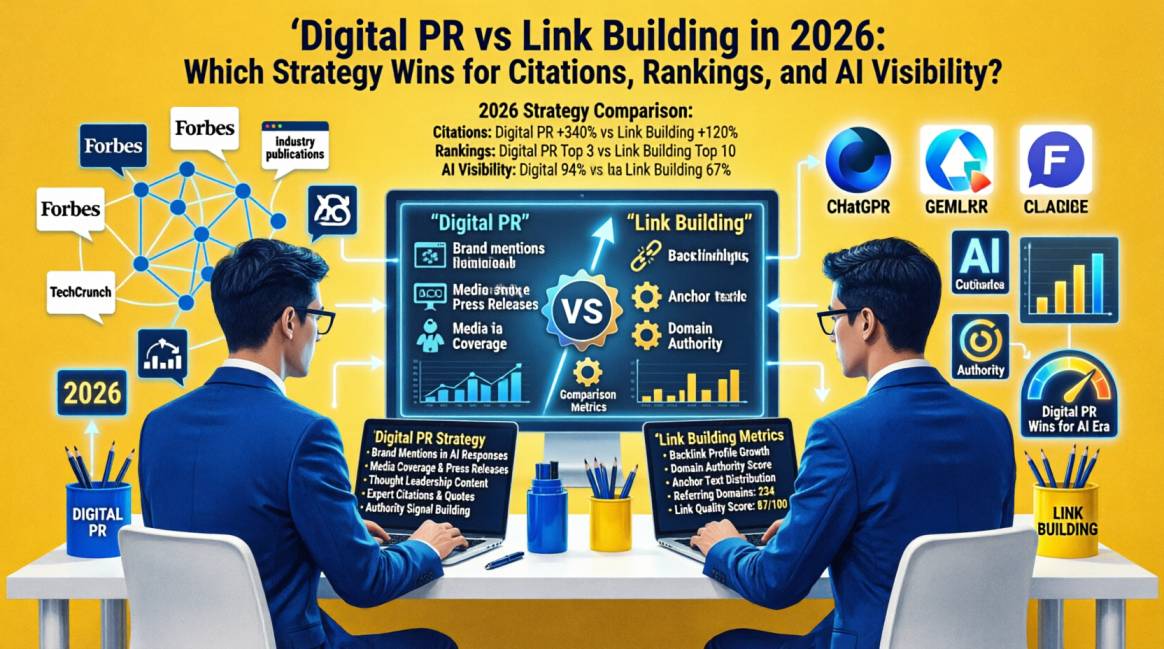
Digital PR vs Link Building in 2026: Which Strategy Wins for Citations, Rankings, and AI Visibility?

| 📌 Key Points to Note |
|---|
| 94% — of link farm backlinks had their value removed in Google's 2026 Link Spam Update — traditional low-quality link building is structurally broken |
| 3× — Higher entity authority growth rate from a single editorial media placement vs ten directory citations of equivalent domain authority |
| 2026 — The year AI citation share became as commercially significant as traditional Page 1 rankings for many commercial query categories |
| <5% — of Nigerian businesses currently executing a systematic Digital PR programme — the first-mover advantage is still wide open |
Table of Contents
Table of Contents
This is Not a Close Contest
For most of the history of SEO, link building and Digital PR occupied separate professional disciplines. Link building was a tactical SEO activity designed to acquire target URLs. Digital PR was a communications function focused on earning media coverage that occasionally yielded a link.
In 2026, this separation has decisively collapsed. The question is no longer whether to choose Digital PR or traditional link building. The real question is whether you want to build a compounding brand asset or rent a diminishing positional advantage.
The search landscape has shifted fundamentally. Google’s modern spam prevention architecture has made volume-based link manipulation largely obsolete by quietly devaluing low-quality placements rather than issuing manual penalties. Concurrently, generative search engines like Perplexity, ChatGPT Search, and Google Gemini source their citations from editorially vetted, credible publications—not from low-tier directories or manufactured link networks. Entity authority is built through genuine third-party validation—precisely what Digital PR produces and what traditional link building cannot replicate.
This article is the definitive comparison. Not a diplomatic 'both have their place' equivocation — a clear-eyed assessment of what each strategy produces in 2026, which one builds more durable commercial value, what the specific use cases for each are, and how Nigerian businesses can execute a Digital PR programme with the resources they actually have.
📌 WHAT THIS ARTICLE COVERS:
- How Modern Search Infrastructure Handles Links
- The 10-dimension head-to-head comparison: Digital PR vs Link Building across every metric that matters
- How Digital PR produces three simultaneous benefits that link building cannot: editorial links, entity co-occurrence, and AI citation eligibility
- The five Digital PR campaign types that work in the Nigerian market — with realistic link and AI citation yield estimates
- The business scenario framework: which strategy makes sense for which situation
- The hybrid playbook for Nigerian businesses that need link volume AND brand authority simultaneously
- A Nigerian Digital PR execution guide: how to run a campaign with no PR agency budget
Section 1: How Modern Search Infrastructure Handles Links
Rather than relying on loud, disruptive algorithm rollouts to penalize sites, Google’s modern ranking systems utilize continuous, algorithmic filtering to assess backlink profiles retroactively. The result is structural: links originating from obvious link farms, private blog networks (PBNs), and low-quality paid placements are simply stripped of their equity value.
Sites that built their authority on volume-based link acquisition are seeing their organic visibility steadily decline. This isn't necessarily due to a penalty; it is because their underlying link mass has been mathematically neutralized. The sites outranking you with fewer links are doing so because their links are genuinely editorial, not because they have a higher volume of referring domains.
The AI Citation Amplifier
This algorithmic shift has a secondary effect: it dramatically raises the relative value of editorial links from credible media sources. An editorial feature in an authoritative publication carries far more weight today because the competing, low-quality link noise has been filtered out.
Furthermore, these editorial placements produce a critical byproduct: entity co-occurrence signals. When an authoritative sector publication mentions your brand name alongside relevant industry keywords, search systems log that relationship. This strengthens your brand's topical footprint within the Knowledge Graph, directly increasing your eligibility for AI search citations.
Section 2: 10-Dimension Head-to-Head Comparison
The comparison below is not a general assessment of which tactic is 'better.' It is a specific evaluation across the dimensions that determine commercial value in 2026 — rankings, AI citation, brand authority, and long-term asset value. Each dimension is scored against what each strategy actually produces, not what its advocates claim.
| Dimension | Digital PR | Traditional Link Building |
|---|---|---|
| Primary mechanism | Earns editorial links through content value, data, and genuine newsworthiness — reporters and editors link because they want to, not because they were paid | Acquires links through relationship management, content placement fees, directory submissions, and direct outreach to site owners |
| Link quality profile | High DA, topically relevant, editorial context, real audience — the most trusted link type in Google's evaluation system | Variable — ranges from genuine editorial placements to sponsored posts to low-quality directories |
| AI citation impact | Very high — editorial media mentions create entity co-occurrence signals, build corroboration for Knowledge Panel, and produce the type of trusted third-party citations AI systems prefer | Low to moderate — links from low-quality sites do not build entity authority; even high-DA placements rarely produce AI citations unless accompanied by genuine editorial mentions |
| Speed to results | Slow — 2–4 months from outreach to placement; 3–6 months for rankings impact. Campaigns require sustained effort | Faster initial impact — direct link placements can be live within 2–4 weeks; rankings response within 4–8 weeks |
| Scalability | Limited by editorial quality standards and journalist/editor relationships. Cannot be mass-produced without quality degradation | Highly scalable in volume; low-quality link building can reach hundreds of placements per month but with declining returns |
| Durability | Very high — an editorial mention in BusinessDay or TechPoint.Africa does not expire, rarely gets removed, and compounds as the publication's authority grows | Variable — paid placements may be removed if policies change; PBN links are regularly devalued in spam updates; directories decline in authority over time |
| E-E-A-T contribution | High — media coverage builds Experience and Authoritativeness signals through named expert quotes and brand association with credible outlets | Low to none — a link from a link farm or low-context directory provides no E-E-A-T signal whatsoever |
| Brand awareness byproduct | Yes — editorial coverage reaches real audiences, drives branded search volume, and creates entity co-occurrence that AI systems evaluate | No — a link on a low-traffic directory or PBN reaches no real audience and produces no branded search signal |
| Cost structure | Higher upfront (agency or in-house PR team, campaign development, data/research investment); lower per-link cost at scale | Lower per-placement (especially for lower-quality links); higher total cost to achieve equivalent quality to editorial placements |
| Algorithm update risk | Very low — editorial links are what Google's link quality evaluation system is designed to reward | High for low-quality approaches — every major spam update removes value from link farm, PBN, and paid placement link profiles |
The verdict across 10 dimensions: Digital PR wins 8 of 10. Traditional link building wins 2 (speed to initial results, scalability in volume). The two dimensions link building wins are precisely the ones that matter least for long-term organic and AI visibility performance. Speed matters when you have an immediate campaign need. Volume matters when quality does not. In 2026, neither is a strategic priority for a business building durable search authority.
Section 3: The Triple Benefit of Digital PR That Link Building Cannot Replicate
The reason Digital PR wins the 2026 comparison is not that editorial links are better than directory links — though they are. It is that Digital PR produces three simultaneous benefits from a single campaign investment, where traditional link building produces at most one.
Benefit 1 — Editorial Links (The SEO Benefit)
An editorial link placement in a credible publication produces a link that passes genuine authority because a real editor decided your content or data was worth referencing. This is what Google's link quality evaluation system was designed to reward, and it is what survived the 2026 spam update intact. One editorial link from BusinessDay Nigeria carries more authority than fifty directory citations — not because of a DA calculation, but because Google's systems evaluate the editorial judgement behind the link.
Benefit 2 — Entity Co-occurrence (The Entity Authority Benefit)
Even when a media placement does not include a link — and many Digital PR placements are unlinked brand mentions — the entity co-occurrence signal is still generated. When your brand name appears alongside your industry category, your key services, and your target market in an authoritative publication, AI systems record this association. It strengthens your entity's topical profile in the Knowledge Graph. It increases the probability that AI systems will associate your brand with the relevant queries. It is a GEO signal that link building cannot produce — because a link in a directory does not carry any semantic context about what your brand is and what it does.
Benefit 3 — AI Citation Eligibility (The GEO Benefit)
AI systems — particularly Perplexity and ChatGPT with web browsing — actively retrieve and cite content from media publications when answering research questions. A Digital PR campaign that places your original data or expert commentary in TechPoint.Africa creates a directly citable source that AI systems will retrieve and cite when answering relevant queries. The media placement is both a link source and an AI citation source — two separate commercial benefits from the same activity. Traditional link building produces neither entity co-occurrence signals nor direct AI citation eligibility from the types of links it typically acquires.
Section 4: Digital PR in the Nigerian Market — The Five Campaign Types That Work
Digital PR in Nigeria requires a different playbook from global PR strategies. Nigerian journalists and editors operate under specific conditions: shorter news cycles, preference for data over opinion, high interest in anything that contextualises the Nigerian business or technology environment for both domestic and international audiences, and genuine scarcity of original market research. These conditions create specific opportunities for businesses willing to invest in original content.
| Campaign Type | What It Is | Target Publications (Nigerian Market) | Expected Link and Citation Yield |
|---|---|---|---|
| Original Data Report | Conduct a survey, compile market data, or analyse publicly available datasets to produce findings that do not exist anywhere else. 'The State of Nigerian E-Commerce 2026: 500 Consumer Responses' gives journalists a source they cannot find elsewhere. | BusinessDay, TechPoint.Africa, Nairametrics, Reuters Africa, Bloomberg Africa | 3–8 editorial links per campaign; 1–3 AI citation appearances within 60 days of publication |
| Expert Commentary on Breaking News | Position a named expert at your organisation to provide rapid-response comment on breaking business, technology, or regulatory news in your sector. Speed is the differentiator — journalists sourcing commentary need it within hours of a story breaking. | National newspapers, news wires, broadcast media, industry publications | 1–3 editorial links per placement; primarily builds entity co-occurrence and branded search rather than direct link volume |
| Proprietary Research Tool or Calculator | Build a free, publicly accessible tool in your sector: a Nigerian salary benchmarking tool, an SEO cost estimator, a business registration fee calculator. Tools earn links passively for years after launch. | Any publication covering the tool's topic; often earns links without outreach simply by being useful | 5–20+ editorial links over 12 months; high AI citation value due to tool's ongoing utility and reference-worthiness |
| Annual Benchmarking Report | Publish an annual report with year-over-year data in your sector. Annual reports earn links every year at re-publication, build a citation reputation over time, and become the default reference source for their category. | Business media, industry associations, academic institutions, policy publications | Compounds annually — first year: 3–6 links; Year 3+: 10–20+ links as the report becomes the category standard |
| Reactive PR — 'Newsjacking' | Monitor relevant industry news and prepare rapid expert commentary, data rebuttals, or analysis pieces within 48 hours of a significant story. The HARO (Help A Reporter Out) model applied proactively. | Varies by story — can include national and international media when the story is large enough | 1–2 links per placement but accumulates rapidly with a systematic programme; builds journalist relationships that compound |
Section 5: The Business Scenario Framework — Which Strategy for Which Situation
The answer to 'Digital PR or link building?' depends on three variables: your site's current authority level, your competitive environment, and your time horizon. Here is the scenario framework we apply at Semola Digital when advising clients on off-page strategy:
| Business Scenario | Recommended Primary Strategy | Specific Execution Approach |
|---|---|---|
| New website, 0–12 months old | Traditional targeted link building — specifically: editorial directory listings in your sector, supplier/partner link exchanges, and local Nigerian business association listings. Digital PR is premature without an audience or authority base to amplify the story. Build the foundation first. | Structured outreach for 5–10 high-quality relevant directory and association links per month. Focus on topically relevant sources, not generic link farms. |
| Established website, competitive sector (fintech, legal, healthcare) | Digital PR — aggressive editorial campaign targeting Nigerian and pan-African business media. At this competition level, only editorial links from credible sources move the needle. Generic link building volume has negligible impact against established competitors with strong entity authority. | One major digital PR campaign per quarter with original data (survey, market analysis). Target: BusinessDay, TechPoint.Africa, Nairametrics, The Punch Business. |
| Local service business (Lagos/Abuja only) | Hybrid: local digital PR (community media, local business journalism) combined with targeted local directory citations. The link profile for local SEO dominance is shallower than for national rankings — quality local citations matter more than high-DA global links. | 5–10 Nigerian local citations per month + 1–2 local press mentions per quarter. Google Maps ranking requires NAP-consistent citations, not global editorial links. |
| E-commerce store (Nigerian market) | Hybrid, phase-dependent: start with product/category directory submissions and manufacturer links (link building); add digital PR via data-driven buying guides and market reports (Digital PR) once the store has 6+ months of content and traffic history. | Product review sites, comparison directories, manufacturer partner pages (link building) + original Nigerian market data or trend reports (digital PR) for editorial placement. |
| Nigerian business targeting international rankings | Digital PR with international media angle — Nigerian businesses have a unique story advantage in international media because African market insights are genuinely scarce and underrepresented. An original Nigerian fintech data report has a higher placement rate in global financial media than a generic UK competitor's equivalent. | Target international media with original Nigerian/African market data. Wire service distribution (PR Newswire Africa) amplifies placement reach. Build international editorial links that simultaneously strengthen Nigerian rankings. |
Section 6: The Hybrid Playbook — Running Both in Sequence
For most Nigerian businesses at an intermediate stage — established site, moderate competition, growth-oriented — the optimal strategy is not pure Digital PR OR pure link building. It is phase-sequenced hybrid execution that uses foundational link building to build the minimum credibility base, then transitions to Digital PR as the primary growth lever once that base is established.
Phase 1 (Months 1–3): Foundation Link Building
Execute a targeted, quality-focused link building programme to build the minimum credible link profile for your sector. This means editorial directory listings in reputable Nigerian business directories, association memberships with linking benefits, supplier and partner link exchanges where genuine relationships exist, and any natural links that can be facilitated by publishing genuinely useful content. Target: 10–15 high-quality, topically relevant links. Quality over volume — every link in this foundation should survive a manual review.
Phase 2 (Months 4–6): First Digital PR Campaign
Commission or conduct your first original research piece. For a Nigerian business, this is often simpler than it sounds: a survey of 100 existing clients, an analysis of publicly available Nigerian government data, or an original framework for thinking about a problem in your sector. Pitch it to 3–5 Nigerian business media outlets with a clear news angle. Even one placement in this phase produces more authority than the preceding three months of link building combined.
Phase 3 (Months 7–12): Shift to Digital PR as Primary Channel
By Month 7, your foundation link profile is established and your first editorial placement has produced entity co-occurrence signals. Transition your off-page investment to a quarterly Digital PR campaign cadence — one significant original data release per quarter, supplemented by reactive expert commentary between campaigns. Maintain the link foundation through natural link acquisition and partnership links, but stop investing in volume-based link building entirely.
The Long-Term Compound Effect
A Nigerian business that executes this hybrid playbook for 24 months will have: a clean, credible link profile of 30–50 high-quality links; 4–8 original research assets that continue earning links and media mentions passively; a Knowledge Panel or advanced Knowledge Graph entity recognition; regular AI citation appearances for target queries; and a brand presence in Nigerian business media that produces ongoing inbound opportunities — journalists who have cited your research once will return when the next relevant story breaks.
Section 7: How to Run a Digital PR Campaign Without a PR Agency Budget
The most common objection to Digital PR from Nigerian business owners is budget: 'we cannot afford a PR agency.' This objection misunderstands the model. A Digital PR campaign does not require an agency. It requires an original piece of content worth publishing and a targeted outreach to the journalists likely to cover it. Here is the no-agency execution model:
- Define your research question: What would Nigerian journalists in your sector find genuinely interesting? Frame it as a data question — 'What percentage of Nigerian SMEs have experienced a cyber attack?' or 'What is the average salary for tech workers in Lagos in 2027?'
- Conduct the research: A 100-person survey via Google Forms takes 2–3 weeks to collect. Alternatively, analyse publicly available FIRS, CAC, NBS, or CBN data in a way that has not been done before. Original analysis of existing public data is as citable as primary survey research.
- Write a press release: One page, news angle in the first paragraph, your key data point in the second paragraph, supporting data in bullet points, expert quote from your founder or a named team member, and a 'Notes to Editors' section with methodology. No more than 500 words.
- Build a target journalist list: Identify 10–15 journalists who cover your sector at BusinessDay, TechPoint.Africa, Nairametrics, The Punch Business, Guardian Business, Techcabal, and Ventures Africa. Find their email addresses on their bylines or their publication's masthead.
- Send personalized pitches: A 4-line email — one line introducing the story angle, one line with the key data point, one line on why it is relevant to their audience, one line offering an exclusive or an interview. No attachments. Embed the press release in the email body.
- Follow up once, 4 business days later. Then move to the next batch of journalists. Most placements come from the second or third outreach batch, not the first.
- When a placement appears: save the URL, note whether it includes a link, and add it to your entity-building records (your sameAs corroboration source log). Submit the publication URL as a mention in your Wikidata entry's 'described by source' property to strengthen entity recognition.
📋 DIGITAL PR VS LINK BUILDING — QUICK REFERENCE DECISION FRAMEWORK
- Use Digital PR when: your site has at least 6 months of history, you operate in a competitive sector where generic links do not move rankings, you want AI citation eligibility alongside ranking improvement, or you have original data, research, or expert commentary that is genuinely newsworthy.
- Use targeted link building when: your site is new (under 6 months), you are building a local citation foundation for Google Maps rankings, you are pursuing manufacturer/supplier/partner links that represent genuine business relationships, or you need faster initial link acquisition before a Digital PR programme produces results.
- Use the hybrid (sequence) approach when: you are an established Nigerian SME in a moderately competitive sector who needs both a quality link foundation and the compounding authority of editorial placements.
- The 2027 rule: any link you would be embarrassed to name in a board meeting is not worth building. Any editorial placement you are proud enough to add to your About page is worth pursuing.
- Nigerian Digital PR targets: BusinessDay, TechPoint.Africa, Nairametrics, The Punch Business, Guardian Business Nigeria, Techcabal, Ventures Africa, This Day Business, Channels Television Business, Reuters Africa, Bloomberg Africa.
- AI citation multiplier: every editorial media placement that mentions your brand by name — linked or unlinked — contributes to the entity co-occurrence signals that AI systems use to evaluate citation eligibility. Digital PR earns both links and AI citation signals from the same campaign investment.
Conclusion: In 2026, the Best Link Building is the Kind That Produces More Than Links
The debate between Digital PR and link building is, at its core, a debate about what you are building. Traditional link building builds a link profile — a quantifiable asset measured in referring domains, domain authority, and anchor text distribution.
Digital PR builds a brand presence — an editorial footprint that produces authority, entity recognition, AI citation eligibility, and audience awareness simultaneously.
In 2025, you could make a reasonable case that a large volume of decent-quality links produced comparable ranking results to a smaller volume of editorial placements. The 2026 Link Spam Update ended that argument. The AI citation revolution extended the advantage of editorial authority into a new visibility layer that traditional link building is structurally incapable of addressing. The best link building in 2026 and beyond is the kind that produces a link, an entity signal, and an AI citation from the same activity — and that is Digital PR.
For Nigerian businesses: the competitive landscape for Digital PR is thinner than in any other major market. Fewer than 5% of Nigerian businesses run systematic Digital PR programmes. The first-mover advantage in editorial authority, entity recognition, and AI citation share is available right now, to any business willing to conduct original research, write a press release, and send it to 10 journalists. The bar is not high. The competition has not yet arrived.
Frequently Asked Questions
Questions readers ask about this topic
The FAQs below are pulled directly from this article's structured content and are designed to help readers quickly find answers to common questions related to the topic.
Can a small Nigerian business compete in Digital PR against larger companies?
How many links does a typical Digital PR campaign produce in Nigeria?
What happens to our existing link building if we switch to Digital PR?
We had links devalued recently. How do we recover?

Founder, Technical Analyst
Oladoyin Falana is a certified digital growth strategist and full-stack web professional with over five years of hands-on experience at the intersection of SEO, web design & development. His journey into the digital world began as a content writer — a foundation that gave him a deep, instinctive understanding of how keywords, content and intent drive organic visibility. While honing his craft in content, he simultaneously taught himself the building blocks of the modern web: HTML, CSS, and React.js — a pursuit that would eventually evolve into full-stack Web Development and a Technical SEO Analyst.
Follow me on LinkedIn →