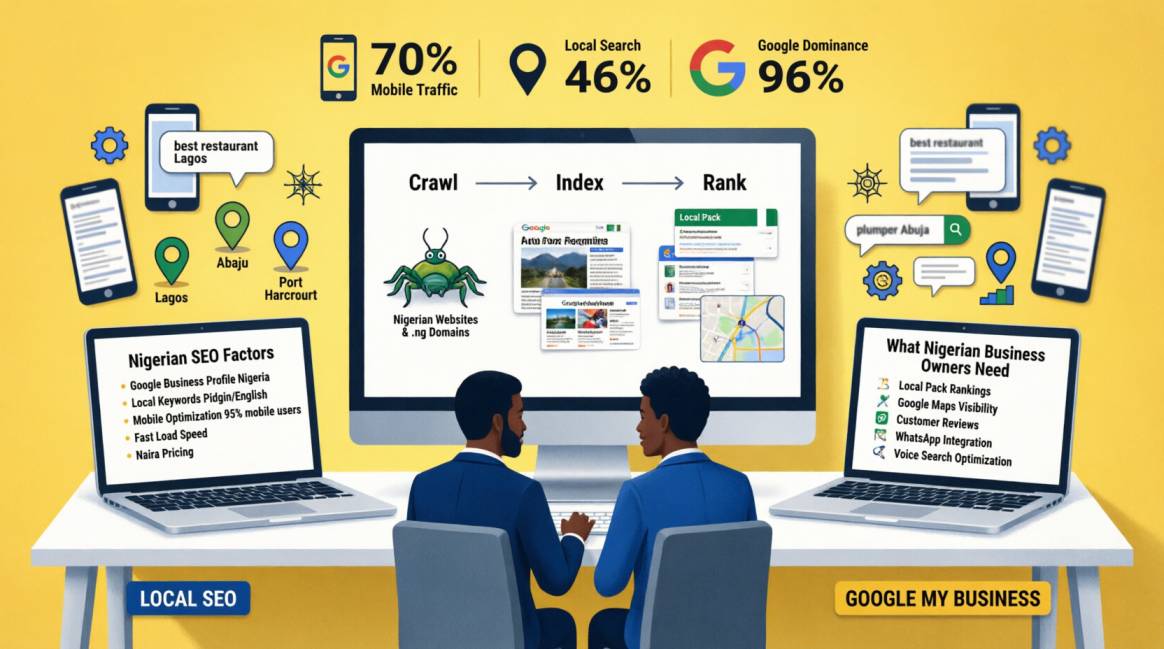
How Google Search Actually Works in Nigeria: What Every Business Owner Needs to Know

| 📌 Important stats to know |
|---|
| 100M+ — Nigerians using Google regularly as of 2026 |
| 83% — of Nigerian web searches happen on a smartphone |
| 200+ — Signals Google evaluates to rank a single search result |
| 1s — Performance matters: Studies consistently show that even 1-second delays in page load times significantly decrease conversion rates. In the Nigerian mobile-first market, performance is not just a ranking factor—it is a critical revenue driver |
Table of Contents
Table of Contents
What Most Nigerian Business Owners Believe About Google — and Why it Limits Them
Most Nigerian business owners understand Google Search at the level of a user: you type a query, results appear, you click. While this is sufficient for finding information, it is insufficient for making Google work for your business.
To consistently grow organic traffic, earn AI search citations, and attract inquiries, you must understand how Google’s systems evaluate your website. This is the difference between guessing why a competitor outranks you and knowing exactly which technical, content, or authority signals to optimize.
In the AI-first era, Google has moved beyond static ranking checklists. Today, search is powered by dynamic, AI-integrated systems that weigh relevance, user intent, and trust in milliseconds.
This guide explains the modern search ecosystem in plain language, with specific reference to how Nigerian market conditions—from mobile-first infrastructure to local search intent—shape the way the algorithm evaluates your business.
📌 What This Guide Explains
- The Three Phases of Modern Search: How Google crawls, indexes, and ranks your site using advanced machine learning.
- The Five Primary Ranking Dimensions: How relevance, authority, proximity, user experience, and trust-based frameworks influence your visibility.
- Navigating the AI Shift: How to earn visibility in AI Overviews and capture traffic in a changing SERP landscape.
- Common Myths vs. Reality: Debunking outdated SEO practices that cost Nigerian businesses time and money.
- A Proven Action Plan: Six specific, high-impact steps to improve your search position this week, this month, and this quarter.
The 3 Phases of Google Search — Crawling, Indexing, and Ranking
Before a single search is typed, Google has already done three things to every website it knows about. Understanding these three phases explains why some pages appear in search results and others do not — regardless of how good the business behind them is.
Phase #1 — Crawling: Google Reads Your Website
Google operates a system of automated programs called Googlebot that continuously visit websites, read their content, and follow links to discover new pages. This process is called crawling. If Googlebot cannot access your page, nothing else matters — Google cannot rank what it cannot read.
Common reasons Googlebot cannot access a Nigerian website: the site is blocked by a robots.txt file that was set up incorrectly on the developer's staging server and never updated for the live site; the site requires JavaScript to load content and the server renders it too slowly for Googlebot's crawl timeout; the site is on a slow shared hosting server in Europe or the US with high latency from Nigerian users and Google's crawl infrastructure; or the site simply has not been discovered yet because no other website links to it.
You can check whether Google can access your pages using Google Search Console's URL Inspection tool — a free tool that shows you exactly what Googlebot sees when it visits any URL on your site.

Phase #2 — Indexing: Google Decides What Your Page is About
After crawling your page, Google processes its content and adds it to its index — a database of hundreds of billions of pages. The indexing process is where Google determines what your page is about, what questions it answers, what topics it covers, and which entities (businesses, people, places, products) it references.
Pages can fail to be indexed for two reasons: technical barriers that prevent the content from being read correctly, or quality signals that lead Google to determine the page adds insufficient value to the index. Google explicitly removes thin, duplicate, and low-quality pages from its index —
meaning publishing a page is not sufficient to ensure it is indexed. The page must meet Google's quality threshold.

In 2026, Google's quality assessment at the indexing stage is significantly more sophisticated than it was five years ago. Google’s core ranking algorithms now deeply integrate helpfulness evaluations, constantly assessing whether a page was created primarily to serve a user's genuine information need — or if it was manipulated strictly to rank in search results. Pages that fail this assessment are indexed but suppressed, or not indexed at all.
Phase #3 — Ranking: Google Orders Results for Each Search
When a user in Lagos types a query into Google, the system does not re-evaluate the entire web in real time. It queries its index and applies ranking algorithms to order the already-indexed pages that are relevant to that query. This ranking process utilizes advanced machine learning models that dynamically evaluate a vast, fluid array of signals. Instead of a static checklist, these AI systems weigh relevance, user intent, and content quality simultaneously to order results in milliseconds.

The ranking result is personalised: the same query typed by two different Nigerian users may return slightly different results based on their location, their search history, and the device they are using. A user in Lekki and a user in Kano searching 'best restaurant' will see different local results. A user who regularly searches for cooking content may see different food-related results than a user whose search history shows commercial business queries.
5 Ranking Factors That Determine Where Nigerian Businesses Appear
Google's ranking algorithm evaluates over 200 signals, but they cluster around five primary dimensions that every Nigerian business owner needs to understand. Each dimension has a specific Nigerian-market characteristic that shapes how it should be approached.
| Ranking Factor | What It Means | Nigerian Context | Where It Comes From |
|---|---|---|---|
| Relevance | Does your page answer what the Nigerian searcher actually wants — including local context, local pricing, and local service realities? | A page that mentions Lagos, Naira pricing, Nigerian regulations, and Nigerian delivery timelines is more relevant for a Nigerian user than an identical page with no local signals — even if both use the same keywords. | Content and on-page signals |
| Authority | Does Google trust your site enough to rank your content? Authority is primarily built through editorial backlinks and entity recognition signals. | A new Nigerian site with zero backlinks must earn authority gradually. A site cited in BusinessDay or TechPoint.Africa inherits authority from those sources. There are no shortcuts — but Nigerian-market editorial coverage is achievable. | Off-page and entity signals |
| Proximity | For local searches (restaurant near me, plumber Ikeja, hospital Lagos Island), how close is your business to the searcher? | Google resolves proximity from the user's GPS location on mobile and their network location on desktop. You cannot change your physical location, but you can optimise for every area you serve via GBP service area settings and location-specific content. | Google Business Profile and local SEO |
| User Experience | Does your site load quickly, display correctly on mobile, and provide a stable, engaging experience for Nigerian users on Nigerian connections? | Core Web Vitals are confirmed ranking signals. While Google prioritizes content quality first, page speed acts as a critical tie-breaker. A site loading in 7 seconds on a Nigerian 4G connection misses out on the ranking boost awarded to a competitor loading in 2 seconds—and will suffer massive user abandonment. African server proximity and CDN use are competitive advantages, not luxuries. | Technical SEO and speed |
| E-E-A-T | Trust & Authority (E-E-A-T): While E-E-A-T is not a single, direct ranking factor, it is the framework Google’s systems try to emulate. Google relies on a mix of algorithmic signals—like high-quality editorial backlinks, consistent entity data, and verifiable authorship—to determine if your content aligns with these trust principles. Failing to establish this trust is a dominant cause of ranking failure. | Named authors with credentials, verifiable business information, consistent entity signals across platforms, and original content contribute to Google's trust assessment. Weak E-E-A-T is the dominant cause of ranking failure for Nigerian business websites. | Content quality and entity signals |
How Google's Algorithm Specifically Processes Nigerian Searches
Google's search results are not the same globally. The results a user sees in Nigeria are shaped by several Nigeria-specific factors that are distinct from what a user in the UK or US would experience for the same query.
Google's Nigerian Index — Local Content Gets Local Priority
Google maintains country-specific search indexes and applies geographic localisation to result ranking. When a user in Nigeria searches for a service, Google prioritises results from Nigerian websites, websites with Nigerian-specific content, and businesses with verified Nigerian locations. A generic UK-based guide to 'starting a business' will rank below a Nigerian-specific guide that references CAC registration, FIRS requirements, and Lagos-specific business considerations — even if the UK guide has significantly more backlinks.
This is a structural advantage for Nigerian businesses that create genuinely Nigerian-specific content. You are competing primarily against other Nigerian websites for your market's search queries — not against the entire global web. The competitive bar is lower than international comparisons suggest, and the localisation premium is significant.
Mobile-First Indexing and the Nigerian 4G Reality
Google's mobile-first indexing means it evaluates your website's mobile version as the primary basis for all ranking decisions — even for desktop search results. In Nigeria, where 83% of web searches happen on smartphones and average 4G speeds range from 8–20 Mbps with significant variability, mobile optimisation is not optional.
The specific Nigerian infrastructure challenge: hosting servers located in Europe or the US add 150–300 milliseconds of network latency to every page request from a Nigerian user. On a variable Nigerian mobile connection, this compounds into LCP scores of 5–10 seconds — well above Google's 2.5-second 'Good' threshold. This is why Nigerian businesses hosted on African-proximate servers or using Cloudflare CDN systematically outperform equivalent businesses on slow, geographically distant hosting.
Nigerian Search Query Patterns — How Nigerians Actually Search
Nigerian search behaviour has specific characteristics that differ from global patterns and that directly affect what content ranks well in the Nigerian market:
- Location-modified queries dominate commercial searches: Nigerians routinely add their city or neighbourhood to service queries — 'doctor in Surulere,' 'lawyer Abuja,' 'generator Lagos Island.' Content that explicitly names Nigerian cities and neighbourhoods matches these queries more precisely than generic national content.
- Price-point queries are high volume: 'phones under 100,000 naira,' 'affordable laptop Nigeria,' 'cheap generator Lagos' are genuine high-volume query patterns reflecting Nigerian consumers' price-consciousness. Content that addresses real Nigerian price ranges directly serves this intent.
- Trust-verification queries are significant: 'is [business name] legit,' '[product] original vs fake Nigeria,' 'verified seller Lagos' — Nigerian consumers research trust before transacting. Content that addresses authenticity and legitimacy directly engages this high-intent audience.
- Conversational mobile search is growing: with voice search increasing on smartphones, longer, conversational queries are becoming more common — 'where can I buy quality shoes in Lagos that won't break the bank?' Content with FAQ sections and conversational subheadings captures this traffic.
The AI Layer in Nigerian Search — A 2026 Development
With the global rollout of Google's AI Overviews, searchers in Nigeria increasingly see AI-generated summaries above organic results for qualifying queries in Yoruba and Hausa language. This changes the competitive landscape in two ways: high-ranking organic positions capture fewer clicks when an AI Overview appears above them (users may find their answer without clicking), and a new visibility layer — AI citation — rewards businesses whose content is structured, authoritative, and schema-marked in ways that AI systems can extract.
For Nigerian businesses, AI Overviews represent both a challenge (reduced clicks on some queries) and an opportunity (a new citation position that no Nigerian competitor has yet systematically optimised for). The businesses that invest now in FAQPage schema, structured Q&A content, and entity authority will earn AI citations before the market catches up.
What Appears in Nigerian Google Search Results — and How to Earn Each Feature
A Google search results page in Nigeria in 2026 is not just a list of blue links. It contains multiple distinct features, each appearing in different positions and each earned through different signals. Understanding what each feature is, when it appears, and how to earn it gives Nigerian businesses a roadmap for visibility beyond traditional organic rankings.
| SERP Feature | What It Is | When It Appears in Nigeria | How to Earn It |
|---|---|---|---|
| AI Overview | An AI-generated summary appearing above all organic results for qualifying queries. Sources from multiple websites and displays links to cited pages. | Increasingly common on how-to, best-of, and definition queries. Position zero — above everything else. FAQPage schema and structured Q&A content are the primary eligibility signals. | Produce structured, question-answer content with FAQPage schema. Be the most complete, authoritative source on your topic. Your content must demonstrate 'Information Gain'—providing unique data, new perspectives, or original expertise that distinguishes it from the existing top-ranking results for that topic. |
| Local Pack (3-Pack) | Three local businesses displayed in a map box for location-intent searches. The most commercially valuable SERP feature for Nigerian businesses with physical locations. | Appears for location-intent searches, including direct queries (e.g., 'restaurant') where Google infers your location, as well as geo-modified queries (e.g., 'SEO agency Abuja') | Fully optimise and verify your Google Business Profile. Build local citations. Generate genuine reviews. Maintain an active Google Business Profile by posting updates about offers, events, or company news. Focus on quality and relevance rather than a strict publishing frequency |
| Featured Snippet | A highlighted box answering a specific question directly — pulling from a single webpage and displaying it prominently above the first organic result. | Appears frequently for 'how to,' 'what is,' and definition queries. Nigerian business sites are dramatically under-represented in featured snippets — a significant untapped opportunity. | Write direct, structured answers to the specific questions your audience asks. Use H2 or H3 question headings followed by a concise, direct answer paragraph of 40–60 words. |
| People Also Ask (PAA) | An expandable question-and-answer section showing related queries users frequently search for in the same session. | Appears on most informational query results. Each PAA answer links to a specific source page — earning a PAA position drives meaningful click volume. | Use FAQ sections on your articles and service pages. Answering related questions directly, concisely, and naturally within your text is the best way to earn Featured Snippets and capture long-tail query traffic. While structured data is helpful for general site architecture, natural language formatting is what truly drives PAA visibility. |
| Knowledge Panel | An information box on the right side of desktop results (top of mobile) showing key facts about a recognised entity — business, person, or organisation. | Indicates Google recognises your brand as a verified entity in its Knowledge Graph. Improves brand trust and AI citation eligibility simultaneously. | Build entity signals: Wikidata entry, Organization schema with sameAs, consistent NAP, media mentions. The Knowledge Panel is the output of a complete entity-building strategy. |
| Organic Blue Links | The traditional list of 10 ranked webpage results — still the dominant result format for most Nigerian query categories. | Despite AI Overviews and featured snippets capturing some clicks, organic blue links still drive the majority of search traffic. Position 1 receives approximately 39% of clicks for non-featured-snippet results. | All standard SEO activities: technical SEO, content quality, backlink building, on-page optimisation. The foundation of everything in this guide. |
6 Google Search Myths That Are Costing Nigerian Businesses Rankings
These myths are genuinely widespread in the Nigerian digital market — not because business owners are uninformed, but because Google's actual mechanisms are not widely explained, and incorrect beliefs fill the gap. Each one represents a real opportunity cost: businesses acting on these myths make decisions that systematically undermine their search visibility.
| The Myth | The Reality | |
|---|---|---|
| #1 | If I use the keyword many times, I will rank for it. | Keyword frequency has not been a primary ranking signal since Google's Hummingbird update in 2013. Google now understands topics and semantic context. A page that uses a keyword 50 times without providing a genuinely useful answer will be outranked by a page that uses it 5 times but provides comprehensive, original, expert-level coverage. |
| #2 | My competitor is ranking because they paid Google. | Organic search results cannot be purchased. The only paid positions in Google Search are labelled 'Sponsored' and appear at the top and bottom of the page. Everything between those labels — the entire organic section — is determined exclusively by Google's ranking algorithm. A competitor outranking you has better SEO signals, not a larger Google bill. |
| #3 | Google updates happen and there is nothing I can do. | Google's algorithm updates are quality recalibrations, not random reshufflings. They consistently reward the same qualities: genuine expertise, trustworthy authorship, helpful content, fast loading, and accurate entity signals. A site built on these foundations does not need to fear updates — it typically benefits from them as the quality bar rises above competitors who relied on shortcuts. |
| #4 | I need to submit my site to Google for it to be indexed. | Google discovers pages through its crawling process — following links across the web. To ensure your new pages are indexed promptly, submit your XML sitemap via Google Search Console and use the URL Inspection tool for priority pages. Strengthening your internal linking structure further helps Googlebot discover and understand the hierarchy of your site. |
| #5 | Social media followers and likes improve my Google rankings. | Google has confirmed multiple times that social media signals (likes, shares, followers) are not direct ranking factors. Social media can indirectly help SEO by distributing content that earns links, or by driving branded search volume that builds entity signals — but the social metrics themselves are not read by Google's ranking algorithm. |
| #6 | A .ng domain ranks better for Nigerian searches than a .com domain. | Country code top-level domains (.ng) send a geographic targeting signal that can help in some localisation contexts, but the advantage is modest. A .com domain with strong local content, a verified GBP, consistent Nigerian NAP, and local backlinks will outperform a .ng domain with weak local SEO signals. Domain extension is a minor signal; local SEO substance is the major one. |
Six Actions to Take Now — This Week, This Month, This Quarter
Understanding how Google works is useful. Acting on that understanding is what produces results. The following six actions apply directly to the mechanisms explained in this guide and are sequenced in the order that produces the fastest improvement in your Google search visibility.
| When | Action |
|---|---|
| This week | Search your own business name on Google. What appears? Is your business listed? Is the information accurate? Is there a Google Business Profile? If not, claim one immediately at business.google.com. |
| This week | Search your primary service + your city on Google (e.g., 'accounting firm Lagos'). Which position does your website appear in? Which competitors outrank you? This is your competitive baseline. |
| This month | Set up Google Search Console (search.google.com/search-console) and verify your website. This free tool shows you exactly which queries your site appears for, which pages Google has indexed, and what errors exist. It is the single most important free diagnostic tool available to any Nigerian business. |
| This month | Check your site's mobile load speed at pagespeed.web.dev. Enter your homepage URL and run the mobile test. A score below 50 means your site is loading too slowly for Nigerian mobile users and is measurably disadvantaged in Google's rankings. |
| This quarter | Publish one comprehensive, genuinely helpful article on a topic your customers ask about regularly. Make it 800+ words, write it under a named author with real credentials, and structure it with clear headings. Submit it for indexing in the Search Console. This is the first step in building topical authority. |
| This quarter | Test your AI visibility: open Google AI Mode and ChatGPT and type 'best [your service] in [your city].' Does your business appear? If competitors are being recommended by AI and you are not, your entity signals and content structure need attention — the same investment that builds your Google rankings also builds your AI citation eligibility. |
Wrapping it up…
Google is Not a Mystery. It is a System. And Systems Can Be Understood
The businesses that dominate Google Search in Nigeria in 2026 are not the ones with the largest budgets or the longest history. They are the ones who understand the system well enough to build toward what it rewards: relevant, trustworthy, technically sound, locally specific content from verified entities.
Every mechanism in this guide — crawling, indexing, ranking, localisation, SERP features, ranking factors — is a system with understandable inputs and predictable outputs. A Nigerian business that provides Google with the right inputs — genuine expertise, verified entity signals, locally relevant content, fast mobile performance, and consistent business information — receives the right output: search visibility that grows with time and compounds into an organic customer acquisition channel.
The gap between where most Nigerian business websites are today and where they could be is almost entirely explained by a gap in understanding. Not a gap in quality, not a gap in products, and not a gap in effort. A gap in knowing what the system evaluates and building toward it deliberately.
That gap closes here.
📋 Article Summary: How Google Search Works in Nigeria
- Google processes your website in three phases: crawling (reading your content), indexing (deciding what it is about), and ranking (ordering it against other pages for each query).
- Five ranking factors determine Nigerian search positions: relevance, authority, proximity (for local searches), user experience (speed and mobile quality), and E-E-A-T (expertise, experience, authoritativeness, trustworthiness).
- Google's Nigerian index prioritises Nigerian-specific content. Businesses with local place names, Nigerian price references, Nigerian regulatory context, and local backlinks have a structural advantage for Nigerian queries.
- Nigerian search is 83% mobile. Average 4G speeds and server geography mean hosting location is a direct ranking factor. African CDN or African-proximate hosting is not optional for competitive Nigerian search positions.
- Six SERP features now appear in Nigerian search results: AI Overviews, Local Pack, Featured Snippets, People Also Ask, Knowledge Panels, and Organic Blue Links. Each is earned through different signals.
- Six myths cost Nigerian businesses rankings daily: keyword stuffing, believing competitors paid for rankings, fatalism about algorithm updates, using submission services, conflating social metrics with rankings, and overvaluing .ng domains.
- Six actions: search your own brand name now, search your primary service + city now, set up Search Console this month, test mobile speed this month, publish one expert article this quarter, test your AI visibility this quarter.
Frequently Asked Questions
Questions readers ask about this topic
The FAQs below are pulled directly from this article's structured content and are designed to help readers quickly find answers to common questions related to the topic.
How long does it take for my website to appear on Google?
Why does my competitor outrank me even though my business is older and better?
Does Google treat Nigerian websites differently from UK or US websites?
What is the most important thing I can do for my Google rankings starting today?

Founder, Technical Analyst
Oladoyin Falana is a certified digital growth strategist and full-stack web professional with over five years of hands-on experience at the intersection of SEO, web design & development. His journey into the digital world began as a content writer — a foundation that gave him a deep, instinctive understanding of how keywords, content and intent drive organic visibility. While honing his craft in content, he simultaneously taught himself the building blocks of the modern web: HTML, CSS, and React.js — a pursuit that would eventually evolve into full-stack Web Development and a Technical SEO Analyst.
Follow me on LinkedIn →