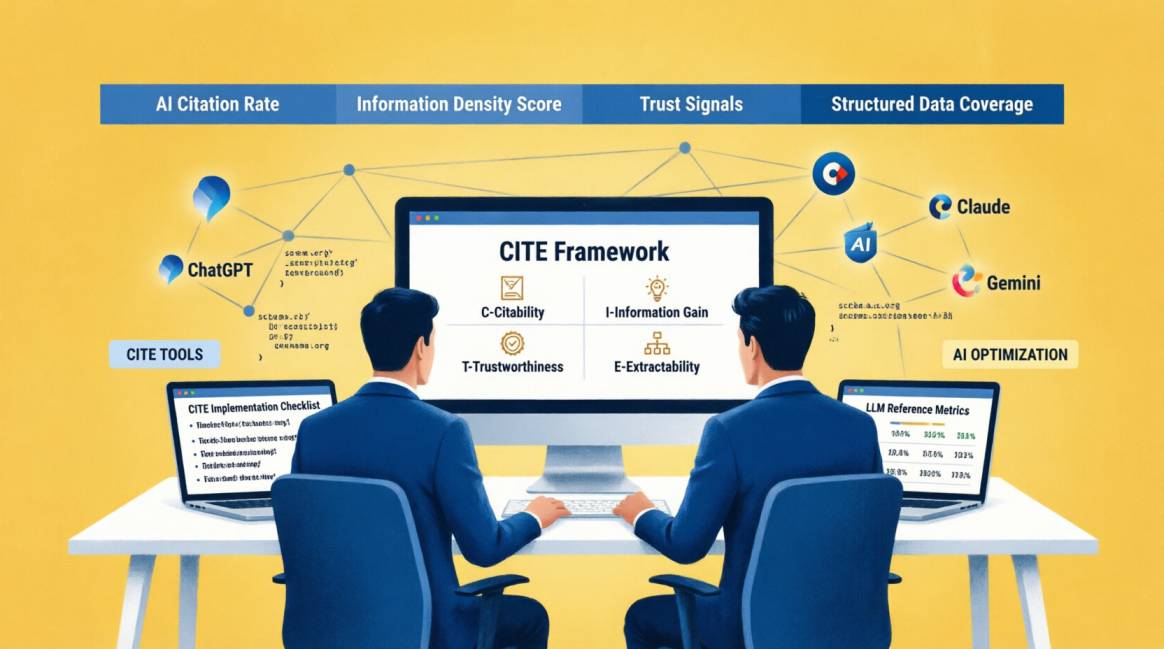
The CITE Framework in Practice: How We Build Content That Gets Referenced by LLMs

| 📌 Key Stats |
|---|
| 2.4× — Higher AI citation rate for content with complete CITE Framework implementation vs partial |
| 40% — of commercial Google queries now showing AI Overviews in Nigeria (June 2026) |
| 500%+ — Growth in AI-referred web traffic between July 2024 and February 2025 (Adobe Research) |
| 4 — Pillars of Semola CITE Framework — Citability, Information Gain, Trustworthiness, Extractability |
Table of Contents
Table of Contents
The Gap Between Ranking and Being Cited
There is a gap opening in digital marketing that most businesses have not yet noticed — and by the time they notice it, it will have cost them months of competitive ground.
The gap is this: a website can rank on Page 1 of Google's traditional blue link results and be entirely absent from AI-generated answers for the same query. Ranking and being cited by AI systems are increasingly distinct achievements, requiring distinct optimisation strategies, evaluated by distinct quality criteria.
Google AI Overviews now appear for approximately 40% of commercial queries in Nigeria as of June 2026. ChatGPT with web browsing cites sources for informational queries. Perplexity answers every question by retrieving and citing live web content. Gemini synthesises brand recommendations from both its Knowledge Graph and live web content. The businesses whose content is cited in these AI-generated answers earn a visibility position that is, for many queries, more prominent than the first organic blue link below the AI Summary.
At Semola Digital, we have been building and refining a content framework specifically designed to earn AI citations since the early rollout of Google's Search Generative Experience in 2023. We call it the CITE Framework — four pillars that, applied consistently, produce content that AI language models select as citation sources. This article documents that framework in full: what each pillar means, why AI systems reward it, how to implement it on every piece of content you publish, and how to monitor whether it is working across each major AI platform.
This is not theoretical. It is a working methodology built from the specific patterns we observe in which content earns citations and which content, despite strong traditional rankings, is consistently passed over by AI systems synthesising answers for their users.
📌 What This Article Covers:
- Why ranking and AI citation are increasingly separate achievements requiring separate optimisation strategies
- The four pillars of the CITE Framework: Citability, Information Gain, Trustworthiness, and Extractability
- Deep implementation guidance for each pillar — with specific, actionable instructions and before/after content comparisons
- The five AI platforms that matter for business citation in 2026 and the specific signals each evaluates
- A complete CITE Framework audit checklist: apply it to any piece of content in under 20 minutes
- The Nigerian market opportunity: why CITE Framework implementation now creates citation advantages that will compound for years
Why AI Systems Cite Differently from How Google Ranks
To understand why a separate content framework for AI citation is necessary, you need to understand the fundamental difference between how Google's traditional ranking algorithm and AI language models evaluate content. These are not the same evaluation system, even when they originate from the same company.
Google's traditional ranking algorithm is optimised for relevance and authority: it uses backlinks, keyword matching, technical quality, and a range of behavioural signals to identify which pages are most likely to satisfy a user's query. It ranks pages — URLs — in order of probable usefulness.
AI systems like Gemini, GPT-4, and Perplexity are optimised for a fundamentally different task: synthesising a complete, accurate, reliable answer from multiple sources. They are not selecting a ranked list of pages. They are selecting specific content to extract and incorporate into a generated response. This requires different qualities from their source material — qualities that traditional SEO has never been optimised to provide.
The four qualities AI systems need from content they cite are precisely the four pillars of the CITE Framework:
- Citability — Is this content clearly attributable to a credible, named source that an AI system can reference with confidence?
- Information Gain — Does this content provide specific, original, accurate information that goes beyond what is already known — giving the AI system something worth extracting?
- Trustworthiness — Does this content provide signals that it is accurate, current, and produced by a genuine expert — giving the AI system confidence in the information it is extracting?
- Extractability — Is this content structured in a way that allows an AI system to isolate and retrieve a specific, coherent answer — rather than requiring interpretation of a flowing narrative?
A page that ranks in position 2 for a competitive keyword but scores poorly on all four CITE Framework pillars is highly likely to be bypassed by AI systems in favour of a page that ranks in position 8 The CITE Framework optimises for the second evaluation system — the one that is growing fastest and that most businesses have not yet begun to address.

The 4 Pillars of the CITE Framework
C — CITABILITY
Is your content clearly attributable to a credible, named source?
What it Means: Citability is the foundation of AI citation eligibility. An AI system that extracts a claim from your content and presents it to a user is making an implicit endorsement — it is saying 'this information comes from a source I am confident enough in to reference.' Content without clear authorship, without credible institutional affiliation, and without verifiable credentials makes this endorsement impossible. AI systems will not cite sources they cannot verify.
Why LLMS Reward It: AI language models are trained to evaluate source credibility as a quality filter when synthesising answers. Anonymous content, generic 'Team Author' bylines, and organisations without a clear entity presence in the Knowledge Graph all score low on citability. The model's quality filters — built to prevent hallucination and misinformation — exclude low-citability sources before content quality is even evaluated.
How to Implement: Assign every piece of content to a named, credentialled human author. Create a dedicated author bio page with the author's full name, photo, credentials, years of experience, and a link to their LinkedIn profile. Implement Person schema on the author bio page. Add Article schema to every content page with the author's @id linking to their entity. Add an Organization schema on your homepage with your brand's verifiable profile. The author and the organisation must both be identifiable entities.
Implementation Checklist:
- Named author on every content page — no anonymous, 'Admin,' or 'Web Team' bylines
- Author bio page with credentials, photo, LinkedIn profile link, and years of experience in the topic area
- Article or BlogPosting schema with author @id pointing to the author's Person entity
- Organization schema on homepage with complete sameAs array including Wikidata Q-ID
- Author's LinkedIn, Twitter/X, or external profile mentioned in the bio — external corroboration of the author's expertise
- Clear institutional affiliation: 'This article was reviewed by [Name], Technical SEO Practice Lead at Semola Digital, with 8 years of experience in...'
I — INFORMATION GAIN
Does your content provide something specific and original that AI systems cannot find anywhere else?
What it Means: Information Gain is the quality dimension that Google's March 2026 core update explicitly elevated as a primary ranking and citation signal. For AI systems, it is the determinant of whether your content is worth extracting at all. An AI synthesising an answer has access to millions of indexed pages. It will select the ones that provide specific, accurate, verifiable information — not the ones that rephrase what every other source already says. Vague, generic, or purely derivative content is invisible to AI citation systems not because it is wrong, but because it adds nothing.
Why LLMS Reward It: AI models are tasked with synthesising accurate, comprehensive answers. A source that provides a specific statistic, an original case study outcome, a proprietary methodology, or a first-hand experience account gives the model something concrete to extract and cite. A source that provides generic advice gives the model nothing it could not construct itself — and AI systems constructing answers from their training data have no reason to cite external sources for information they already 'know.'
How to Implement: Produce content that contains at least one of the following per piece: original data or research specific to your market or experience; a proprietary framework or methodology (like the CITE Framework itself); specific, named case study outcomes with verifiable figures; first-person expert experience ('In our analysis of 160 sites affected by the March 2026 update...'); or a unique synthesis of existing information that produces a novel insight not present in competing content. The test is simple: could an AI synthesise this answer from its training data without citing you? If yes, your Information Gain is insufficient.
Implementation Checklist:
- Include at least one original data point per article: a statistic from your own research, a client case study outcome, or a market observation unique to your experience
- Include a proprietary framework, named methodology, or original classification system that requires citation to attribute correctly
- Open each section with the specific answer to its heading question — do not build to the answer, lead with it
- Run an Information Gain self-test: search your primary keyword and read the top 3 ranking pages. Does your content contain something specific and original that none of them do? If not, add it before publishing.
- Use specific numbers over generalisations: '23% increase' over 'significant improvement,' '160 sites' over 'many sites,' '₦150,000/month' over 'a reasonable budget'
T — TRUSTWORTHINESS
Does your content signal that it is accurate, current, and produced by a genuine expert?
What it Means: Trustworthiness is the dimension that prevents AI systems from inadvertently spreading misinformation. AI models have robust quality filters specifically designed to avoid citing sources whose accuracy cannot be assessed — because a cited inaccuracy reflected back to millions of users damages the AI system's credibility. Content without freshness signals, without factual verification, without expert attribution linked to a known entity , and without clear publication and review dates is filtered out at the trustworthiness evaluation stage regardless of its relevance or citability.
Why LLMS Reward It: AI systems are explicitly penalised — by user feedback, by safety teams, and by competitive pressure — for citing inaccurate sources. Their quality filters have become increasingly sophisticated at identifying trustworthy signals: current dateModified timestamps, citations of verifiable primary sources, expert author credentials, and consistency of claims across multiple corroborating sources. Content that cannot be verified as current and accurate is excluded from citation consideration even when it is topically relevant.
How to Implement: Implement Article schema with both datePublished and dateModified on every content page — and update dateModified whenever you make a substantive content change. Cite primary sources for every specific claim: link to the original study, the official Google documentation, the specific report, or the government database. Add a 'Last reviewed' date and a 'Next review' date in your author bio section — a practice we follow at Semola Digital on every article. State explicitly when your content was written for a specific time period: 'Based on data from the March 2026 Core Update.' Avoid unverifiable superlatives: 'the most effective,' 'universally recognised' — replace with specific, evidenced claims.
Implementation Checklist:
- Article schema with datePublished and dateModified — update dateModified on every substantive revision
- Primary source citations with direct links for every specific statistic, study finding, or data claim
- 'Last reviewed' and 'Next review' dates visible in the article body or author bio section
- Time-bound accuracy statements: 'As of June 2026...' 'Based on Google's March 2026 update...'
- No unverifiable superlatives — replace 'best,' 'leading,' 'most popular' with specific, evidenced comparatives
- External expert validation where available: a quote from a named Google spokesperson, a referenced industry study, or a peer review from a named colleague in the field
E — EXTRACTABILITY
Is your content structured so AI systems can isolate and retrieve specific answers?
What it Means: Extractability is the technical dimension of the CITE Framework — and the most immediately actionable. An AI system generating a response does not read your article the way a human does: from beginning to end, absorbing the narrative arc, and synthesising a conclusion. It identifies the specific section that answers the query, extracts the relevant passage, and incorporates it into its generated response. Content that is not structured for this extraction process — dense narrative paragraphs that blend multiple claims, buried answers preceded by extensive context-setting, or information presented through implication rather than direct statement — is technically ineligible for extraction regardless of its accuracy or authority.
Why LLMS Reward It: AI extraction systems use semantic chunking — they identify self-contained, coherent answer units within a page and evaluate whether each chunk answers the query directly and completely. A chunk that requires reading three paragraphs of context to be understood is not a clean extraction. A chunk that directly states the answer in the first sentence, provides supporting evidence in the following 2–3 sentences, and ends with a clear conclusion is a perfect extraction. FAQPage schema makes this chunking explicit by formally marking question-answer pairs for AI system consumption.
How to Implement: Structure every piece of content around specific, answerable questions — and answer them directly. Use question-format H2 and H3 headings: 'How does Google evaluate Nigerian websites?' not 'Google's approach to Nigerian content.' Write an answer-first paragraph under every heading: the first sentence must directly answer the heading question. Keep answer paragraphs to 60–150 words — long enough to be complete, short enough to be extractable as a coherent chunk. Add a FAQ section to every content page with at least 4 questions answered in 40–80 words each. Implement FAQPage schema on every FAQ section. Use numbered and bulleted lists for process-based content — lists are the easiest content format for AI extraction systems to process and present cleanly.
Implementation Checklist:
- Question-format headings (H2/H3): 'How does X work?' not 'Understanding X'
- Answer-first paragraphs: the first sentence answers the heading question directly — no preamble
- Answer chunks of 60–150 words — self-contained, complete, and coherent without surrounding context
- FAQ section on every page: minimum 4 questions, each answered in 40–80 words
- FAQPage schema on every FAQ section — this is the most direct AI extraction signal available
- Numbered lists for process content, bulleted lists for feature and attribute content
- Summary box or key takeaways section at the end of each article — AI systems frequently extract from summary sections
Recommended Reading: The GEO Maturity Matrix: Assess Your AI Visibility Readiness + Build Your 90-Day Roadmap
The CITE Framework in Practice — Before and After
Abstract descriptions of the four pillars are useful. Seeing them applied to actual content is more useful. The following comparison shows the same content topic written without the CITE Framework and with it fully applied — and explains specifically which signals each version triggers or fails to trigger in AI citation systems.
| ❌ Without CITE Framework | ✅ With CITE Framework Applied |
|---|---|
| SEO takes time — typically several months before you start seeing results. It depends on many factors including your website's current state, competition level, and the quality of your SEO work. Most experts agree that 6–12 months is a reasonable expectation. | Most websites see first meaningful ranking movements within 60–90 days of beginning a structured SEO programme. Based on our work with 50+ Nigerian business websites from 2022 to 2026: technical fixes (schema, speed, crawl errors) register in Search Console within 2–4 weeks; on-page content improvements produce ranking movement in 45–75 days; new content cluster pages enter top-30 positions within 60–90 days; and competitive head-term rankings typically require 6–9 months of consistent topical authority building. |
| Vague time range ('several months'), no specific claim, no original data, no named author, generic expert attribution ('most experts'). The AI system has no specific claim to extract and no reason to cite this over any other page saying the same thing. | Specific timeframes with clear attribution ('Based on our work with 50+ Nigerian business websites'), four distinct data points in a structured format, named source implied by institutional voice, extractable as a complete answer chunk. AI systems have specific, original, citable claims to work with. |
| OPENING PARAGRAPH (No CITE Framework): 'Search engine optimisation is a complex discipline. Many factors influence how quickly your website can begin ranking on Google. In this article, we explore what those factors are and what you can realistically expect.' | OPENING PARAGRAPH (CITE Framework applied): 'The honest answer: 60–90 days for first ranking movements, 6–9 months for competitive head-term positions. This timeline assumes a correctly executed technical foundation, consistent content production, and at least one authoritative backlink earned per month. Here is the specific breakdown of what happens at each phase — and what slows recovery down.' |
| FAQ SECTION (No CITE Framework): Q: How long will SEO take? A: It depends on many factors and varies by industry and competition level. Contact us to learn more about your specific situation. | FAQ SECTION (CITE Framework applied): Q: How long does SEO take to show results for a Nigerian business? A: First Search Console impressions typically appear within 2–4 weeks of technical fixes. Ranking movement on long-tail queries: 45–75 days. Competitive commercial keyword rankings: 6–9 months with consistent content and link building. Sites with existing authority (domain age 3+ years, 20+ backlinks) often see movement in 30–45 days. |
The second version passes all four CITE Framework tests: it has a named institutional source (Citability), it contains specific original data from a defined dataset (Information Gain), it states time-specific claims and a defined observation period (Trustworthiness), and it is structured as a direct answer with a specific breakdown in list format (Extractability). The first version passes none of them — and that is why AI systems consistently bypass pages like the first version even when they rank on Page 1.
#5 AI Platforms That Matter — and What Each One Rewards
The CITE Framework's four pillars apply universally across AI citation systems. But each platform has nuances in how it evaluates and weights these signals. For small businesses investing in GEO, understanding platform-specific citation patterns allows you to optimise for the platforms most relevant to your audience — and to monitor your citation performance accurately.
| AI Platform | How It Sources Citations | Primary Citation Signals | How to Monitor |
|---|---|---|---|
| Google AI Overviews | Answers factual, how-to, best-of, and definition queries with an AI-generated summary above blue links. Sources from 3–8 cited web pages. | FAQPage schema, structured Q&A format, Information Gain, E-E-A-T signals (named author + credentials), fresh dateModified. | Search Console AI Overview impressions report. Manual query testing in Google AI Mode. Monitor monthly for target queries. |
| ChatGPT (GPT-4o / web browsing) | When web browsing is enabled, GPT-4o retrieves current information and cites sources. Without browsing, it draws from training data up to the knowledge cutoff. | High domain authority, clean crawlability, clear factual claims, structured content. Frequently cites Wikipedia, major publications, and sites with strong entity signals. | Manual prompting of target queries in ChatGPT with web browsing enabled. Note which pages are cited and why — compare their structure to yours. |
| Perplexity AI | A dedicated AI search engine that always retrieves live web content and cites every source. Currently one of the most citation-transparent AI platforms available. | Recency (datePublished and dateModified), specific factual claims with verifiable data, structured content that is easy to extract, and authority signals from clean domain. | Search your target queries directly in Perplexity. It shows you exactly which URLs it cited and the specific text it extracted — the most direct content gap diagnostic available. |
| Google Gemini | Google's AI assistant — integrated across Google products and directly linked to the Knowledge Graph. Gemini queries entity data and live web content simultaneously. | Knowledge Graph entity recognition (sameAs schema, Wikidata entry, GBP), FAQPage schema, authoritative domain signals, and fresh content. | Test in Google Gemini directly. Entities with Knowledge Panels appear more frequently in Gemini responses — entity building and AI citation are directly linked. |
| Microsoft Copilot (Bing-backed) | Microsoft's AI assistant uses Bing's web index for retrieval. Relevant for businesses wanting cross-platform AI visibility beyond Google's ecosystem. | Bing Webmaster Tools submission, Bing-indexed content, structured data, and high-authority domain signals. Similar citation criteria to Perplexity. | Submit your sitemap in Bing Webmaster Tools. Test target queries in Copilot. Monitor Bing Search Console for impressions and indexation. |
Nigerian Citation Opportunity — Why Acting Now Creates an Advantage

The CITE Framework opportunity in the Nigerian market is, in a word, enormous — and it is available right now, before the majority of Nigerian businesses know it exists.
When a user in Lagos asks Google AI Mode 'what are the best SEO agencies in Nigeria?' or asks ChatGPT 'how do I grow my business online in Nigeria?' — these AI systems source their answers from whatever content exists in their index that meets their citation quality threshold. At the time of writing, the corpus of Nigerian-specific, CITE-Framework-compliant content on the indexed web is extremely thin.
This means: a Nigerian business that publishes CITE-Framework-compliant content today — with named expert authors, original Nigerian market data, current dateModified timestamps, structured FAQPage schema, and answer-first content architecture — is building a citation corpus in a space where almost no competitor has yet planted a flag. The AI systems that answer questions about Nigerian business, Nigerian SEO, Nigerian e-commerce, or any Nigerian professional service category are actively seeking citable, authoritative sources. They are not finding many.
The first publisher of quality, CITE-compliant content in any Nigerian market category becomes the default cited authority for AI-generated answers in that category — a position that compounds over time as more AI citations build more branded search volume, which builds more entity authority, which builds more AI citations. The compounding cycle begins with the first correctly structured, citable piece of content.

The Three-Platform Nigerian Citation Strategy
For Nigerian businesses targeting multiple AI platforms simultaneously, the optimal content investment sequence is:
- Optimise for Google AI Overviews first: The largest immediate impact for Nigerian audiences. FAQPage schema and structured Q&A content are the primary levers. Every piece of content should have a FAQ section with at least 4 questions answered in direct, extractable format.
- Build Wikidata and entity signals for Gemini: Gemini's direct Knowledge Graph integration means entity-building investments (Wikidata entry, Organization schema with sameAs, verified GBP) directly improve Gemini citation eligibility — separate from but complementary to content quality.
- Submit to Bing Webmaster Tools for Copilot visibility: Often overlooked by Nigerian businesses, Bing Webmaster Tools submission takes 20 minutes and opens your content to Microsoft Copilot citation — a growing AI platform with significant business user penetration through Microsoft 365 integration.
Monitoring Your AI Citation Performance
The CITE Framework is only as valuable as your ability to measure whether it is working. AI citation monitoring requires a different approach from traditional SEO measurement — because most traditional rank trackers measure static blue-link positions, not dynamic AI summary inclusions. To properly monitor this, you must rely on Google Search Console's AI Overview impressions, manual query testing in incognito modes, and tracking referral traffic specifically originating from AI platform domains (like chatgpt.com or perplexity.ai). AI citation monitoring requires a different approach from traditional SEO measurement — because most AI systems do not report their sources in your analytics tools. Here is the complete monitoring system we recommend:
Monthly AI Citation Test Protocol
- Define your 10 most commercially important target queries — the questions your target clients type when searching for what you offer.
- On the first Monday of each month, open Google AI Mode, ChatGPT (with web browsing enabled), Perplexity, and Google Gemini in separate tabs.
- Type each of your 10 target queries into each platform. Document: (a) whether an AI answer was generated, (b) whether your content was cited, (c) if not, which page was cited instead, (d) what specific text was extracted from the cited page.
- Record results in a shared spreadsheet with columns: Date | Platform | Query | Cited? | Cited URL | Competitor cited (if not you) | Notes.
- When a competitor is cited and you are not: open the cited page and run a CITE Framework audit against it. Identify which specific pillar your content fails relative to theirs. This competitor page is your improvement brief.
Search Console AI Overview Monitoring
Google Search Console now reports AI Overview impressions separately from standard organic impressions for sites with access to the feature. Check Search Console → Performance → Search Type → AI Overviews monthly. Track total AI Overview impressions, click-through rate from AI Overview citations, and which specific pages and queries are generating AI Overview impressions. This is the only platform-provided data source for AI citation performance available at scale.
GA4 AI Referral Traffic Tracking
Some AI platforms do pass referrer headers when users click through to cited pages. In GA4, navigate to Traffic Acquisition and search for sessions from 'perplexity.ai,' 'chat.openai.com,' 'gemini.google.com,' and 'bing.com' (Copilot referrals often arrive via Bing). Track this monthly. A growing AI referral session count is the most direct evidence that your CITE Framework implementation is producing citation traffic.
The Complete CITE Framework Audit Checklist
Apply this checklist to any existing page you want to make AI-citation-eligible, or use it as a pre-publication standard for every new piece of content. A page that passes all items on this checklist has met the full CITE Framework standard.
| C — CITABILITY SIGNALS | |
|---|---|
| ☐ | Named author with full name, credentials, and years of experience in the topic area |
| ☐ | Author bio page with photo, LinkedIn profile link, and professional background |
| ☐ | Article or BlogPosting schema implemented with author @id linking to Person entity |
| ☐ | Organization schema on homepage with complete sameAs array including Wikidata Q-ID |
| ☐ | Institutional affiliation stated in the article body or author bio |
| ☐ | Citability test: Could an AI system confidently attribute this content to a specific, verifiable expert? If you replaced the author byline with 'Anonymous,' would the content become unverifiable? If yes, the Citability signals are insufficient. |
| I — INFORMATION GAIN SIGNALS | |
|---|---|
| ☐ | At least one original data point, proprietary finding, or first-person experience claim per article |
| ☐ | A named methodology, framework, or classification system that requires citation to attribute correctly |
| ☐ | Specific numbers throughout: percentages, timeframes, quantities, prices — never vague generalisations |
| ☐ | Information Gain self-test completed: read the top 3 competing pages. Does this content contain something specific and original that none of them do? |
| ☐ | Opening paragraph answers the primary query directly — no preamble, no context-building before the answer |
| ☐ | Information Gain test: Could an AI system synthesise this exact answer from its training data without citing you? If yes, add an original data point or proprietary insight before publishing. |
| T — TRUSTWORTHINESS SIGNALS | |
|---|---|
| ☐ | Article schema with both datePublished and dateModified implemented |
| ☐ | dateModified reflects the actual date of the most recent substantive content update |
| ☐ | Every specific statistic, data claim, or research finding cited with a direct link to the primary source |
| ☐ | 'Last reviewed' date visible in article body or author bio section |
| ☐ | Time-bound accuracy statements where relevant: 'As of June 2026...' / 'Based on the March 2026 update...' |
| ☐ | No unverifiable superlatives — every comparative claim is evidenced with a specific source or data point |
| ☐ | Trustworthiness test: Would a fact-checker be able to verify every specific claim in this article independently? If not, either remove the unverifiable claim or add the primary source link. |
| E — EXTRACTABILITY SIGNALS | |
|---|---|
| ☐ | All H2 and H3 headings are phrased as direct questions: 'How does X work?' not 'Understanding X' |
| ☐ | First sentence of every section directly answers its heading question — no preamble |
| ☐ | Answer chunks are 60–150 words: complete enough to be coherent, concise enough to be extractable |
| ☐ | FAQ section with minimum 4 questions — each answered in 40–80 words of direct, self-contained prose |
| ☐ | FAQPage schema implemented on the FAQ section with zero validation errors (test in Google Rich Results Test) |
| ☐ | Summary box or key takeaways section at the end of the article |
| ☐ | Process content presented as numbered lists; feature/attribute content as bulleted lists |
| ☐ | Extractability test: Could someone read only the heading and first sentence of each section and understand the complete answer? If they need to read the rest of the paragraph to make sense of the first sentence, Extractability is insufficient. |
Content Standard That Compounds Across Every Search Surface
The CITE Framework is not a separate content strategy from SEO. It is the evolved standard of what good content means in a world where AI systems mediate an increasing proportion of information discovery — alongside, above, and sometimes instead of traditional blue link rankings.
Content that meets the CITE Framework standard — genuinely citable, informationally valuable, trustworthy, and structured for extraction — is also content that performs exceptionally well in traditional search. It earns Featured Snippets, People Also Ask positions, and Knowledge Panel mentions. It builds topical authority faster. It attracts natural editorial backlinks because it is genuinely worth citing. It survives algorithm updates because it was built toward the quality standards that updates enforce.
For Nigerian businesses publishing content in a market where almost no competitor has yet implemented a systematic approach to AI citation eligibility: the first mover who publishes CITE-compliant content in their topic category earns a citation advantage that compounds for years. AI systems that begin citing your content become progressively more likely to continue citing it — because citation builds entity authority, which builds more citation eligibility, which builds more branded search demand.
Apply the four-pillar audit checklist to every piece of content before it publishes. Run the monthly AI citation test across the five platforms in Section 4. Document what gets cited and what does not. Close the gap. The CITE Framework is not a one-time implementation — it is a content quality standard that, applied consistently, produces the compounding visibility advantage that defines market leadership in the age of AI search.
📋 THE CITE FRAMEWORK — SUMMARY REFERENCE
- C — CITABILITY: Named author with credentials, bio page with LinkedIn, Article schema with author @id, Organization schema with sameAs. Test: could an AI confidently attribute this to a verifiable expert?
- I — INFORMATION GAIN: Original data, proprietary frameworks, specific numbers, answer-first paragraphs. Test: could an AI generate this answer from training data without citing you? If yes, add something original.
- T — TRUSTWORTHINESS: Article schema with datePublished + dateModified, primary source links for all claims, 'Last reviewed' date, time-bound accuracy statements. Test: could a fact-checker verify every claim independently?
- E — EXTRACTABILITY: Question-format headings, answer-first paragraphs (60–150 words), FAQ section (4+ Q&As, 40–80 words each), FAQPage schema, summary box. Test: does the first sentence of each section answer the heading question directly?
- The five AI platforms: Google AI Overviews (FAQPage schema + Information Gain), ChatGPT (domain authority + structured content), Perplexity (recency + specific claims), Gemini (entity recognition + FAQPage), Copilot (Bing indexation + authority).
- Monthly monitoring: 10 target queries tested across all five platforms on the first Monday of each month. Search Console AI Overview impressions tracked. GA4 AI referral sessions from perplexity.ai, chat.openai.com, gemini.google.com tracked.
- Nigerian opportunity: the corpus of CITE-compliant content for Nigerian market queries is extremely thin. The first publisher in any Nigerian market category earns AI citation authority that compounds with every subsequent citation.
Frequently Asked Questions
Questions readers ask about this topic
The FAQs below are pulled directly from this article's structured content and are designed to help readers quickly find answers to common questions related to the topic.
Does the CITE Framework replace traditional SEO or work alongside it?
How quickly will CITE Framework implementation produce measurable AI citations?
Can AI-generated content meet the CITE Framework standards?
Is the CITE Framework specific to Semola Digital or can any business apply it?

Founder, Technical Analyst
Oladoyin Falana is a certified digital growth strategist and full-stack web professional with over five years of hands-on experience at the intersection of SEO, web design & development. His journey into the digital world began as a content writer — a foundation that gave him a deep, instinctive understanding of how keywords, content and intent drive organic visibility. While honing his craft in content, he simultaneously taught himself the building blocks of the modern web: HTML, CSS, and React.js — a pursuit that would eventually evolve into full-stack Web Development and a Technical SEO Analyst.
Follow me on LinkedIn →