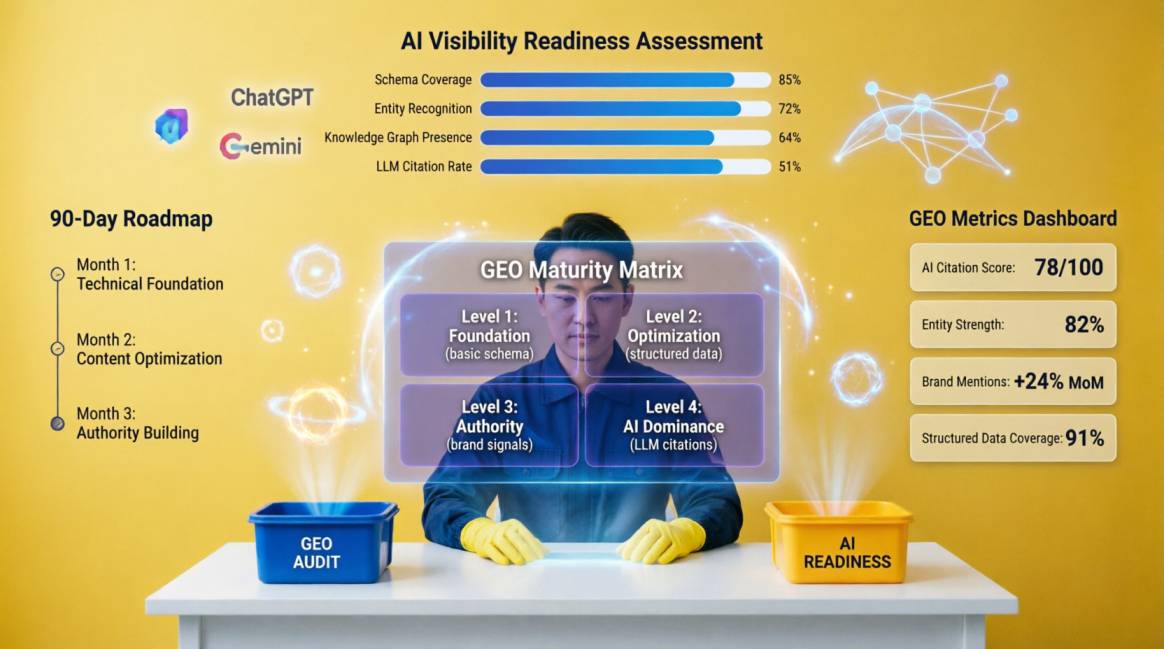
The GEO Maturity Matrix: Assess Your AI Visibility Readiness + Build Your 90-Day Roadmap

| Key Notes: |
|---|
| 5 Maturity levels in the Semola GEO Maturity Matrix — from Invisible to Authority |
| 40% — of Nigerian Google queries now showing AI Overviews — growing monthly |
| <2% — of Nigerian businesses estimated to be at GEO Level 3 or above as of May 2026 |
| 90 Days to move from Level 1 to Level 2 with focused, systematic GEO investment |
Table of Contents
Table of Contents
You Cannot Improve What You Have Not Measured

Generative Engine Optimisation (GEO) is the fastest-growing discipline in digital marketing. Google AI Overviews now appears for 57% to 88% of informational queries, roughly 8% to 14% of product or shopping searches, and around 10% of the time for navigational queries.
ChatGPT and Perplexity continue to scale aggressively, with referral traffic volumes to authoritative websites seeing sustained triple-digit growth over the last 18 months. AI-mediated search is no longer a future development — it is the present reality for any African and International business whose customers use Google, ChatGPT, or any other AI-assisted platform to find information.
Most businesses have no idea where they stand in this landscape. They have not checked whether their brand appears in AI-generated answers. They have not assessed whether their content structure qualifies for AI citation. They have not verified whether their entity signals are strong enough for AI systems to confidently reference them. They are investing in SEO without knowing whether that investment is producing AI visibility — which is increasingly the more commercially valuable dimension.
The GEO Maturity Matrix is Semola Digital's proprietary framework for answering this question with precision. It is a structured self-assessment tool that places any business on a five-level GEO maturity scale — from Level 1: GEO Invisible through to Level 5: GEO Authority — based on 20 observable, verifiable signal dimensions across five categories. It is not a theoretical framework. It is a diagnostic instrument built from our direct work assessing AI visibility across Nigerian, African, and international businesses since the rollout of Google AI Overviews in 2023.
This guide walks you through the complete matrix, explains what each level means for your business, gives you a 90-day roadmap for your current level, and provides the monitoring framework that tells you when you have advanced to the next level.
Together with the CITE Framework, they represent Semola's diagnostic tool and methodology for building authority across search and AI engines in 2026.
📌 WHAT THIS GUIDE DELIVERS
- The five GEO maturity levels: what each looks like, what its symptoms are, and what its specific risks and opportunities are
- The 20-signal self-assessment matrix: five dimensions, four signals each — answer 20 yes/no questions and calculate your exact GEO maturity level
- Your score interpretation: what your level means for your organic visibility, AI citation frequency, and competitive position
- Four tailored 90-day roadmaps — one for each actionable level (Level 1 through Level 4) — with month-by-month deliverables
- The GEO monitoring protocol: how to track progress between levels and verify advancement
- The Nigerian first-mover advantage: why the GEO authority gap in the Nigerian market represents the most significant digital marketing opportunity available right now
Why GEO Requires a Maturity Model
Traditional SEO is measured in rankings — a page is either on page 1 or it is not. GEO does not work this way. AI citation is not a binary state that flips on when a specific threshold is reached. It is a confidence-building process through which AI systems gradually form a higher and higher degree of trust in a brand as a citable authority — based on the accumulation of consistent, verifiable, structured signals across multiple independent sources.
A brand with a Wikidata entry but no named author attribution has partial entity recognition. A brand with FAQPage schema but no Organization schema sameAs array has partial extractability signals. A brand with editorial backlinks but no structured content has partial authority without extractability. AI citation eligibility is not achieved by any single signal — it is the product of signal stacks that build on each other, and it develops progressively rather than all at once.
A maturity model is the appropriate framework for this kind of progressive development because it:
- Provides a clear current-state diagnosis — you know exactly where you are, not just that you need to 'improve your GEO'
- Sequences interventions correctly — the actions that matter at Level 1 are different from the actions that matter at Level 3
- Sets realistic expectations — advancing from Level 1 to Level 2 takes 90 days; from Level 2 to Level 3 takes a further 90–120 days. Knowing this prevents premature abandonment of the strategy
- Creates measurable milestones — you know you have advanced to the next level when specific, verifiable signals are confirmed
The Five GEO Maturity Levels
Each level in the GEO Maturity Matrix represents a distinct state of AI visibility — with a characteristic signal profile, a characteristic set of business symptoms, and a characteristic competitive position. Identifying your level is the prerequisite for all further action.
👻 LEVEL #1: GEO Invisible — You Do Not Exist to AI Systems
At Level 1 (Score: 0–4), your brand is effectively absent from the AI information landscape. Google AI Overviews do not cite you. ChatGPT does not reference you. Perplexity does not include you in answers. When AI systems answer questions about your industry or your service category, your competitors appear and you do not. You are not losing an AI visibility race — you have not yet entered it.
Common Symptoms:
- Business searches on ChatGPT or Google AI Mode return competitor recommendations with no mention of your brand
- No Organization schema on your website homepage — or schema that fails Rich Results Test validation
- No Wikidata entry for your brand — AI systems have no machine-readable entity anchor to reference
- No named authors on any content — AI citation eligibility requires attributable human expertise
- Google Search Console shows zero impressions from AI Overview features
🌱 LEVEL #2: GEO Emerging — Foundational Signals Present, Inconsistent
At Level 2 (Score: 5–9), you have made some initial GEO investments — perhaps some schema markup, perhaps a partial sameAs array, perhaps some FAQ sections — but the signal stack is incomplete and inconsistent. AI systems occasionally surface your content for low-competition or highly specific queries, but you lack the depth for reliable citation on your core commercial queries. Your GEO visibility is fragile and dependent on a narrow set of signals that are not mutually reinforcing.
Common Symptoms:
- Your brand appears in AI answers for some very specific, low-competition queries but not for your primary commercial queries
- Schema markup partially implemented but with validation errors — AI extraction systems skip pages with schema errors
- Some content has FAQPage schema but most does not — inconsistent extractability across your content library
- Named author present on some content but not all — inconsistent Citability signals confuse AI system evaluation
- No systematic AI citation monitoring — your team does not know which queries they are or are not appearing for
📈 LEVEL #3: GEO Established — Core Signals Consistent, Depth Building
At Level 3 (Score: 10–14), your foundational GEO infrastructure is complete and consistent. Your entity is recognised by major AI systems, your content earns citations on moderately competitive queries, and your monitoring practice reveals a growing citation share month over month. The characteristic of Level 3 is consistency across the signal stack — but the depth of topical authority and the breadth of citation coverage are still limited compared to Level 4.
Common Symptoms:
- Your brand appears in AI responses for several target queries but not yet for your highest-competition commercial keywords
- Complete Organization schema with full sameAs array — entity recognition established but Knowledge Panel may not yet be present
- FAQPage schema on all key pages — extractability is strong but topical authority cluster may be incomplete
- Named authors with credentials on all content — Citability signals are consistent across the content library
- Monthly AI citation monitoring in place — you know your citation share and are tracking it, but it is not yet growing rapidly
🏆 LEVEL #4: GEO Competitive — Consistent Citation Across Target Queries
At Level 4 (Score: 15–19), your brand earns consistent AI citations across your primary commercial query set. You appear in Google AI Overviews, Perplexity responses, and ChatGPT answers for your core service or product category in your target market. Your Knowledge Panel is present or imminent. Your topical authority is recognised by AI systems as established. The competitive landscape is beginning to notice you in the AI citation layer.
Common Symptoms:
- Consistent appearance in AI Overviews for 5+ target queries — measured and tracked monthly
- Knowledge Panel present or confirmed in Google's Knowledge Graph via the Knowledge Graph Search API
- Topical authority cluster complete — pillar page plus 8+ cluster pages building comprehensive coverage
- Multiple Nigerian editorial backlinks — entity corroboration confirmed across authoritative external sources
- Competitors beginning to appear in your branded query AI responses — they are tracking your visibility and responding
🌟 LEVEL #5: GEO Authority — Definitive Category Citation Leader
At Level 5 (Score: 20), your brand is the cited authority for your target topic category across all major AI platforms. When AI systems answer questions about your industry, your service category, or your geographic market — your content is the primary or consistently cited source. Competitors reference your frameworks and content. Journalists and media platforms cite you as an expert source. Your GEO authority has become a self-reinforcing competitive advantage that compounds with every citation earned.
Common Symptoms:
- Cited in AI responses for 10+ target queries across Google AI Mode, ChatGPT, and Perplexity consistently
- Knowledge Panel with robust entity attributes — logo, founding date, social profiles, description all accurate
- Original proprietary frameworks (like the GEO Maturity Matrix) that competitors and AI systems cite by name
- Wikipedia article or Wikipedia-quality Wikidata entry with multiple external corroboration sources
- Natural inbound link acquisition — other sites link to your content because it is the definitive reference source
20-Signal Self-Assessment — Find Your Level Now
Answer the following 20 yes/no questions honestly. Count your 'Yes' answers. Each 'Yes' is one point. Do not estimate or assume — if you are not certain whether a signal is present, check it before answering. An assumed 'Yes' that should be 'No' produces an inflated score and a roadmap that begins at the wrong level.
| Dimension | Signal 1 | Signal 2 | Signal 3 | Signal 4 |
|---|---|---|---|---|
| Entity Foundation | Does your brand have a Wikidata entry with a Q-ID? | Is your Organization schema on your homepage complete with a full sameAs array (Wikidata, LinkedIn, Facebook, GBP)? | Is your brand name identical across your website, GBP, LinkedIn, Facebook, and Twitter/X? | Does Google Search Console show branded queries generating impressions for your brand name? |
| Content Structure | Does every piece of content on your site have a named author with credentials? | Does your site utilize clear Q&A content formatting structured cleanly within standard Article or WebPage schema for LLM extractability? | Do your headings follow the answer-first pattern (question headings with direct answer paragraphs)? | Does your content contain original data, proprietary frameworks, or first-person experience claims? |
| Technical Signals | Is Article schema with datePublished and dateModified implemented on all content pages? | Does your site have Product schema (for e-commerce) or Service schema validating in Rich Results Test? | Is your BreadcrumbList schema validating on all category and page types? | Is your site passing Core Web Vitals (LCP < 2.5s, INP < 200ms, CLS < 0.1) on mobile? |
| Platform Presence | Is your sitemap submitted in both Google Search Console AND Bing Webmaster Tools? | Does your content appear when you prompt your target queries in Google AI Mode? | Does your content appear when you prompt your target queries in Perplexity? | Does your content appear in ChatGPT responses for target queries (with web browsing enabled)? |
| Topical Authority | Has your site published a structured content cluster on its primary topic (pillar + 4+ cluster pages)? | Have you earned at least 3 editorial backlinks from credible Nigerian or African media sources? | Does your brand generate enough branded search volume to appear in Google's People Also Search For? | Has your content been cited in an AI Overview for any of your target queries in the last 30 days? |
Scoring instructions: For each of the 20 questions, answer Yes (1 point) or No (0 points). Total your score across all five dimensions. Be conservative — if you are not certain whether a signal is fully implemented and validating correctly, score it as No until you have verified it. A 'Yes' for Organization schema requires that the schema validates without errors in Google's Rich Results Test. A 'Yes' for AI citation requires that you have manually tested the query in the relevant platform in the last 30 days and confirmed your content appeared.
| Score | Level | GEO Status | What This Means for Your Business |
|---|---|---|---|
| 0–4 YES | Level 1 | GEO Invisible | Your brand is effectively absent from AI-generated answers. Google, ChatGPT, and Perplexity do not have sufficient verified signals to cite you confidently. Every competitor with any GEO investment is already ahead. |
| 5–9 YES | Level 2 | GEO Emerging | You have made some foundational investments but the signal stack is incomplete. AI systems may occasionally surface your content for low-competition queries, but you lack the depth for consistent citation on commercial queries. |
| 10–14 YES | Level 3 | GEO Established | Your core GEO foundations are in place. You earn citations on some target queries and your entity is recognisable to major AI systems. The opportunity is to deepen the signals that accelerate citation frequency. |
| 15–19 YES | Level 4 | GEO Competitive | Your brand appears consistently in AI responses for target queries. Your entity signals are strong, your content is structured for extraction, and you monitor citation performance monthly. The focus is compounding and defending. |
| 20 YES | Level 5 | GEO Authority | Your brand is a cited authority across all major AI platforms for your target topic category. You set the standard competitors reference. The goal is maintaining this position through consistent quality investment and early adoption of emerging AI platform signals. |
Your 90-Day Roadmap — Tailored to Your Current Level
The roadmap for each level is sequenced to address the specific signal gaps that prevent advancement to the next level. Do not attempt to execute a Level 3 roadmap if you are at Level 1 — the foundation must be built before the structure can be added. Each month within each roadmap represents approximately 4–6 hours of work per week for a single person, or 2–3 hours per week with basic tooling in place.
LEVEL 1 → 2 → 90-DAY ROADMAP
Month 1: Foundation
- Begin building your digital footprint: Audit your brand properties to ensure exact name, address, and phone consistency across LinkedIn, Crunchbase, and local business profiles to prepare your entity for future Wikidata eligibility.
- Implement Organization schema on your homepage: @type, name, url, logo, foundingDate, address, contactPoint, and a sameAs array including your new Wikidata Q-ID, LinkedIn, Facebook, and GBP URL.
- Validate your Organization schema using Google's Rich Results Test: zero errors required before proceeding.
- Create/complete your Crunchbase profile and LinkedIn company page with your exact canonical brand name.
- Assign a named author to your top 5 most-visited content pages. Create an author bio page for each with credentials and LinkedIn profile link.
Month 2: Build
- Add Article schema with datePublished, dateModified, and author @id to all 5 named-author pages.
- Write and publish a FAQ section (4+ questions) on your top 2 service or product pages. Implement FAQPage schema on each. Validate.
- Submit your sitemap in Bing Webmaster Tools if not already done (takes 10 minutes, opens Copilot citation eligibility).
- Run your first AI citation test: prompt your top 5 target queries in Google AI Mode, ChatGPT (web browsing on), and Perplexity. Document results — this is your baseline.
- Set up a Google Alert for your brand name to begin tracking media mentions and external entity signals.
Month 3: Measure + Compound
- Verify GSC Social Channels report: has Google auto-populated your social profiles from your sameAs schema? This confirms entity disambiguation is progressing.
- Add FAQPage schema to 3 more content pages — aim for all key category and service pages covered by end of Month 3.
- Check your Search Console AI Overview impressions — compare to your Month 1 baseline. Any increase confirms signal uptake.
- Repeat your AI citation test. Document any new appearances. Even one new citation confirms Level 2 progression.
- Plan your Month 4 content investment: identify one informational query cluster where your content gap is addressable with a single well-structured pillar article.
LEVEL 2 → 3 → 90-DAY ROADMAP
Month 1: Foundation
- Audit your existing schema for errors: use Screaming Frog's structured data report to find all pages with schema that fails Rich Results Test validation. Fix every error — invalid schema is worse than no schema.
- Audit named author coverage: every piece of content must have a named author with a bio page. Identify any pages still lacking this and assign authors this month.
- Add FAQPage schema to every page that has a FAQ section. Use the FAQ content already there — do not create new content yet, just mark up what exists.
- Update dateModified in Article schema on your top 10 content pages with the date of their most recent substantive update.
- Ensure all existing sameAs URLs are live and pointing to active profiles — dead links in sameAs arrays reduce entity confidence.
Month 2: Build
- Publish your first topical authority cluster: a pillar page (1,500+ words) on your primary topic plus 4 cluster pages (800+ words each) targeting specific subtopics. All with FAQPage schema, named authors, and bidirectional internal links.
- Begin your first media outreach sprint: contact TechPoint.Africa, BusinessDay, Nairametrics, or a relevant industry publication with a story angle. One editorial mention is worth more than 50 directory citations for entity corroboration.
- Implement answer-first headings on all new content: every H2/H3 should be a question, answered directly in the first sentence of the following paragraph.
- Run your monthly AI citation test and compare to baseline. Document which new queries produce citations.
Month 3: Measure + Compound
- Verify your Wikidata entry has at least 8 populated statement fields: label, description, instance of, website, founding date, country, industry, and social profiles.
- Check Google's Knowledge Graph Search API (developers.google.com/knowledge-graph) for your brand name. If your entity appears with a Knowledge Graph ID, you have achieved Level 3 entity recognition.
- Assess your content cluster performance in Search Console: is your pillar page generating impressions for head terms? Are cluster pages generating impressions for their target subtopic queries?
- Set a monthly AI citation monitoring reminder: first Monday of every month, test all 10 target queries across 3+ platforms.
LEVEL 3 → 4 → 90-DAY ROADMAP
Month 1: Foundation
- Expand your topical authority: add 4 more cluster pages to your primary cluster, filling the content gaps identified by your monthly AI citation test. Focus on the queries where competitors are cited but you are not.
- Publish original research or proprietary data: a survey, a market analysis, a benchmarking report, or a case study series. Original data earns natural citations and establishes the Information Gain signals that distinguish Level 4 from Level 3 content.
- Pursue your second and third editorial backlinks from Nigerian media. One placement per month is the Level 3→4 target. Brief a story angle around your original research.
- Check Knowledge Panel status: search your brand name on Google. A panel should be appearing or appearing soon. If not, strengthen sameAs corroboration and ensure your Wikidata entry is complete.
Month 2: Build
- Launch your second topical authority cluster on an adjacent topic to your primary cluster. Cross-link the two clusters where semantically relevant.
- Implement Product, Service, or Event schema (whichever applies) on your primary commercial pages — beyond the foundation schema already in place. Validate all new schema types.
- Add a 'Last reviewed' date and 'Next review' date to every content page — this is a Trustworthiness signal that both Google's E-E-A-T system and AI citation filters evaluate.
- Test your AI citation share at the category level: prompt 'best [your service category] in [your city]' across all major AI platforms. Are you consistently in the response? If not, which competitor is? Their content is your improvement brief.
Month 3: Measure + Compound
- Assess Knowledge Panel status and claim it immediately if visible. Submit corrections for any inaccurate panel information.
- Run a comprehensive AI citation audit: test your full set of 15+ target queries across Google AI Mode, ChatGPT, Perplexity, and Gemini. Document citation frequency by platform and query type.
- Identify your Level 4 signal gap: which of the 20 assessment signals are you still scoring 'No' on? These specific gaps are preventing the final advancement to Level 4. Assign each one an owner and a completion date.
- Define your Level 5 strategy: what proprietary frameworks, original research, or definitive industry resources would establish you as the cited authority in your category? This is your 6–12 month Level 5 investment plan.
LEVEL 4 → 5 → 90-DAY ROADMAP
Month 1: Foundation
- Publish the definitive resource in your category: a comprehensive industry report, an annual benchmarks study, or a framework that establishes a new standard for how your topic is discussed. This is the Level 5 trigger — a piece of content so complete and original that competitors and AI systems reference it by name.
- Pursue Wikipedia notability if your brand meets the criteria (10+ independent news mentions). Engage an experienced Wikipedia editor to assess and draft the article.
- Expand your external media presence: guest articles, podcast appearances, speaking engagements. Each external context in which you are named as an expert builds the co-occurrence signals that advance AI systems from 'knows your brand' to 'associates your brand with category authority'.
- Commission or conduct original market research: a Nigerian e-commerce report, a salary survey, a technology adoption study. Data-driven original research earns the highest citation rates of any content type across all AI platforms.
Month 2: Build
- Build a second authoritative cluster on a laterally adjacent topic — expanding your citation surface area from one category to two. Level 5 authority is multi-dimensional, not single-topic.
- Formalise your proprietary methodology: name it, document it, publish it, and reference it consistently across all content. Named methodologies are highly AI-citable because they have a distinct identity that AI systems can attribute and reference.
- Audit your backlink profile for link authority: are you receiving natural inbound links from other authoritative sources without active outreach? Natural link acquisition is the Level 5 signal that distinguishes genuine authority from actively built authority.
- Develop a thought leadership calendar: monthly original insights, quarterly data releases, annual definitive guides. Level 5 authority requires ongoing investment, not a one-time achievement.
Month 3: Measure + Compound
- Measure your AI citation share at the category level across all major platforms. Level 5 requires consistent appearance for 10+ queries across Google AI Mode, ChatGPT, and Perplexity.
- Track branded search volume trend in GSC: Level 5 authority produces growing branded search — people search your brand name because AI systems recommended it. This is the compounding signal that makes Level 5 self-reinforcing.
- Document your Level 5 position and plan for maintaining it: which content needs annual refresh, which research needs updating, which clusters need expansion. Authority is not a destination — it is a maintenance standard.
- Assess competitors: are they beginning to cite your frameworks in their own content? Are media outlets referencing your research? These are the external validation signals that confirm Level 5 achievement.
The GEO Monitoring Protocol — Tracking Progress Between Levels
Advancing through GEO maturity levels is a process measured in weeks and months, not days. The monitoring protocol below gives you the specific metrics to track, the frequency to track them, and the signal thresholds that confirm advancement to the next level.
| WEEKLY MONITORING (15 MINUTES) | |
|---|---|
| ☐ | Check Search Console AI Overview impressions: compare this week vs last week. Growing AI Overview impressions is the earliest leading indicator of GEO progress. |
| ☐ | Check for new media mentions via Google Alert for your brand name. Every mention is a corroboration data point for your entity authority. |
| ☐ | Spot-check 2–3 priority queries in Google AI Mode: are you still appearing (or beginning to appear) in the responses? |
| MONTHLY MONITORING (60–90 MINUTES) | |
|---|---|
| ☐ | Full AI citation test: prompt all 10+ target queries across Google AI Mode, ChatGPT (web browsing), Perplexity, and Gemini. Record results in your citation tracker. |
| ☐ | Search Console AI Overview report: total AI Overview impressions month-over-month. Growing impressions confirm GEO signal investment is working. |
| ☐ | GA4 AI referral traffic: sessions from perplexity.ai, chat.openai.com, claude.ai, gemini.google.com. Growing AI referral traffic is the commercial outcome of growing AI citation frequency. |
| ☐ | Schema validation audit: run your homepage and top 5 pages through Rich Results Test. Catch any new schema errors introduced by CMS updates or plugin changes. |
| ☐ | Entity check: search your brand name on Google. Is the Knowledge Panel present? Has it been updated correctly? Are the social profiles linked correctly? |
| ☐ | Level advancement threshold: When your monthly AI citation test shows a majority (50%+) of target queries returning your content as a cited source, and your Search Console AI Overview impressions have grown consecutively for 3 months, you have advanced to the next maturity level. Update your self-assessment score and move to the corresponding roadmap. |
African, Nigerian First-Mover Advantage — Why the Timing of This Guide Matters
At the time of writing — May 2026 — our estimate is that fewer than 2% of established Nigerian businesses are at GEO Level 3 or above. The majority are at Level 1 or Level 2. The AI citation landscape for Nigerian and at large African business queries is, in most market categories, almost entirely uncontested.
This is not an abstract opportunity. It is a specific, time-limited window. When you prompt Google AI Mode with 'best accounting firm in Lagos,' 'top logistics company in Nairobi,' or 'most reliable SEO agency in Ghana' — in most cases, the AI systems are not returning confident, consistently cited African brands. They are either surfacing global results, offering generic summaries, or returning whatever thin GEO-signal the first business to make any investment has produced.
The businesses that invest in GEO maturity now — in 2026, before this window closes — earn a citation authority that will take competitors 2–3 years to match. This is not because the framework is secret or the signals are difficult. It is because consistent, sustained investment across 20 signal dimensions takes time to accumulate, and the businesses that start first have a compounding head start that cannot be closed quickly.
Every Nigerian or African business that completes the self-assessment in this guide and executes the corresponding 90-day roadmap is investing in a position that will be significantly harder to achieve in 2027 and beyond as the market matures and competition for AI citation increases. The first-mover advantage in GEO, in the Nigerian or African market, is real, measurable, and available right now.
Wrapping it up…
Know Your Level. Build Your Next 90 Days.
The GEO Maturity Matrix is the starting point for every Semola Digital engagement involving AI visibility. Before we recommend a single content change, schema update, or entity-building action, we assess where the business is starting from — because the correct investment at Level 1 is completely different from the correct investment at Level 3.
The self-assessment in this guide is designed to give you that same starting point diagnosis without needing an agency engagement to access it. Twenty questions. An honest count of your Yes answers. A score that places you on a five-level scale. A 90-day roadmap that begins exactly where you are.
GEO authority in the Nigerian–African market is available to the businesses that pursue it systematically — not to the largest businesses, not to the businesses with the most content, and not to the businesses that invest the most money. It is available to the businesses that understand the signal stack, implement it consistently, and monitor their progress honestly. The maturity matrix gives you the map. The 90-day roadmaps give you the first steps. The CITE Framework guides your content structuring towards AI extraction and Citation.
The first-mover window in the Nigerian market is open right now.
💡 Want to run this audit with your team?
Get the print-ready GEO Maturity Matrix Assessment & Audit Checklist to track your scores offline.
📋 THE GEO MATURITY MATRIX — SUMMARY REFERENCE
- Five levels: Level 1 (GEO Invisible, 0–4 signals) → Level 2 (GEO Emerging, 5–9) → Level 3 (GEO Established, 10–14) → Level 4 (GEO Competitive, 15–19) → Level 5 (GEO Authority, 20/20).
- 20 signals across 5 dimensions: Entity Foundation (Wikidata, sameAs schema, NAP consistency, branded search), Content Structure (named authors, FAQPage schema, answer-first format, original data), Technical Signals (Article schema, Product/Service schema, BreadcrumbList, Core Web Vitals), Platform Presence (Bing/GSC sitemap, Google AI Mode, Perplexity, ChatGPT citations), Topical Authority (content cluster, editorial backlinks, branded PASF, AI Overview citation).
- Scoring: Yes = 1 point, No = 0 points. Score all 20 before looking at your level interpretation. Conservative scoring produces a more accurate baseline and a more effective roadmap.
- Level 1→2 (90 days): Wikidata entry, Organization schema + sameAs, author attribution, FAQPage schema on key pages, Bing submission, first AI citation baseline test.
- Level 2→3 (90 days): Fix schema errors, complete author coverage, topical cluster (pillar + 4 pages), first media outreach, Knowledge Graph verification.
- Level 3→4 (90 days): Expand cluster, original research, editorial backlinks, Knowledge Panel claim, AI citation share assessment.
- Level 4→5 (90 days): Definitive category resource, Wikipedia pursuit, named proprietary methodology, natural backlink acquisition, multi-platform citation dominance.
- Monthly monitoring: AI citation test across 4 platforms, Search Console AI Overview impressions, GA4 AI referral traffic, schema validation, entity/Knowledge Panel check.
- Nigerian first-mover window: fewer than 2% of Nigerian businesses are estimated to be at Level 3 or above as of mid-2026.
Frequently Asked Questions
Questions readers ask about this topic
The FAQs below are pulled directly from this article's structured content and are designed to help readers quickly find answers to common questions related to the topic.
How often should I reassess my GEO maturity level?
Can a brand skip levels — for example, go from Level 1 to Level 3 in 90 days?
We scored Level 3 on the assessment but are not seeing AI citations. Why?
Does GEO maturity affect our traditional SEO rankings as well?

Founder, Technical Analyst
Oladoyin Falana is a certified digital growth strategist and full-stack web professional with over five years of hands-on experience at the intersection of SEO, web design & development. His journey into the digital world began as a content writer — a foundation that gave him a deep, instinctive understanding of how keywords, content and intent drive organic visibility. While honing his craft in content, he simultaneously taught himself the building blocks of the modern web: HTML, CSS, and React.js — a pursuit that would eventually evolve into full-stack Web Development and a Technical SEO Analyst.
Follow me on LinkedIn →