How to Track Your AI Citation Share: The New Metric That Matters More Than Rankings

| KEY STATS: |
|---|
| ~40% — of Google searches now trigger an AI Overview for high-intent commercial queries — meaning about 40% of queries have an AI citation position above the first blue link |
| 500%+ — Growth in AI-referred web traffic between mid-2024 and early 2025 (Adobe Analytics) |
| 0 — GA4 channels that accurately capture AI-referred traffic by default — it almost entirely lands in Direct |
| 6 — Metrics in the AI Citation Share scorecard — one per measurement dimension across the AI search landscape |
Table of Contents
Table of Contents
The Metric Your Dashboard is Missing
Open your analytics platform right now. You will see organic search traffic. You will see your keyword rankings. You will see your search impressions in Google Search Console. What you will not see is how frequently your content is cited by AI systems when they answer questions in your market.
This is a significant blind spot — and it is growing. Google AI Overviews now appear for 40% of searches. ChatGPT with web browsing directs users to external websites. Perplexity cites sources for every answer it generates. Gemini synthesises brand recommendations from its Knowledge Graph. Collectively, these AI systems are mediating hundreds of millions of daily information discoveries that produce no traditional click, no organic session, and no impression in your standard analytics.
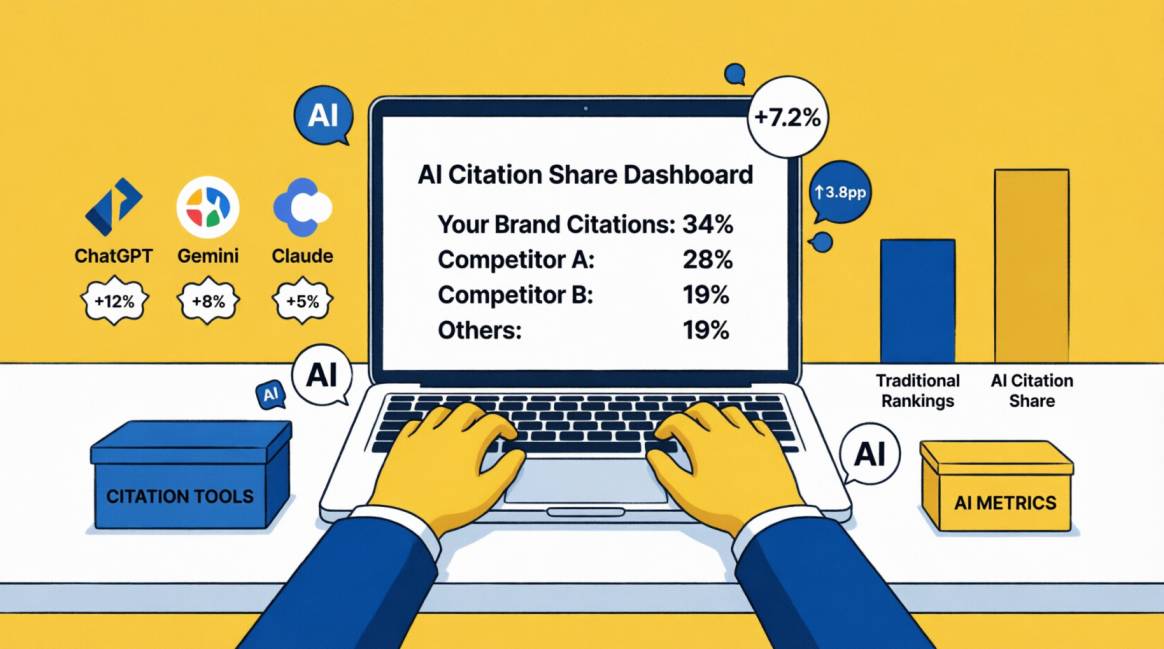
AI Citation Share is the metric that fills this gap. It measures how frequently your brand, content, or products are cited by AI systems when they answer queries relevant to your business — across all major platforms, for all target queries, measured consistently over time. It is not a vanity metric. It is a leading indicator of the organic visibility that traditional rankings will eventually reflect, and in some query categories it is already the more commercially significant measurement.
This guide gives you the complete AI Citation Share tracking system: what the metric is, why it matters more than rankings for an increasing proportion of commercial queries, how to measure it across six AI platforms, and how to build a monitoring routine that takes under two hours per month.
📌 What This Guide Covers;
- Why AI Citation Share is displacing traditional rankings as the primary visibility metric for many commercial queries
- The six measurement dimensions that form the complete AI Citation Share scorecard
- Platform-by-platform tracking guide: Google AI Overviews, Perplexity, ChatGPT, Gemini, Copilot, and brand visibility monitoring
- The monthly AI Citation Share testing protocol: 90 minutes per month, structured, repeatable
- How to diagnose gaps: what a low citation share on specific queries tells you about your content strategy
- The AI Citation Share reporting template for marketing teams and executive stakeholders
Section 1: Why AI Citation Share Matters More Than Rankings for Many Queries
The Visibility Layer Shift
Traditional SEO measures visibility through ranking position: position 1 on a given keyword means maximum exposure, with CTR declining as position falls. This model assumed that the SERP was a ranked list of blue links, and that users worked through that list from top to bottom. That assumption is no longer correct for 40% of searches.
When a Google AI Overview appears above the organic results for a query, it occupies a visual position that no organic ranking can match. The AI Overview is not position 1 — it is position zero, spanning the full width of the page above all traditional results. A brand cited in the AI Overview earns the most prominent visibility on the page. A brand ranked position 1 in the blue links below the AI Overview earns less visibility than the cited brand.
For queries where AI Overviews appear, AI Citation Share is not a supplementary metric to rankings — it is the primary visibility metric. A brand with no AI citation and a position-3 ranking is less visible than a brand with an AI citation and a position-7 ranking. This relationship will only become more pronounced as AI Overview coverage expands.
The Dark Traffic Problem Makes Rankings Misleading
AI-referred traffic overwhelmingly lands in your Direct channel in GA4 — not in Organic Search. When Perplexity, ChatGPT, or Gemini sends a user to your website, the referrer header is usually stripped, producing a Direct session with no attribution. This means: your organic rankings can be declining while your AI Citation Share is growing — and your GA4 organic channel will show a traffic decline that misrepresents your actual search visibility.
AI Citation Share monitoring reveals the traffic your analytics cannot see. A brand whose rankings dropped from position 2 to position 8 but whose AI Citation Share increased from 10% to 60% of target queries has not lost visibility — it has shifted visibility channels. Without AI Citation Share tracking, that shift looks like a traffic decline. With it, it looks like the strategic reallocation it actually is.
The Commercial Compounding Effect
AI citations produce a compounding commercial effect that traditional rankings do not. When an AI system cites your brand in its response to a user query, three things happen simultaneously: the user sees your brand recommended by a trusted AI system (brand credibility signal), they may click through to your site (direct traffic signal), and they may subsequently search your brand name directly (branded search signal). The branded search signals, in turn, strengthen your entity authority in Google's Knowledge Graph, which improves your future AI citation eligibility. The compoudnd cycle accelerates over time.
Section 2: The Six AI Citation Share Metrics
AI Citation Share is not a single number — it is a six-dimensional measurement framework. Each dimension captures a different aspect of your AI visibility and tells you something different about where gaps exist and where investment is producing results.
| Metric | Data Source | Frequency | What It Measures | What Movement Signals |
|---|---|---|---|---|
| AI Overview Impressions | Search Console → Performance → AI Overviews | Weekly | Number of times your pages appeared in an AI Overview feature, regardless of whether the user clicked | Rising impressions = AI systems are considering your content for synthesis. Flat impressions despite growing search volume = content quality or schema gap. |
| AI Overview Estimated Clicks/CTR | GA4 (via GTM Text Fragment tracking) + Standard GSC Query Data | Monthly | Monthly | Estimated click-through behavior from AI Overview features. | Note: Google's native Generative AI report currently only exposes impression data. To estimate CTR, teams must look for a divergence in standard GSC click vs. impression data or use GTM to track URL text fragments |
| AI Referral Sessions | GA4 → Traffic Acquisition → filter by Source: perplexity.ai, chat.openai.com, gemini.google.com, bing.com (Copilot) | Monthly | Sessions arriving from AI platform domains | Growing AI referral sessions = citation frequency increasing on platforms that pass referrer headers. Flat despite known citations = most AI referrals still landing in Direct. |
| Manual Citation Rate | Shared tracking spreadsheet: queries tested ÷ queries returning your citation | Monthly | % of manually tested target queries returning your content as a cited source across 3+ AI platforms | This is your primary AI Citation Share metric. A citation rate above 50% of target queries across major platforms = strong GEO position. Under 20% = significant gap. |
| Brand Visibility in AI Responses | Manual test: prompt 'best [service] in [market]' — is your brand mentioned? | Quarterly | Whether your brand name appears in AI-generated category recommendations, with or without a source link | Brand name appearance without a source link = entity recognition without content citation. Still commercially valuable — users who see your brand recommended may search directly. |
| Competitor Citation Share | Same manual test — how often does each competitor appear in AI responses for your target queries? | Monthly | % of tested queries where each tracked competitor appears in AI citations | Rising competitor citation share on your target queries = they are investing in GEO. Analyse their content structure against your CITE Framework gaps. |
Section 3: Platform-by-Platform Tracking Guide
Each major AI platform provides different data through different channels. The tracking approach varies by platform — some provide quantitative reporting through native tools, others require manual testing. Here is the complete tracking approach for each platform:
| Platform | Data Available | How to Track It | Frequency |
|---|---|---|---|
| Google AI Overviews | Search Console → Performance → Search Appearance → AI Overviews. Shows impressions and top pages appearing within AI Overviews and AI Mode. Note: Clicks and CTR are not yet broken out separately in this view and remain blended in your overall Web results. | Available in Search Console now (2026). Set date range to last 28 days. Filter by your top 20 target queries to see which generate AI Overview impressions. | Weekly — AI Overview coverage is expanding rapidly; weekly monitoring catches changes faster than monthly. |
| Perplexity AI | Direct manual prompting. Perplexity is the most citation-transparent AI platform — it shows every source it used and the exact text extracted. No API reporting available. | Prompt your 10 target queries directly in Perplexity. Screenshot or log which URLs are cited. Perplexity also sends some referral traffic — check GA4 for sessions from perplexity.ai. | Monthly manual test + ongoing GA4 referral monitoring. |
| ChatGPT (web browsing) | Manual prompting with web browsing enabled. ChatGPT's source display is less consistent than Perplexity — sources appear inline or in footnotes depending on the query type. | Test target queries in ChatGPT with GPT-4o and web browsing enabled. Note which domains appear in citations. GA4: filter for sessions from chat.openai.com. | Monthly manual test. GA4 referral tracking ongoing. |
| Google Gemini | Manual prompting in Gemini. Gemini often does not display source links for synthesised answers — entity recognition via Knowledge Graph is more important than direct citation tracking for this platform. | Prompt target queries in Gemini. Assess whether your brand is mentioned by name in responses — brand name appearance (with or without a link) confirms entity recognition. | Monthly. Focus on brand name appearance, not link citations. |
| Microsoft Copilot | Manual prompting. Copilot cites sources more consistently than Gemini. Check Bing Webmaster Tools for structured data validation — Copilot reads Bing's index. | Prompt in Copilot. Note domain citations. Bing Webmaster Tools: check Search Performance → Copilot Impressions if available in your account. | Monthly manual test. |
| Brand-prompted AI searches | Track how AI systems describe your brand when directly searched: 'Who is [Brand Name]?' 'What does [Brand] do?' These responses reveal your entity authority score in each AI system's knowledge representation. | Prompt brand name queries in all 5 platforms. Document the response: Is your brand mentioned? Is the description accurate? Does it cite your primary services/products correctly? | Quarterly — brand description accuracy changes more slowly than citation frequency. |
Section 4: The Monthly AI Citation Share Testing Protocol
Manual testing is the foundation of AI Citation Share tracking because most AI platforms do not provide reporting interfaces. The protocol below takes approximately 90 minutes once per month — 30 minutes for platform testing, 30 minutes for data logging and comparison, and 30 minutes for gap analysis and action planning.
Step 1 — Define Your Target Query Set (One-Time Setup, 30 Minutes)
Create a shared spreadsheet with two tabs: Query List and Monthly Results. In the Query List tab, add your 10–15 most commercially important target queries — the questions your target customers type when searching for what you offer. Structure each query as it would appear in a conversational AI prompt:
- Informational: 'How do I choose the best SEO agency in [your market]?'
- Commercial investigation: 'What are the best [your service/product category] in [your market]?'
- Brand-aware: 'What does [your brand name] offer?' / 'Is [your brand name] reputable?'
- Problem-to-solution: 'How do I [problem your product solves]?'
Include 2–3 queries at each intent level. More than 15 queries makes the monthly testing protocol too long to sustain. Fewer than 10 queries produces insufficient data to identify patterns.
Step 2 — Run the Monthly Platform Test (30 Minutes)
On the first Monday of each month, open the following in separate browser tabs: Google (for AI Overview testing), Perplexity.ai, ChatGPT (with GPT-4o and web browsing enabled), Google Gemini, and Microsoft Copilot. For each query in your Query List:
- Type the query into each platform. Do not copy-paste — type it as a user would, in conversational language.
- Record in your Monthly Results tab: (a) Did an AI answer appear? (b) Was your brand cited — with link? Without link? (c) Which competitor(s) were cited instead? (d) What specific text or data was cited from your content or theirs?
- Screenshot any citation of your brand or any citation of a competitor on your core commercial queries — these screenshots are your monthly citation evidence base.
Step 3 — Calculate Your Monthly Citation Rate
Your Citation Rate for the month = (number of queries returning a citation of your brand across all tested platforms) ÷ (total queries tested × total platforms tested) × 100. Example: 10 queries tested across 5 platforms = 50 total test instances. Your brand appeared in 23 of them. Citation Rate = 46%. Track this monthly. A rising citation rate over consecutive months confirms GEO investment is working. A plateau after an initial rise suggests a content quality ceiling — the CITE Framework audit should identify the specific barrier.
Step 4 — Gap Analysis (30 Minutes)
For each query where a competitor was cited and you were not, answer four questions:
- What specific content did the AI cite from the competitor? (Open the cited page and identify the cited section)
- Is that content type present on your equivalent page? (FAQ section, original data, answer-first structure)
- Does your equivalent page have FAQPage schema and Article schema with a current dateModified?
- Is your brand's entity recognition strong enough for this AI platform? (Check sameAs completeness, Wikidata entry)
The answer pattern across these four questions points to a specific CITE Framework pillar gap: Citability (entity signals missing), Information Gain (original content missing), Trustworthiness (schema freshness missing), or Extractability (content structure missing). Address the identified gap on the relevant pages in the following month.
Section 5: Reporting AI Citation Share to Stakeholders
AI Citation Share data is valuable to marketing teams. It is very valuable to executive stakeholders — because it provides the forward-looking visibility metric that traditional rankings cannot. Rankings tell you where you are in the SERP today. AI Citation Share tells you whether the AI systems that are increasingly mediating information discovery are treating your brand as an authoritative source.
The Executive One-Pager Format
Present AI Citation Share data to senior stakeholders in three numbers per reporting period:
- Citation Rate: % of target queries returning your brand citation across all platforms (e.g., 'We are cited in 46% of our target query tests — up from 31% last month')
- Competitive Position: How your citation rate compares to your top two competitors on the same query set (e.g., 'Competitor A cited in 62% of the same queries, Competitor B in 28%')
- AI Overview Impressions (from Search Console): Total AI Overview impressions for the month vs prior month (quantitative, directly from Google's data)
These three numbers tell a complete story: where you are, where you stand vs competition, and whether Google specifically is increasing your AI visibility. They are defensible — backed by primary data from Google's own reporting and your own testing records — and they are strategically meaningful in a way that a keyword ranking position chart is not.
Connecting Citation Share to Revenue
The most persuasive executive framing connects AI Citation Share to commercial outcomes. As your Citation Rate grows, monitor these parallel metrics in GA4: Direct channel traffic to key landing pages (AI-referred sessions often appear here), branded search volume in Search Console (AI recommendations drive branded queries), and conversion rate on sessions that originated from AI-referred traffic (identifiable when referrer headers are passed from perplexity.ai or chat.openai.com).
A brand that can show: 'Our AI Citation Rate grew from 20% to 55% over six months; simultaneously, branded search volume grew 34%; Direct traffic to our service pages grew 28%; and AI-attributed referral sessions (perplexity.ai + chat.openai.com) grew 180%' has built a credible commercial case for GEO investment that no rankings dashboard can replicate.
Section 6: The AI Citation Share Monitoring Checklist
| MONTHLY AI CITATION SHARE MONITORING ROUTINE | |
|---|---|
| ☐ | Search Console → Performance → Search Appearance → AI Overviews: record total impressions and featured URLs for the month. Isolate corresponding query clicks via standard performance reports to estimate traffic impact. |
| ☐ | GA4 → Traffic Acquisition: filter for sessions from perplexity.ai, chat.openai.com, gemini.google.com. Record session count. Compare to prior month. |
| ☐ | Manual platform test: prompt all 10–15 target queries in Google (AI Overviews), Perplexity, ChatGPT (web browsing), Gemini, and Copilot. Record results in your Monthly Results tab. |
| ☐ | Calculate monthly Citation Rate: (citations received ÷ total test instances) × 100. Record in your Citation Rate trend tracker. |
| ☐ | Gap analysis: for each query where a competitor was cited instead of you — identify the CITE Framework pillar gap (Citability, Information Gain, Trustworthiness, Extractability). |
| ☐ | Assign one gap-fix action for the following month: one specific content or schema improvement on one specific page. Small, targeted improvements are more attributable than sweeping site-wide changes. |
| ☐ | Quarterly: Run brand visibility test ('What is [Brand]?' / 'What does [Brand] offer?') across all 5 platforms. Assess accuracy and completeness of AI brand descriptions. Submit corrections via schema updates and Wikidata entry revisions if descriptions are inaccurate. |
Conclusion: The Dashboard You Build Today Defines the Visibility You Measure Tomorrow
Traditional SEO metrics — rankings, organic sessions, domain authority — were built for a SERP that no longer describes 40% of searches. They are not wrong. They remain important. But they are incomplete in 2026 in a way they were not in 2022.
AI Citation Share fills the gap. It measures the visibility that traditional analytics cannot see: the brand recommendations in AI answers, the citations in AI Overviews, the entity recognition in Knowledge Graph queries, and the referral sessions that land in your Direct channel because no AI platform passes a referrer header. Building this measurement infrastructure now — while the metric is still novel and most competitors are not tracking it — is a genuine competitive intelligence advantage.
The monthly testing protocol in this guide takes 90 minutes. The spreadsheet takes an afternoon to build. The competitive intelligence it produces — knowing which queries your competitors are being cited for that you are not, and exactly why the gap exists — is not available from any paid tool, any agency report, or any platform dashboard. It is available only to the teams that build the discipline of measuring what their analytics currently misses.
📋 Summary: AI Citation Share — At a Glance
- AI Citation Share measures how frequently your content is cited by AI systems across target queries — the primary visibility metric for the 40% of searches now featuring AI Overviews.
- Six measurement dimensions: AI Overview Impressions (Search Console), AI Overview CTR (Search Console), AI Referral Sessions (GA4), Manual Citation Rate (monthly testing), Brand Visibility in AI Responses (quarterly), Competitor Citation Share (monthly).
- Platform tracking: Google AI Overviews (quantitative, Search Console), Perplexity (manual, most transparent), ChatGPT (manual + GA4 referral), Gemini (manual, brand visibility focus), Copilot (manual + Bing Webmaster Tools).
- Monthly protocol: 90 minutes — 30 min platform testing, 30 min data logging, 30 min gap analysis. Run on the first Monday of each month.
- Citation Rate calculation: (citations received ÷ total test instances) × 100. Benchmarks: <20% = significant gap, 20–50% = emerging, 50–70% = competitive, >70% = category authority.
- Gap diagnosis: when a competitor is cited and you are not — check the four CITE Framework pillars (Citability, Information Gain, Trustworthiness, Extractability) against the cited competitor page.
- Executive reporting: three numbers — Citation Rate, Competitive Position, AI Overview Impressions. Connect to commercial outcomes via branded search growth, Direct traffic to key pages, and AI referral sessions.
Frequently Asked Questions
Questions readers ask about this topic
The FAQs below are pulled directly from this article's structured content and are designed to help readers quickly find answers to common questions related to the topic.
What is a good AI Citation Share rate?
Our AI Citation Share is growing but organic traffic is not. Is GEO replacing SEO?
We do not have time to test 10 queries across 5 platforms every month. What is the minimum viable tracking?

Founder, Technical Analyst
Oladoyin Falana is a certified digital growth strategist and full-stack web professional with over five years of hands-on experience at the intersection of SEO, web design & development. His journey into the digital world began as a content writer — a foundation that gave him a deep, instinctive understanding of how keywords, content and intent drive organic visibility. While honing his craft in content, he simultaneously taught himself the building blocks of the modern web: HTML, CSS, and React.js — a pursuit that would eventually evolve into full-stack Web Development and a Technical SEO Analyst.
Follow me on LinkedIn →