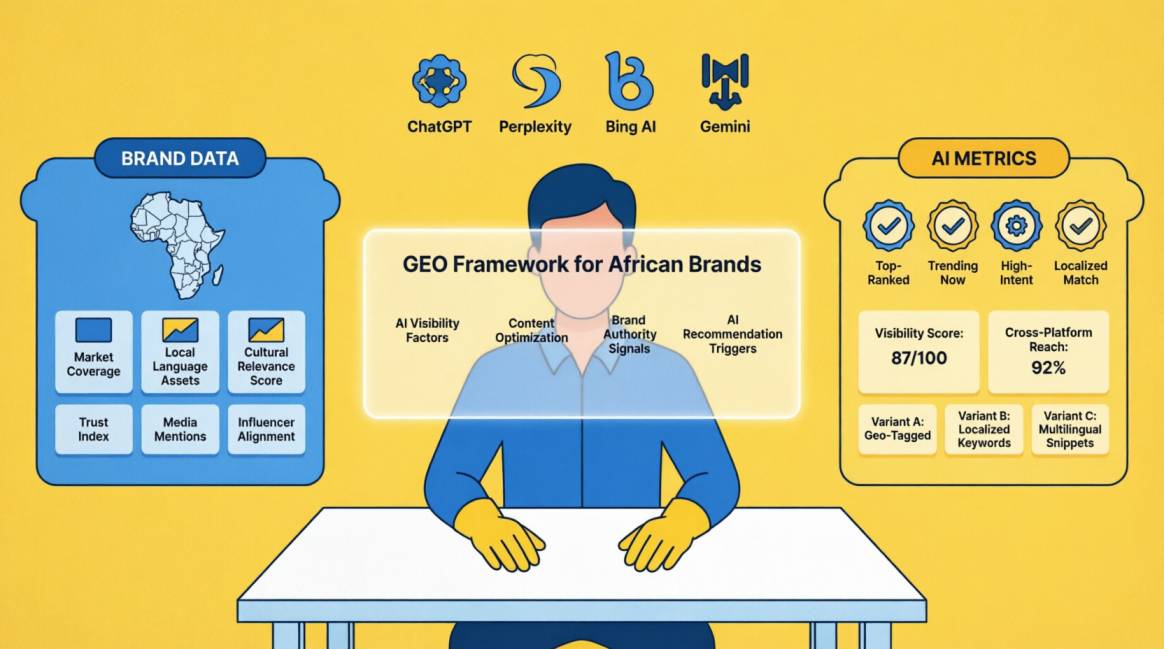
GEO for African Brands: How to Get ChatGPT and Perplexity to Recommend Your Business

AI systems cite what they can find, verify, and extract. If they cannot find structured, credible, African-specific information about your business, they recommend the Western alternative.
Table of Contents
Table of Contents
AI Systems Are Being Asked About Your Business — and They Don't Know You Exist
Right now, someone in Lagos, Nairobi, Accra, or Johannesburg is typing a question into ChatGPT or Perplexity that your business should be answering. 'What is the best digital marketing agency in Nigeria?' 'Which logistics company is most reliable for Kenya e-commerce?' 'What are the leading fintech companies in Ghana?'
AI systems are generating answers to these queries. And for most African businesses — regardless of how established they are — those answers do not include them. The brands being recommended are often Western alternatives, global directories with thin African data, or the rare African business that stumbled into GEO compliance.
This is not a technology problem. It is an information problem with a specific, solvable solution. AI systems cite what they can find, verify, and extract. If they cannot find structured, credible, African-specific information about your business, they cannot recommend it. If you provide that information in the format AI systems are built to read, they can recommend you — often within weeks of first implementation.
Semola Digital achieved Google AI Overview citation within 30 days of launching on a brand new domain. That result — achieved through correctly structured, entity-verified, information-rich content — is replicable for any African brand that applies the same principles. This guide documents the process specifically for African brands, addressing the African-specific barriers and the African-specific advantages that global GEO guides ignore.
📌 What This Guide Covers:
- Why African brands are structurally absent from AI recommendations — the four specific gaps
- How ChatGPT and Perplexity differ in how they source African business content and the different approach each requires
- The five content types that earn the fastest AI citations for African brands
- The African entity-building stack: Wikidata, Organisation schema, Bing Webmaster Tools, LinkedIn, and African media
- The 90-day GEO roadmap: Month 1 (entity), Month 2 (content + structure), Month 3 (citations + monitoring)
- The African first-mover advantage: why acting in 2026 creates citation authority that competitors will take years to match
Why African Brands Are Missing From AI Recommendations
The absence of African brands from AI recommendations is caused by four specific gaps between what AI systems need to cite a source and what most African businesses currently provide.
| The Gap | What It Means | The Opportunity |
|---|---|---|
| Thin African content corpus | AI systems encountered very little high-quality structured content about African businesses during training. Queries about Nigerian fintech, Kenyan logistics, or Ghanaian e-commerce return generic global results. | First African brand per category to publish GEO-compliant content becomes the default cited authority — with almost no competition. |
| Entity recognition gap | Most African brands lack Wikidata entries, sparse Crunchbase profiles, and limited Knowledge Graph presence. AI systems cannot recommend brands they cannot verify as real entities. | A 30-minute Wikidata entry immediately builds entity recognition that fewer than 2% of African businesses have established. |
| African context scarcity | AI systems apply Western assumptions to African queries — recommending unavailable payment methods, citing inapplicable regulations, ignoring infrastructure realities. | African brands publishing locally accurate content (Naira pricing, Nigerian payment systems, CAC registration, local logistics) become the only citable African-specific source. |
| Media coverage deficit | AI calibrates entity credibility partly from editorial media coverage. African businesses receive a fraction of the coverage equivalent Western businesses receive. | One editorial mention in TechCabal, TechPoint.Africa, or BusinessDay builds more entity corroboration than 50 directory listings for an African brand. |
How ChatGPT and Perplexity Specifically Source African Content
ChatGPT and Perplexity are the two AI platforms generating the most commercially significant business recommendations in 2026. They operate very differently — and the optimisation approach for each is distinct. Understanding the difference allows African brands to prioritise the right signals for each platform.
| Feature | ChatGPT Search (OpenAI) | Perplexity AI |
|---|---|---|
| Primary retrieval method | Proprietary OAI-SearchBot crawler network + Bing web index partners | Always retrieves live web — every answer cites current sources |
| Citation transparency | Moderate — footnote-style inline citations | Highest — every source URL displayed, extracted text highlighted |
| Primary citation signal | Entity recognition (Wikidata + domain authority via Bing) | Answer-first content + specific data + FAQPage schema + recency |
| African brand optimisation | Wikidata entry + Organisation sameAs + Bing Webmaster Tools submission | Specific African market data + question headings + FAQPage schema |
| How to monitor | Prompt in ChatGPT (web browsing on). Check domain in source footnotes | Prompt directly — all sources displayed. Check GA4 for perplexity.ai referrals |
| First action for African brands | Create Wikidata Q-ID → add to Organisation sameAs → submit sitemap to Bing | Publish one deeply specific African market article with FAQPage schema |
The combined strategy: build the entity signals that ChatGPT requires (Wikidata, Organisation schema, Bing submission) and the content signals that Perplexity requires (answer-first structure, FAQPage schema, specific African market data) simultaneously. These two tracks take under a week to execute from scratch.
Five Content Types That Earn the Fastest AI Citations for African Brands
For African brands, five content types produce disproportionately fast citation results because they directly address the African content gap that AI systems are actively trying to fill. AI systems reward content that provides information they cannot find elsewhere — and African market-specific information is precisely what is missing.
| Content Type | Why AI Cites It | African Brand Application | Citation Speed |
|---|---|---|---|
| African Market Data Report | Original data cannot be reconstructed from training data — it must be sourced. African market data is extremely scarce. | Survey 50–100 clients or consumers in your sector. 'Nigerian SME Digital Payment Adoption Report 2026.' Original data from any sample size. | Fast — 2–6 weeks |
| Country-Specific How-To Guide | AI systems receive many 'how to [task] in Nigeria/Kenya/Ghana' queries with few accurate local sources. | 'How to Register a Business in Nigeria (CAC, 2026).' 'How to Set Up Paystack for WooCommerce.' Hyper-local, hyper-specific. | Moderate — 4–8 weeks |
| African Market Option Comparison | 'Best mobile money in Nigeria?' 'Fastest Lagos delivery service?' — queries with thin, outdated, or Western-biased existing sources. | Compare specific African-market options with local pricing, local availability, local customer experience data. | Fast — strong first-mover advantage where competition is thin |
| Named Proprietary Framework | A named methodology that is unique to your brand is permanently citable by name. AI systems must cite the originator. | Name and publish something original: 'The Lagos SME Readiness Score.' 'The Nairobi Digital Adoption Matrix.' Semola Digital's GEO Maturity Matrix was cited by name in 30 days. | Very fast — no competing source exists |
| Expert Commentary on African News | When breaking African business news occurs, AI systems seek expert African commentary and find very little. | Rapid-response analysis within 48 hours of CBN policy changes, Naira movements, major African tech developments. | Fast for timely queries |
The African Entity-Building Stack
Without a verified entity presence, AI systems cannot confidently recommend your brand by name. They can cite your content, but they cannot recommend your brand without verifying that you exist as a credible entity.
Step #1 — Wikidata Entry (30 Minutes, Free)
Navigate to wikidata.org and create a new item for your brand. Required fields: Label (exact canonical brand name), Description (one sentence: '[Brand] is a [category] company based in [city], [country]'), Official website, Country, Industry, and social media profile URLs. Note your Q-ID — this is the entity anchor that links your website entity to your Knowledge Graph entry.
Step #2 — Organisation Schema on Your Homepage
Implement via Rank Math Pro. Required properties: @type: Organization, name (must match Wikidata label exactly), url, logo, foundingDate, address (PostalAddress with addressCountry: NG/KE/GH/ZA), sameAs array (Wikidata Q-URL, LinkedIn, Facebook, Twitter/X, Crunchbase if available). Validate in Google Rich Results Test — zero errors before proceeding.
Step #3 — Bing Webmaster Tools (10 Minutes, Free)
Microsoft Copilot reads Bing's index. Submitting your sitemap to Bing Webmaster Tools takes 10 minutes and immediately opens Copilot citation eligibility — a major AI platform that most African brands have never activated. Navigate to bing.com/webmasters, verify your site, submit your XML sitemap, and validate your structured data in Bing's validation tool.
Step #4 — LinkedIn Company Page Completeness
ChatGPT and Perplexity both evaluate LinkedIn as a high-authority corroboration source. A complete LinkedIn company page — exact canonical brand name, industry, company size, founding date, website URL — strengthens your entity profile. LinkedIn is indexed by both Google and Bing, creating additional corroboration pathways.
Step #5 — African Media Editorial Coverage
One editorial mention in TechCabal, TechPoint.Africa, BusinessDay Nigeria, Nairametrics, or Ventures Africa provides more entity corroboration for an African brand than 50 directory listings. AI systems evaluate the credibility of sources that corroborate an entity — African media citations are uniquely valuable because they are the only sources with authentic African market authority.
Writing Content That African AI Citations Are Built From
The entity stack tells AI systems your brand exists and is credible. The content layer tells them what you know. For African brands, content carries a structural advantage: authentic, first-hand African market expertise that no Western competitor can replicate.
The African Context Advantage
When a user asks ChatGPT 'what payment methods should I offer on my Nigerian e-commerce store?', the AI system needs specific, accurate information about Nigerian payment infrastructure. A UK-based guide mentioning Stripe is useless. A Nigerian-authored guide covering Paystack integration, Flutterwave setup, USSD payment options, and bank transfer handling is exactly what the AI needs — and cannot find from any Western source.
Three Content Rules for African AI Citation
Rule 1 — Be specific about African context: Write 'how to set up a Nigerian WooCommerce store with Paystack, ₦ pricing, and Lagos delivery' — not 'how to set up an online store.' Reference specific Nigerian/Kenyan/Ghanaian payment systems, regulations, currencies, and logistics providers.
Rule 2 — Provide original African data: Any original survey, market analysis, or aggregated observation specific to an African market is extremely high-value for AI citation. A 50-person Nigerian consumer survey beats 1,000 words of well-written generic content for citation rate.
Rule 3 — Structure for extraction: Question-format headings, answer-first paragraphs (first sentence answers the heading question directly), FAQPage schema on all key pages. Without structure, good African content is invisible to AI extraction systems.
90-Day GEO Roadmap for African Brands
| Month 1: Entity Foundation | Month 2: Content + Structure | Month 3: Citations + Monitor |
|---|---|---|
| • Create Wikidata entry with Q-ID (30 min, free) • Implement Organisation schema on homepage with sameAs array including Wikidata Q-ID • Submit sitemap to Bing Webmaster Tools (10 min, free) • Verify PerplexityBot and OAI-SearchBot NOT blocked in robots.txt • Assign named authors to all content — create bio pages with credentials and Article schema • Complete LinkedIn company page with exact canonical brand name • Run AI Citation baseline: test top 10 queries across ChatGPT, Perplexity, Gemini | Publish first African Market Data article with original survey or analysis data • Add FAQPage schema to top 5 content pages — minimum 4 Q&As per page, 40–80 word answers • Rewrite section openings on top 10 pages to answer-first format • Add datePublished and dateModified to all Article schema • Publish one country-specific how-to guide addressing African market context • Set up Search Console AI Overview impressions monitoring | Run monthly citation test across ChatGPT, Perplexity, Gemini, and Google AI Mode • Calculate Citation Rate: citations ÷ total test instances × 100 • Identify gap queries: open competitor cited pages, identify what they have that you do not • Publish one named proprietary framework specific to your sector and African market • Pitch data report to TechCabal, TechPoint.Africa, or sector-relevant African media •Check Search Console AI Overview impressions vs Month 1 baseline |
Implementation Strategy: Monitoring Your AI Citation Progress
Optimizing your site for Generative Engine Optimization (GEO) is only half the battle; you must actively track whether AI engines are actually crawling, understanding, and recommending your brand. Because traditional SEO tools cannot accurately measure conversational search share, tracking your visibility across ChatGPT Search, Perplexity, and Google AI Overviews requires a new framework.
Use the monthly checklist and diagnostic workflow below to audit your performance, calculate your conversational citation rate, and spot gaps where competitors might be outranking you in AI responses.
| MONTHLY AI CITATION MONITORING FOR AFRICAN BRANDS | |
|---|---|
| ☐ | Test your top 10 target queries in ChatGPT (web browsing on), Perplexity, Google AI Mode, and Gemini — first Monday of each month |
| ☐ | Record: Did an AI answer appear? Was your brand cited (with link / without link / not at all)? Which competitor was cited instead? |
| ☐ | Calculate Citation Rate: citations received ÷ total test instances × 100. Track month-over-month trend. |
| ☐ | Search Console: check AI Overview impressions vs prior month. Growing impressions confirm GEO momentum. |
| ☐ | GA4: filter for sessions from perplexity.ai, chat.openai.com, gemini.google.com. Record and track monthly. |
| ☐ | Gap diagnostic: for each query where a competitor is cited instead of you — identify the specific CITE Framework gap (Citability / Information Gain / Trustworthiness / Extractability) |
| ☐ | Quarterly: Prompt 'Who is [your brand]?' across all five platforms. Is your brand described accurately? Submit Wikidata corrections for any inaccurate AI descriptions. |
The African GEO Window is Open — and Will Not Stay Open Forever
The African GEO opportunity exists because fewer than 2% of African businesses have GEO-compliant content. That number will not stay at 2% indefinitely. The businesses that implement the entity stack, publish African market-specific structured content, and build editorial corroboration in 2026 will establish citation authority that competitors will spend 2027 and 2028 trying to replicate.
ChatGPT and Perplexity are being asked about African businesses today. The current answers are often wrong, outdated, or absent. The brands that fill that gap with correctly structured, expert-attributed, African-specific content become the cited authorities — compounding the advantage with every citation that drives more branded search, more entity recognition, and more future citations.
Start with Step 1 of the entity stack: create your Wikidata entry today. It takes 30 minutes. It costs nothing. It is the single most impactful foundational GEO action available to any African brand in 2026.
📋 Summary: Geo For African Brands
- Four gaps causing African brand absence from AI: thin African content corpus, entity recognition gap, African context scarcity in AI training, media coverage deficit.
- ChatGPT: entity-first (Wikidata + Organisation schema + Bing Webmaster Tools). Perplexity: content-first (answer-first structure + FAQPage schema + specific African market data).
- Five content types for fastest African citations: African market data reports, country-specific how-to guides, African market comparisons, named proprietary frameworks, expert African news commentary.
- African entity stack: Wikidata Q-ID → Organisation schema with sameAs → Bing Webmaster Tools → complete LinkedIn page → one African media editorial mention.
- Three content rules: (1) Specific African context — local currency, payment systems, regulations. (2) Original African data — any survey or analysis is citation gold. (3) Structured for extraction — FAQPage schema, answer-first paragraphs, question headings.
- 90-day roadmap: Month 1 (entity foundation) → Month 2 (content + structure) → Month 3 (citation + monitoring).
- The African first-mover window: fewer than 2% of African businesses have GEO-compliant content. The brands that build citation authority in 2026 will be the recommended authorities in 2027 and 2028.
Frequently Asked Questions
Questions readers ask about this topic
The FAQs below are pulled directly from this article's structured content and are designed to help readers quickly find answers to common questions related to the topic.
How long does it take for an African brand to start appearing in ChatGPT recommendations?
Our business operates across multiple African countries. How do we handle GEO for each market?
A Western competitor is appearing in AI recommendations for our African market queries. How do we displace them?

Founder, Technical Analyst
Oladoyin Falana is a certified digital growth strategist and full-stack web professional with over five years of hands-on experience at the intersection of SEO, web design & development. His journey into the digital world began as a content writer — a foundation that gave him a deep, instinctive understanding of how keywords, content and intent drive organic visibility. While honing his craft in content, he simultaneously taught himself the building blocks of the modern web: HTML, CSS, and React.js — a pursuit that would eventually evolve into full-stack Web Development and a Technical SEO Analyst.
Follow me on LinkedIn →