How to Do a Competitor Content Analysis: A Step-by-Step Guide That Actually Moves Rankings

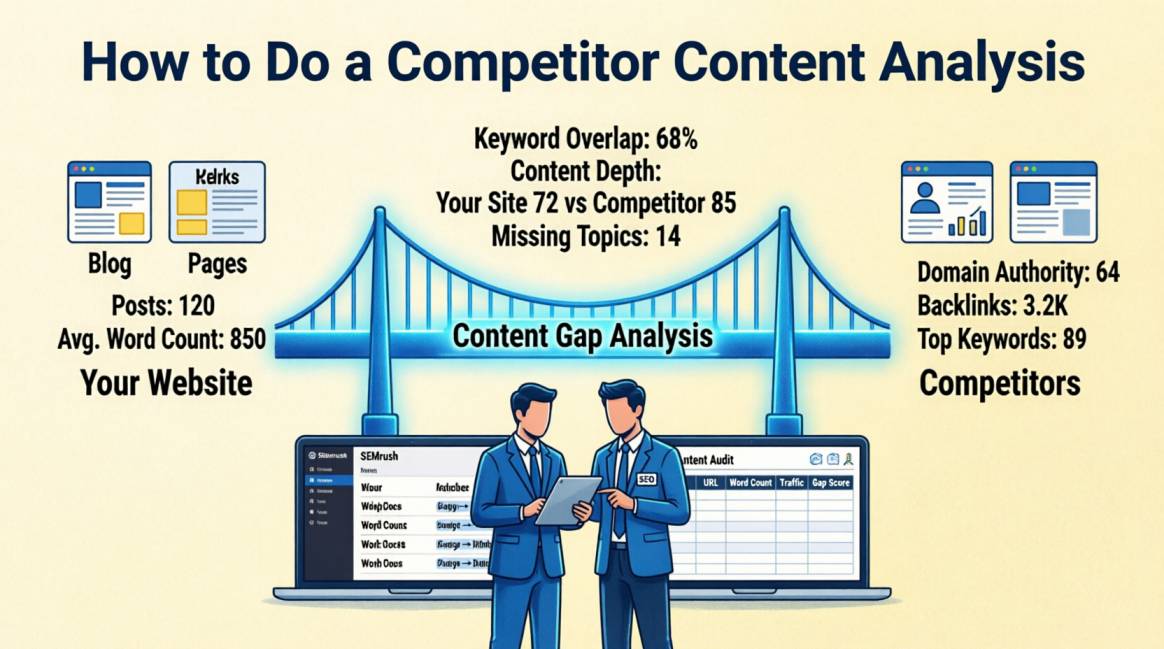
Competitor content analysis is not an exercise in understanding what your competitors publish so you can publish something similar. It is an exercise in understanding what your competitors publish so you can identify what they have not published, what they have published poorly, and what searcher needs remain unmet after reading every result currently on the page.
Table of Contents
Table of Contents
Why Most Competitor Content Analyses Produce Nothing Actionable
The standard advice for competitor content analysis goes like this: find your competitors, look at their top pages, note the topics they cover, and publish something similar. That advice is not wrong. It is simply incomplete — and the incompleteness is expensive, because it leads to content that occupies the same space as what already exists rather than content that displaces it.
Google’s 2022 Helpful Content update and its 2023 core updates institutionalised a concept the search quality team had been working toward for years: information gain. The idea, drawn from a 2022 patent application, is that a page’s value is not measured in isolation but relative to the information already available on the results page. A page that contains everything the top results already contain, but nothing they do not, is not a useful result. A page that adds something — a unique dataset, a practitioner perspective, a gap that the top results collectively ignore — earns preferential treatment.
This reframes what competitor content analysis is for. It is not an exercise in understanding what your competitors publish so you can publish something similar. It is an exercise in understanding what your competitors publish so you can identify what they have not published, what they have published poorly, and what searcher needs remain unmet after reading every result currently on the page.
That is the standard this guide is built around. Five layers, each deeper than the last, culminating in a specific information-gain inventory for every piece of content you commission.
The Framework: Five Layers, One Direction

The five layers are not optional stages. Each depends on the previous one. You cannot identify meaningful gaps (Layer 3) without a thorough content audit (Layer 2). You cannot extract information-gain signals (Layer 5) without understanding intent coverage (Layer 4). Work through them in sequence.
Layer 1: Identify Your Real Search Competitors
Your business competitors and your search competitors are not the same list. The law firm you compete with for clients may not appear anywhere near you on Google. A blog run by a solo practitioner may outrank you for every commercial query you care about. Your search competitors are the sites that occupy the positions you want — and they are identified from the SERP, not from your industry knowledge.
Step 1.1: Map the SERP for your ten most important target queries
Open an incognito window and search each of your target keywords. Record every domain that appears in the top ten organic results for each query. Do not include the searches yourself — use GSC’s average position data as your ranking map so you are working from aggregate position data rather than a single session.
At the end of this exercise, you will have a table with your ten target queries across the top and the top-ten ranking domains down the side. Count how many queries each domain appears in. Any domain appearing in five or more of your target queries is a direct search competitor — regardless of whether you would recognise them as a business rival.
Step 1.2: Use SEMrush or Ahrefs to surface organic overlap
Both SEMrush and Ahrefs have a ‘competitors’ or ‘organic competitors’ report that identifies domains ranking for the same keywords as your site. These tools do a different job from the manual SERP mapping: they surface competitors across your full keyword universe rather than just your ten target queries. Sort the results by overlap: the domains with the highest percentage of shared keywords are the competitors whose content architecture most closely mirrors your intended territory.
Target three to five competitors for deep analysis. More than five makes the subsequent layers unmanageable. Select the domains that rank consistently in the top five across your priority queries — these are the ceiling you are trying to break through.
Layer 2: Audit Their Content Architecture
Once you have identified your three to five search competitors, the Layer 2 audit maps what they have built. You are looking at three dimensions: the topics they cover, the structure of their content clusters, and the technical quality signals embedded in each piece.
Step 2.1: Crawl their site
Use Screaming Frog (set it to crawl external sites) or a tool like Sitebulb to crawl each competitor domain. Export the full URL list. Filter to their blog, resource section, or content hub. Sort by inbound internal links descending — the pages with the most internal links are the pages they have built authority around. These are their pillar pages.
Look at the URL pattern. A site with /blog/keyword-slug/ structure without thoughtful internal linking strategy is publishing isolated articles. A site with /seo/keyword-slug/ and /web-design/keyword-slug/ has organised its content by topic cluster. The second architecture compounds authority. If your competitors have built clusters and you have not, that structural gap is as significant as any content gap. However, beyond the URL structure, the content clustering itself and the internal linking pattern dictate topical authority.
Step 2.2: Score each competitor’s top twenty pages
For each competitor, pull their top twenty pages by organic traffic (visible in Semrush or Ahrefs). For each page, record:
| Signal | What to Record | Why It Matters |
|---|---|---|
| Word count | Approximate length (tools show this or use a word counter extension) | Sets the depth benchmark for your equivalent content |
| H2 structure | The exact H2 headings the page uses | Reveals how they frame the topic — and what sub-questions they answer |
| Answer format | Does it open with a direct answer? Is there a summary callout? FAQ block? | Signals their featured-snippet and AI-citation optimisation maturity |
| Structured data | Run the URL through Google’s Rich Results Test | Schema presence predicts SERP feature eligibility you can match or exceed |
| Internal links | Which pages link to this page? Which does it link to? | Reveals cluster architecture and authority flow direction |
| Estimated traffic | Monthly organic sessions (Semrush/Ahrefs ‘Traffic’ column) | Calibrates the return on investment in your equivalent piece |
| Ranking queries | Which queries does this page rank for? (Semrush: Organic Research → page URL filter) | The queries you must match or beat, and the ones they’ve missed |
| Backlink count | Total referring domains to this specific page | Sets the off-page authority benchmark for competing with this page |
Step 2.3: Map their publishing cadence
Check their blog or resource section and note when articles were published and when they were last updated. A competitor who published 40 articles in 2022 and has published 3 since is not active and can be easily edged out of competition, because their topical authority is static. A competitor publishing two to three quality pieces per month is building a moat.
Publication cadence is a gap signal. A competitor who publishes infrequently on topics you can publish consistently is a competitor you can eventually outpace on freshness and topical depth, even if they have a domain authority advantage today.
Layer 3: Find the Three Types of Content Gap
Content gaps fall into three categories. Most practitioners find only the first. The second and third are where the higher-value opportunities live.

Gap Type 1: Topics your competitors rank for that you do not
This is the most obvious gap and the one every tool surfaces first. In Semrush, this is the Keyword Gap report: enter your domain and up to four competitors, click Compare, and filter the results to show ‘Missing’ — keywords your competitors rank for where you have no ranking at all. In Ahrefs, this is the Content Gap report under Site Explorer.
The critical next step: filter by intent and commercial relevance. Not every keyword your competitors rank for is a keyword you should target. A legal firm should not chase a competitor’s ranking for ‘how to file a small claims suit yourself’ if their practice does not serve self-represented litigants. Filter relentlessly for queries that the right potential client would be asking at a stage in their buying journey where you can genuinely help them.
Gap Type 2: Topics you both cover, but they cover poorly
This is the gap most practitioners miss because the tool surfaces it as ‘you are already competing’ rather than as an opportunity. If you and a competitor both rank for a query but they rank at position 6 and you rank at position 14, both pages have a problem — but the opportunity is yours. A thorough analysis of their page will reveal what it is missing: a specific question unanswered, a format mismatch with the search intent, outdated data, thin depth on a sub-topic searchers clearly care about.
These are upgrade opportunities, not creation opportunities. Your existing page or a refreshed version of it, addressing the specific deficiency in the competitor’s content, can move up the SERP without competing against a page that is comprehensively superior to yours.
Gap Type 3: Topics neither of you covers
These are the hardest gaps to find and the highest-value ones to fill. They are queries that exist — people are searching, the People Also Ask box reveals related questions, the autocomplete suggestions point to intent — but no well-optimised page currently answers them.
Find them by reading every People Also Ask question for your target queries. Filter the GSC Performance report for queries where your site appears in positions 11–20 with high impression volume but low CTR — these are queries Google has tested your site against without finding a strong match. Look at Reddit, Quora, and LinkedIn discussions in your industry for questions people ask that no blog post has adequately answered.
When you find a Gap Type 3 topic with meaningful search volume and no strong incumbent, you have an opportunity to rank first, own the featured snippet, and be cited by AI Answer Engines before any competitor has published anything on the topic.
Layer 4: Analyse Their Intent Coverage
A competitor can rank for a hundred keywords and still be systematically failing their audience at specific funnel stages. Intent coverage analysis looks at whether their content matches what searchers actually need at each stage — informational, commercial, and transactional — and identifies where they have left intent unserved.
Step 4.1: Classify their top content by intent
Take the twenty pages you scored in Layer 2 and classify each by search intent:
- Informational: content answering ‘what is’, ‘how to’, ‘why’, ‘guide to’ queries
- Commercial: content targeting comparison, evaluation, and ‘best X’ queries — searchers deciding between options
- Transactional: content targeting ‘hire’, ‘buy’, ‘book’, ‘get a quote’ — searchers ready to act
- Local: content targeting location-specific queries
Then ask: which intent stages do they dominate? Which are absent? A competitor with 80% informational content and almost no commercial or transactional content has built an audience they are not converting. They are bringing in top-of-funnel traffic without a system to push it toward engagement. That is a structural gap — not in their topics, but in their funnel architecture.
Step 4.2: Check the format-to-intent match
A common misconfiguration: writing a long-form guide (1,800 words) for a transactional query (‘hire SEO agency Lagos’). A person ready to hire does not want a guide. They want a clear service description, a process explanation, proof of results, and a contact mechanism. A competitor with a format mismatch on a transactional query is serving the wrong content to someone who is ready to buy — and they are losing conversions as a result.
When you identify a format-to-intent mismatch in a competitor’s high-ranking page, you have a specific opportunity: match the format correctly and you do not just rank alongside them — you convert better from the same ranking position.
Step 4.3: Map the content journey
Does the competitor’s content connect? Do their informational articles link to commercial evaluation pages? Do their commercial pages link to transactional contact forms? A content cluster that guides a reader from awareness through consideration to decision is more commercially effective than the same number of articles sitting in isolation.
If your competitor’s content architecture is a collection of isolated articles with no internal journey, you have a structural advantage. By building clusters with a deliberate user journey — informational article links to commercial comparison page links to service landing pages — you create a more effective path from search to conversion.
Layer 5: Extract Information-Gain Signals
This is the layer that distinguishes an analysis that produces displaced rankings from one that produces content that sits alongside competitors unnoticed. Layer 5 asks a specific question about every competitor page you have identified as a target: what would a piece of content need to contain that this page does not, in order for Google to prefer it?

Signal 1: Original data
The single most reliable way to earn information gain is to publish data that does not exist anywhere else. This does not require a research budget. It requires the discipline to turn your own experience into evidence.
If you are an SEO agency, your client engagements are a dataset. What is the average LCP improvement after implementing fetchpriority on the hero image? What is the typical organic lead increase from adding FAQPage schema to high-impression pages? These are data points you hold that no competitor has, because they come from your specific work with real clients. They cannot be paraphrased or scraped. They make your content uniquely citable.
For a professional services firm: what percentage of your employment contract disputes involved a specific clause type? What is the average time to resolution for commercial litigation cases in your category? For a logistics company: what does the average delivery delay look like across specific Lagos routes? These data points, published with appropriate anonymisation and context, create content that no competitor can replicate without running the same work.
Signal 2: Specific gap coverage
Read every People Also Ask question for your target query. Read the comments on competitor articles. Read the Reddit and Quora discussions around the topic. You will find specific questions that the top-ranking pages do not answer — not because the questions are niched, but because the competitor did not do this analysis before writing.
Add a section to your content that answers these questions directly. Label the section clearly. Answer in the first sentence of the section, not buried in a paragraph. Google’s systems can identify that your page answers questions the competing pages do not. That is information gain in its most literal form.
Signal 3: Answer-first format with structural clarity
Featured snippets and AI citations share a structural requirement: the content must deliver its answer in a format that can be extracted and displayed independently. A 2,500-word article that buries its core answer in paragraph seven does not win featured snippets regardless of how accurate the answer is.
Every section of your content should open with its direct answer. The H2 heading poses the question. The first one to two sentences answer it. The subsequent paragraphs provide the context, evidence, and nuance. This structure serves two audiences simultaneously: the user who scans for answers and the Google system that extracts content for featured positions and AI citations.
Signal 4: E-E-A-T embedded in substance
Experience, expertise, authoritativeness, and trustworthiness are not demonstrated by a bio at the bottom of the page. They are demonstrated in the substance of the writing. A practitioner who describes a specific diagnostic they ran, a specific error message they encountered, a specific fix they deployed and the result it produced is demonstrating first-hand experience. A writer who describes the same process in generic terms without specific operational detail is not.
For every claim in your content, ask: what specific evidence do I have for this? A specific client outcome. A specific tool reading. A specific before-and-after data point. Where you have that evidence, include it. Where you do not, mark the claim as a general principle rather than a practitioner finding. The specificity of evidence is what separates content that builds E-E-A-T from content that claims it.
Signal 5: Content freshness with genuine updates
Updating dateModified and submitting a URL to GSC is not content freshness. Google can distinguish between a page that updated its schema metadata and a page that has materially expanded its content. Genuine content freshness means: new statistics from the current year replace outdated ones, new examples are added from recent developments, sections that have become less accurate are revised, and new People Also Ask questions that have emerged since the original publication are answered.
A quarterly review cycle for every high-traffic page, checking whether the content still comprehensively answers the searcher intent for its target query, protects rankings more reliably than any volume of new content production.
Turning the Analysis Into a Content Brief
A competitor content analysis is not an end product. It is an input into a content brief. The analysis findings need to be translated into specific writing instructions before they are useful to a writer or to yourself.
The information-gain inventory for each content piece
Before briefing any piece of content identified through this analysis, complete the following for that specific topic:
| Field | What to Fill In | Source in Your Analysis |
|---|---|---|
| Target keyword | The exact query this piece must rank for | Layer 3 gap audit |
| Top competitor URL | The specific page you are trying to displace | Layer 2 scoring table |
| Competitor’s word count | Approximate length of their page | Layer 2 audit |
| Competitor’s H2 structure | The exact headings they use | Layer 2 audit |
| Questions they do NOT answer | Specific unanswered PAA or community questions | Layer 5: gap coverage |
| Original data to include | Specific first-party data points only you can publish | Layer 5: original data |
| Format mismatch to correct | Is their format wrong for the intent? | Layer 4: intent analysis |
| Missing funnel connection | Which next step does their content fail to provide? | Layer 4: journey mapping |
| Structured data to add | Schema type their page is missing | Layer 2: scoring table |
| CTR optimisation target | Better title tag / meta description approach | Layer 2: SERP data |
A brief completed with this inventory is not a topic assignment. It is a displacement instruction: here is what the current ranking page contains, here is what it does not contain, and here is exactly how the new piece needs to be different in order for Google to prefer it.
The Tool Stack for Each Layer
Every step in the five-layer framework has a corresponding tool. The free tools can complete approximately 70% of the analysis. The paid tools add precision and speed but are not required for a first-pass analysis.
| Layer | Free Tools | Paid Tool Additions | Critical Output |
|---|---|---|---|
| Layer 1:Competitor ID | Google Search (incognito)GSC Performance report | Semrush Organic CompetitorsAhrefs Competing Domains | 3–5 confirmed search competitors |
| Layer 2:Content Audit | Screaming Frog (500 URL limit)Google Rich Results TestManual SERP review | Semrush Organic ResearchAhrefs Site ExplorerSitebulb | Scored top-20 pages per competitor |
| Layer 3:Gap Finding | GSC low-CTR filterPeople Also AskManual search of unserved queries | Semrush Keyword GapAhrefs Content Gap | Prioritised gap list by quadrant |
| Layer 4:Intent Analysis | SERP classification (manual)Google Search features audit | Semrush SERP Features filterAhrefs SERP Overview | Intent-format mismatch list |
| Layer 5:Info Gain | Community research (Reddit, Quora)PAA deep-diveFirst-party data review | AI overview analysis toolsContent scoring tools | Information-gain inventory per piece |
The Five Mistakes That Produce Useless Analyses
Competitor content analysis is a research discipline with specific failure modes. These are the ones that consistently produce extensive documentation that generates no content action.
1. Analysing brand competitors instead of search competitors: Your business rival and your search rival are different entities. The company you compete with for clients may rank nowhere near you. Do the SERP mapping before assuming who your search competitors are.
2. Stopping at keyword gaps without reading the pages: A keyword gap list tells you what topics to cover. It does not tell you how to cover them in a way that displaces the ranking page. Reading the actual page and identifying its specific deficiencies is what produces displacement strategy.
3. Treating word count as the primary depth signal: Matching a competitor’s 2,500 words with 2,600 words is not a competitive strategy. Information gain is not a function of length. It is a function of unique value. A 1,400-word piece with original data and gap coverage can displace a 3,000-word competitor page.
4. Ignoring format in favour of topic: A long-form guide written for a transactional query will underperform a short, clear service page on the same topic. Format must match intent. This is a Layer 4 finding — and it is only visible if you do Layer 4.
5. Running the analysis once: Search is not static. Competitors publish new content. Google updates what it considers the best result. A competitor content analysis run once and filed is a historical document. Run it quarterly for your highest-priority keywords and build the refresh triggers into your content calendar.
What This Analysis Changes
A competitor content analysis run to this depth does not produce a list of topics to write about. It produces a map of specific displacements: this competitor page, at this position, has these four specific weaknesses, and a piece built with these specific information-gain signals will outrank it.
That is a different output from ‘our competitors write about HR policy, so we should too.’ It is a specific, evidence-based instruction set that a writer can act on and a content strategist can track against SERP data. The result is content that does not just occupy space in a topic area — it earns its position by being demonstrably more useful than what it displaced.
Google has been moving toward rewarding this kind of content systematically. The Helpful Content system, the increasing sophistication of AI Overviews citations, and the weight given to E-E-A-T signals in the quality rater guidelines all point toward the same conclusion: the sites that win search in the medium term will be the ones whose content is genuinely more useful than what came before it — not the ones who publish the most or optimise the hardest.
Run this analysis. Build the information-gain inventory. Brief the content to displacement standard. Measure the results quarterly. The sites doing this work now are building a compounding advantage over those still treating content analysis as a keyword list exercise.
Continue reading:
- What Is a Content Strategy? How to Build One That Actually Drives Traffic — the system this analysis feeds into
- How to Write Content That Ranks: The Answer-First Framework — implementing information-gain signals in every piece
- How We Report on SEO Progress: The Metrics We Use and Why — tracking displacement results over time
- SEO for Nigerian Businesses: A Complete Beginner’s Guide — the foundational context for this analysis
Need a competitor content analysis for your business?
semoladigita@gmail.com
Semola Digital runs competitor content analyses as standalone engagements and as the keyword architecture phase of every SEO retainer. The deliverable includes a scored competitor content audit, a prioritised content gap matrix, and a fully completed information-gain brief for each recommended content piece.

Founder, Technical Analyst
Oladoyin Falana is a certified digital growth strategist and full-stack web professional with over five years of hands-on experience at the intersection of SEO, web design & development. His journey into the digital world began as a content writer — a foundation that gave him a deep, instinctive understanding of how keywords, content and intent drive organic visibility. While honing his craft in content, he simultaneously taught himself the building blocks of the modern web: HTML, CSS, and React.js — a pursuit that would eventually evolve into full-stack Web Development and a Technical SEO Analyst.
Follow me on LinkedIn →