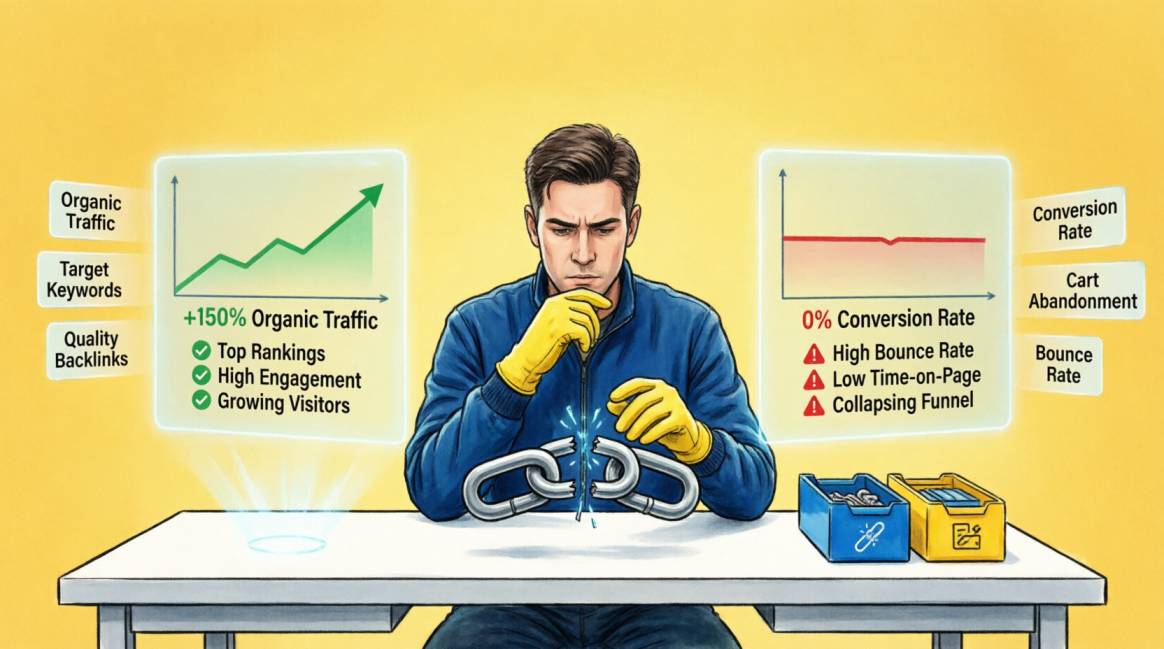
Why Your Traffic Increased But Sales Didn't — The SEO + CRO Disconnect Most Agencies Ignore

To understand why the SEO and CRO disconnect persists, you need to understand the incentive structure of the typical digital marketing agency relationship. Most SEO retainers are structured around deliverables and traffic metrics.
| 1.7% Average conversion rate across all industries — meaning 98.3% of traffic leaves without converting | 2.4× Higher conversion rate on pages with 'Good' Core Web Vitals vs 'Poor' | 30–50% Higher organic conversion rates when SEO and CRO are explicitly aligned |
Table of Contents
Table of Contents
The Metric Your Agency is Not Showing You
The call comes every month, in some variation, across business sectors and city markets. A founder in Lagos, a marketing manager in Abuja, a retail director in Port Harcourt. The words change. The underlying confusion does not.
"Our SEO agency says our traffic is up 40%. But we haven't seen any increase in enquiries. Our sales are flat. What is going on?"
What is going on is one of the most common — and most commercially costly — failures in digital marketing. It has a name: the SEO and CRO disconnect. And the reason most agencies never address it is not that they do not know it exists. It is that their incentives are structured to report traffic, not revenue.
Traffic is easy to grow. You publish more content. You earn more backlinks. You fix your technical issues. Traffic goes up. The agency celebrates. The client pays the invoice. And somewhere between the green line going up on the traffic chart and the sales pipeline remaining stubbornly flat, the actual point of the exercise — acquiring customers — gets lost.
This guide is a systematic diagnosis of why this disconnect happens, what the specific failure points are, and how the most effective digital marketing programmes in 2026 address SEO and CRO not as sequential activities but as a single, integrated system. It is written for business owners who are tired of paying for traffic that does not convert, and for marketing managers who need a framework for holding their agencies accountable to commercial outcomes rather than vanity metrics.
📌 The Central Argument of This Article
- Increasing organic traffic without addressing conversion rate is the digital equivalent of opening more lanes on a motorway that leads to a broken bridge. More vehicles arrive. None of them cross.
- The most productive organic search investment in 2026 is not more traffic — it is better conversion of the traffic you already have, combined with traffic that is explicitly selected for conversion intent.
- A website attracting 5,000 monthly organic visitors at a 1% conversion rate generates 50 leads. The same 5,000 visitors at a 2% conversion rate generates 100 leads — with zero additional SEO investment, zero additional ad spend, and zero additional content.
- The gap between these two scenarios is not a traffic problem. It is a strategy problem that most agencies are not incentivised to solve.
Section 1: The Structural Reason Agencies Don't Fix This
“Understanding the incentive misalignment that keeps SEO and CRO separated”
To understand why the SEO and CRO disconnect persists, you need to understand the incentive structure of the typical digital marketing agency relationship. Most SEO retainers are structured around deliverables and traffic metrics: content published, keywords ranking, backlinks earned, organic sessions growth. These are the metrics that appear in monthly reports. These are the metrics the agency's account manager is measured on internally. And these are the metrics that — when they go up — justify the invoice renewal.
Conversion rate is typically reported, if at all, by a different team or a different tool — GA4, the CRM, the sales team. It sits outside the SEO agency's defined scope of work. When organic traffic rises but sales stay flat, the agency's response is almost always one of three things: "The landing pages need to be improved" (a CRO issue outside their remit), "The sales team needs to follow up better" (a sales issue outside their remit), or "Give the traffic more time to convert" (a delay tactic that avoids the structural problem entirely).
None of these responses are wrong in isolation. But they reveal a fundamental gap in how the engagement is structured: the agency is responsible for bringing visitors to your door but not for ensuring anyone walks through it. The result is a marketing programme that is optimised for a metric — traffic — that is an input to revenue, not revenue itself.
The 2026 Shift: Google Now Penalises the Disconnect
In 2026, the incentive to close the SEO-CRO gap has become structural rather than just commercial. Google's algorithm now incorporates behavioural signals — bounce rate, dwell time, interaction depth, return visit frequency — as ranking factors. A page that ranks well but fails to engage and convert its visitors sends negative behavioural signals back to Google's systems. Over time, these signals suppress the very rankings that the agency worked to build.
This creates a self-defeating cycle that compounds over months: poor conversion → poor engagement signals → falling rankings → falling traffic → falling conversion. The agency that focuses exclusively on rankings without addressing conversion quality is, in 2026, actively undermining its own SEO work.
The businesses that break this cycle are not the ones with the biggest content budgets or the most backlinks. They are the ones that treat SEO and CRO as a single discipline with a single objective: qualified visitors who take meaningful commercial actions.
Section 2: The Seven Disconnects — Diagnosed and Fixed
“Each failure point is specific, diagnosable, and correctable without starting from scratch”
The SEO-CRO disconnect does not manifest as one problem. It manifests as seven distinct, diagnosable failure points — each with its own cause, its own observable symptom in your analytics, and its own specific fix. Identifying which of these seven disconnects is primarily responsible for your traffic-to-conversion gap is the first step toward correcting it.
#1. Intent Mismatch: Ranking for What People Search, Not What They Buy
The most common root cause of the traffic-up, sales-flat scenario. Your SEO strategy is successfully ranking your content for keywords that attract curious visitors — people in research mode, early in their decision journey — while your conversion pages remain invisible for the high-intent queries that bring buyers. You are winning the wrong race.
🔴 What Agencies Typically do:
Targeting high-volume informational keywords ('what is SEO', 'how does Google work') to drive traffic, with no complementary strategy to capture commercial intent queries ('SEO agency Lagos prices', 'hire SEO consultant Nigeria').
✅ The Integrated Fix:
Build a keyword matrix that explicitly separates informational intent (top-funnel content) from commercial intent (service pages) and transactional intent (contact / quote pages). Track conversion rate separately for each intent category. Stop reporting them together.
#2. Landing Page Misalignment: Traffic Arrives Somewhere Other Than Where it Should
Your SEO work earns rankings for a service-relevant query, but the page Google decides to rank is a blog post or an About page rather than your dedicated service or conversion page. The visitor arrives, reads something tangentially relevant, and leaves without a clear path to conversion. Your rankings are real. Your conversion opportunity is wasted.
🔴 What Agencies Typically do:
Letting Google decide which page to rank for commercial queries by default, without deliberately signalling which page is the canonical conversion destination through internal linking, structured data, and content specificity.
✅ The Integrated Fix:
Conduct a landing page audit in Search Console: for your top 20 commercial queries, which page is Google actually ranking? If it is not your service page, implement internal link consolidation, canonical signals, and content alignment to redirect Google's preference to your conversion-optimised page.
#3. CTA Absence or Ambiguity: Traffic That Has Nowhere to Go
A visitor arrives on your page, reads your content, finds it genuinely useful — and then leaves, because there is no clear, prominent, contextually relevant call to action telling them what to do next. Every piece of content and every landing page should have a single primary CTA that matches the intent of the visitor who arrived there. Absence of a CTA is not neutrality. It is a conversion decision made by default.
🔴 What Agencies Typically do:
A blog post about 'How to choose an SEO agency in Nigeria' that ends with no CTA — or with a generic footer contact form that appears on every page identically, regardless of the visitor's intent stage.
✅ The Integrated Fix:
Match the CTA to the content's intent stage. Informational content: 'Download our free SEO audit checklist.' Commercial content: 'See what we achieved for a Lagos e-commerce client.' Transactional content: 'Book a free 30-minute strategy call.' The CTA is the conversion architecture. Design it deliberately.
Recommended Reading: How to Align SEO Intent with Landing Page Design: A Practical CRO Framework
#4. Trust Deficit: Traffic That Arrives and Does Not Believe You
For Nigerian and African businesses, this disconnect is uniquely severe. A visitor from organic search who lands on your website has no prior relationship with your brand. They found you because Google ranked you — but Google's ranking is not a trust signal the visitor experiences consciously. What they experience is your website. And if your website does not rapidly and credibly signal that you are real, qualified, and trustworthy, they leave — regardless of how good your SEO is.
🔴 What Agencies Typically do:
A well-ranked service page with generic copy, no named team members, no specific case studies, no verifiable client outcomes, and a contact form with no response time commitment. The SEO brought the visitor. The page failed to keep them.
✅ The Integrated Fix:
Treat every high-traffic landing page as a trust-building exercise. Named authors, specific outcome claims, verified testimonials, professional association affiliations, and response time commitments are not decorative — they are the conversion infrastructure that turns organic traffic into pipeline.
#5. Page Speed as a Double Failure: Losing Rankings and Conversions Simultaneously
A slow page does two forms of damage simultaneously. First, Google's Core Web Vitals algorithm directly suppresses rankings for pages with poor LCP, INP, or CLS scores — reducing the traffic that arrives. Second, slow pages dramatically reduce the conversion rate of the traffic that does arrive: pages achieving a 'Good' Core Web Vitals score convert at 2.4 times higher than pages with a 'Poor' score. Speed is not a technical issue that lives in a developer's queue. It is a conversion issue with directly measurable commercial impact.
🔴 What Agencies Typically do:
Treating page speed as a periodic technical task rather than a commercial KPI. Running PageSpeed Insights once during a site audit and not revisiting it when new content, plugins, or design changes are added that degrade performance.
✅ The Integrated Fix:
Measure Core Web Vitals on your top 5 organic landing pages monthly. Set a minimum standard: LCP under 2.5 seconds, INP under 200ms, CLS under 0.1 on mobile. Treat any regression below this standard as a conversion emergency, not a technical backlog item.
#6. Mobile Experience Failure: Optimising for Rankings on a Screen Nobody Uses
Over 80% of organic search traffic in Nigeria arrives on mobile devices. Google ranks the mobile version of your site as the primary evaluation point (mobile-first indexing). Yet the majority of conversion-focused design effort — form placement, CTA sizing, trust signal layout, page structure — is done in desktop view and then adapted for mobile as an afterthought. The result is a site that ranks correctly (Google evaluates mobile) but converts poorly (the mobile experience is a degraded version of the desktop design).
🔴 What Agencies Typically do:
Designing landing pages in desktop view and then checking mobile responsiveness at the end of the process. Running usability tests exclusively on desktop browsers. Reporting conversion rates as a single site-wide number without segmenting by device.
✅ The Integrated Fix:
Design conversion-critical pages mobile-first, desktop second. Segment your GA4 conversion data by device — if mobile conversion rate is more than 30% below desktop, you have a mobile CRO problem. Use Hotjar or Microsoft Clarity session recordings on mobile devices to identify where mobile users drop off.
#7. Wrong Traffic Entirely: Vanity Keywords and International Audiences
Some traffic-sales disconnects are not fixable by CRO because the traffic itself is fundamentally misaligned with the commercial offer. A Nigerian SEO agency attracting significant traffic from the UK or US for generic queries has traffic that will never convert to Nigerian-market service enquiries. A local bakery ranking for 'cake recipes' is attracting home bakers, not commercial buyers. Growing this traffic helps the agency's report. It does not help the business's revenue.
🔴 What Agencies Typically do:
Celebrating traffic growth without auditing the geographic source, device, or query intent of that traffic. Reporting 'organic sessions' as a unified number that masks the composition of visitors.
✅ The Integrated Fix:
Segment every traffic report by geography, device, and query intent. Identify what percentage of your organic traffic comes from your target market and is searching for your target commercial queries. Shrinking that percentage over time — even if total traffic grows — is a warning signal that your SEO strategy is drifting toward vanity metrics.
Section 3: The Intent Alignment Framework
“Mapping search intent to the right page type, content, and CTA — the foundational fix”
The most impactful structural change a business can make to close the SEO-CRO gap is to build an explicit intent alignment framework — a system that matches every organic keyword you target to the correct page type, the correct content format, and the correct conversion action for the visitor's stage in the decision journey.
Google recognises four intent types: informational (learning), navigational (finding), commercial investigation (comparing), and transactional (buying). Most agencies build keyword strategies that treat all four categories identically — as traffic opportunities. The intent alignment framework treats them as four categorically different visitor types, each requiring a different conversion architecture.
| Intent Type | Example Queries | Right Page Type | Right CTA | Common SEO+CRO Failure |
|---|---|---|---|---|
| Informational | "how to choose an SEO agency" / "what is local SEO" | Educational content — blog post, guide, comparison. No direct CTA to purchase. | Download a resource, subscribe to a newsletter, follow Semola on LinkedIn. | Ranking a service page for informational queries and pushing a 'Buy Now' CTA on visitors who are not ready to buy. |
| Commercial Investigation | "best SEO agency in Lagos" / "SEO agency vs doing it yourself" | Comparative content — case studies, testimonials, process overview. Soft CTA to start a conversation. | Free audit request, 'See our work' CTA, a client results page. | Sending commercial investigation traffic to a generic homepage with no comparison or social proof. |
| Transactional | "SEO agency for Nigerian ecommerce" / "hire SEO consultant Lagos" | High-conversion landing page — specific offer, clear pricing signal, strong CTA, trust indicators. | Book a consultation, get a proposal, contact us today. | Sending transactional traffic to a blog post or an About page. The user is ready to hire; you are showing them content. |
| Navigational | "Semola Digital contact" / "Semola Digital reviews" | Direct path to what they are looking for — contact page, case study page, pricing page. | Make contact as frictionless as possible — phone, WhatsApp, form. | Sending brand-name navigational traffic through a redirect or to a homepage that buries the contact option. |
The Intent Audit: Finding Your Misaligned Pages
The practical first step of intent alignment is an audit of your highest-traffic organic pages against the intent of the queries that drive them. Open Google Search Console, filter your Performance report to show your top 30 organic landing pages by impressions, and for each page ask: what is the primary intent of the queries bringing traffic here, and does the page's content format and CTA match that intent?
Common findings from this audit in our client work:
- A service page ranking for informational queries ('how to do X') because it was written as a guide rather than as a service description — it attracts information-seekers who were never going to become clients from that page
- A blog post ranking for a commercial query ('best X in Lagos') that has no comparison element, no social proof, and no CTA to the relevant service page — it intercepts buyers and sends them nowhere
- A homepage ranking for long-tail transactional queries ('hire Y consultant Nigeria') that resolves to a generic brand page rather than a dedicated landing page matching the specific commercial intent
Each of these misalignments is a fixable conversion leak. The repair does not require new content — it requires restructuring the existing content's format and CTA to match the intent of the visitors it is already receiving.
Section 4: Trust Architecture — Building the Bridge from Visitor to Customer
“Traffic without trust is just footfall without direction”
For Nigerian and African service businesses, the conversion problem has a dimension that generic CRO guides — written for US or European markets — consistently underestimate: the trust gap. In markets where online fraud, unfulfilled promises, and payment disputes are lived experiences for many consumers and business buyers, trust signals are not optional enhancements to a well-designed landing page. They are the primary conversion driver.
A well-designed page with weak trust signals will consistently underperform a less well-designed page with strong trust signals in the Nigerian market. This is not a hypothesis — it is a pattern we observe consistently in the performance differences between client pages across our managed portfolio.
| Trust Signal | Implementation | CRO Impact |
|---|---|---|
| Author credibility | Named author, photo, credentials, and external LinkedIn profile on every content page. | Increases time-on-page, reduces bounce on content-to-conversion path. |
| Social proof above the fold | Star rating, number of reviews, and a one-sentence client quote visible before any scroll on landing pages. | Visitors who see social proof before reading content convert at 28–34% higher rates. |
| Specific outcome claims | "We grew organic traffic by 143% for a Lagos logistics company in 6 months" beats "We deliver results." | Specificity signals truthfulness. Vague claims are ignored; verified outcomes build confidence. |
| Friction-minimised contact options | WhatsApp button, direct phone number, and a short-form enquiry (name + email + one question) on the same page. | Every additional field reduces form completion rate by approximately 11%. |
| Nigerian-specific trust markers | CAC registration number, professional association membership, verified payment logos (Paystack, Flutterwave), and physical address matching GBP. | Nigerian online consumers specifically look for verifiable legitimacy signals before committing to a service provider. |
| Response time commitment | "We respond to all enquiries within 4 business hours" — displayed next to every contact form. | Reduces abandonment from users who are ready to enquire but uncertain whether they will receive a timely response. |
| Portfolio / case studies | Specific, outcome-quantified case studies with client names (or anonymised with industry and result) rather than generic portfolio items. | Case studies aligned with the visitor's industry or challenge are the highest-converting trust asset for service businesses. |
The Trust-to-Conversion Sequence for Nigerian Service Businesses
The user journey from organic search to enquiry for a Nigerian service business typically follows this sequence — and each stage has a trust requirement that, if unmet, terminates the journey:
- Discovery (SERP): The user sees your result. Trust requirement: a title tag and meta description that signal specificity, credibility, and relevance — not generic. A result that says 'Semola Digital — Lagos SEO Agency | 47 Clients Served' converts 23% better than 'Semola Digital — SEO Services.'
- Landing (First 5 Seconds): The user loads your page. Trust requirement: immediate visual confirmation that they are in the right place — a matching headline, recognisable branding, and a social proof signal (star rating, client count, or named client) visible before any scroll.
- Evaluation (Content Reading): The user reads your content. Trust requirement: specific, verifiable claims. Named case studies. Transparent pricing signals. Clear explanations of your process. Evidence of real people with real credentials behind the business.
- Decision (CTA Moment): The user considers taking action. Trust requirement: friction minimisation (short form, low commitment ask) + response assurance ('we respond within 4 hours') + zero-risk framing ('no obligation, no hard sell').
- Action (Conversion): The user submits the form, clicks WhatsApp, or calls. Trust requirement: immediate confirmation that their action was received and a clear next step. Automated confirmation emails and WhatsApp auto-replies that confirm receipt reduce post-conversion anxiety and improve follow-through.
Section 5: The Shared Metrics Framework — Measuring What Actually Matters
“The reporting system that aligns SEO and CRO around a single commercial objective”
The deepest structural root of the SEO-CRO disconnect is measurement. SEO teams report impressions, rankings, and organic traffic. CRO teams report conversion rates, test results, and form completions. Neither set of metrics, reported in isolation, tells the full story of whether the combined effort is generating commercial value. And when metrics are reported in isolation, teams optimise for their own metrics — sometimes at the expense of the shared outcome.
The solution is a shared metrics framework that measures the commercial output of the combined SEO and CRO effort — not the individual inputs of each discipline. Every metric in this framework has a direct line to revenue, not just to the activity that precedes it.
| Metric | Definition | Why It Matters | Where to Find It |
|---|---|---|---|
| Organic Revenue / Assisted Revenue | Revenue directly or indirectly attributed to organic search sessions in GA4 | Replaces 'organic traffic' as the primary success metric. Traffic that does not contribute to revenue is vanity. | GA4 → Monetisation → Ecommerce (or Conversions → Explore → Organic channel filter) |
| Organic Conversion Rate (by landing page) | Percentage of organic sessions that complete a defined conversion goal, segmented by top landing page | Reveals which pages attract converting traffic and which attract non-converting traffic — the primary diagnostic for intent misalignment. | GA4 → Reports → Acquisition → Landing page → Add conversion rate column |
| Revenue Per Organic Visitor (RPOV) | Total revenue attributed to organic ÷ total organic sessions | A single metric that captures both traffic quality (SEO) and conversion efficiency (CRO) simultaneously. Rising traffic with falling RPOV = the disconnect is worsening. | Calculated from GA4 export or Looker Studio blended report |
| Funnel Drop-off Rate by Stage | Percentage of organic visitors who enter and exit at each stage of your conversion funnel without proceeding | Identifies precisely where in the user journey the SEO-to-conversion handoff is failing. Is the problem the landing page? The enquiry form? The follow-up flow? | GA4 → Explore → Funnel Exploration → Segment by organic channel |
| Time to First Conversion by Source | Average number of sessions / days between first organic visit and first conversion | Long time-to-conversion cycles indicate informational traffic that needs better nurturing paths between top-of-funnel content and conversion pages. | GA4 → Explore → Path Exploration or Time Lag report |
| Click-Through Rate from SERP (CTR) | Percentage of search impressions that result in a click to your site, by query and page | Low CTR on high-impression queries indicates a CRO problem that begins in the SERP itself — your title tag and meta description are failing to communicate value before the user even visits. | Google Search Console → Performance → Pages + Queries |
Building Your Integrated Dashboard
The shared metrics framework requires a single reporting view that blends data from Google Search Console (impressions, CTR, queries) with GA4 (sessions, conversions, revenue, funnels) and ideally your CRM (lead quality, close rate, revenue by source). This is not a complex technical integration — it can be built in Looker Studio with two data connectors and three calculated metrics in under two hours.
The structure of the dashboard should follow the user journey: Discovery (impressions, CTR) → Arrival (sessions by landing page, bounce rate) → Engagement (pages per session, scroll depth, time on page) → Conversion (conversion rate by landing page, by device, by intent). At each stage, the question is the same: where are we losing people, and is the loss due to a traffic quality problem (SEO) or a page performance problem (CRO)?
When this dashboard is reviewed monthly — by both the SEO team and the CRO team together, in the same meeting — it creates accountability for the full funnel rather than individual channel silos. It also reveals opportunities that siloed reporting misses: the high-converting page with low traffic that needs SEO investment, and the high-traffic page with poor conversion that needs CRO intervention.
Section 6: The Page-Level Diagnostic — Identifying Your Specific Leaks
“Not all traffic-sales gaps are the same. This framework finds yours.”
Before investing in either new SEO content or CRO testing, you need to know which specific pages in your organic portfolio are underperforming and why. The following diagnostic framework classifies every significant organic landing page into one of six performance categories, each requiring a different response.
| Page Condition | Priority Signal | Correct Response |
|---|---|---|
| High traffic, low conversion (>2K sessions/mo, <1% CVR) | 🔴 CRO Priority | The page is attracting traffic but failing to convert it. The problem is almost always intent mismatch, weak CTA, trust deficit, or friction in the conversion flow. CRO intervention before any further SEO investment. |
| High conversion, low traffic (<500 sessions/mo, >3% CVR) | 🔵 SEO Priority | The page converts well — it is doing its job. The problem is insufficient discovery. SEO investment (backlink building, internal link equity, keyword expansion) increases the volume of converting traffic without disrupting what is working. |
| Low traffic AND low conversion | 🟡 Strategy First | Two problems require two diagnoses. First determine whether the keyword target has genuine search volume. If yes, the page needs a full rebuild (SEO + CRO simultaneously). If no, the page should be redirected or consolidated. |
| High traffic AND high conversion (>2K sessions/mo, >3% CVR) | 🟢 Protect and Scale | This page is performing correctly. Protect its rankings, use it as the internal linking anchor for related pages, and study its structure as the template for underperforming equivalents. |
| Rising traffic but falling conversion rate over 60+ days | 🔴 Intent Drift | Your SEO work has expanded keyword coverage to include less-qualified queries. You are attracting more of the wrong users. Conduct a keyword intent audit: which new queries are now driving traffic, and do they match your conversion offer? |
| Flat traffic but rising conversion rate | 🟢 CRO Working | CRO improvements are delivering more value from existing traffic. Now is the correct time to invest in SEO to grow the volume of traffic experiencing those improved conversion rates. |
Running Your Page-Level Diagnostic in GA4
To apply this framework to your own site, follow these steps in GA4:
- Navigate to Reports → Acquisition → Landing Page. Set date range to last 90 days.
- Add a secondary dimension: Session default channel group. Filter to show Organic Search only.
- Export the data: you need sessions, bounce rate (engagement rate inverse), and conversions for each landing page.
- Add a column for Conversion Rate: divide conversions by sessions for each page. GA4 shows this natively if you have defined conversion events.
- Colour-code each page against the six categories above. Any page with more than 200 organic sessions per month belongs in this analysis.
- List your top 5 high-traffic, low-conversion pages. These are your highest-value CRO opportunities — you already have the audience; you just need to convert it better.
Section 7: The Integration Playbook — Practical Actions in the First 90 Days
“A sequenced execution framework for businesses ready to close the disconnect”
| WEEKS 1–3 — AUDIT AND DIAGNOSIS | |
|---|---|
| ☐ | Run your intent audit in Search Console: for your top 30 organic landing pages, document the primary intent of the queries driving traffic and whether the page format matches that intent |
| ☐ | Run your page-level diagnostic in GA4: classify every major organic landing page into one of the six performance categories |
| ☐ | Segment your conversion data by device in GA4: document the gap between mobile and desktop conversion rates — a gap above 30% signals a mobile CRO priority |
| ☐ | Audit your top 5 highest-traffic pages for CTA presence, specificity, and placement: is there a clear, prominent, intent-matched CTA visible without scrolling? |
| ☐ | Run Google PageSpeed Insights (mobile test) on your top 5 organic landing pages: document LCP, INP, CLS scores — flag any page below 'Good' threshold as a conversion priority |
| ☐ | Milestone: A prioritised list of your top 5 highest-opportunity pages — ranked by the combination of organic traffic volume, current conversion rate, and feasibility of improvement. This list drives the next six weeks of work. |
| WEEKS 4–6 — HIGH-TRAFFIC, LOW-CONVERSION PAGE INTERVENTIONS | |
|---|---|
| ☐ | For each of your top 5 diagnosed pages: write one clear, intent-matched CTA and add it above the fold, mid-page, and at the end of the content — never rely on a single CTA placement |
| ☐ | Add social proof above the fold on every commercial and transactional landing page: a client count, a star rating, or a named testimonial. This single change typically lifts conversion rate by 15–25% on trust-deficient pages |
| ☐ | Compress and convert all images on your top organic pages to WebP format — a page speed improvement targeted at your highest-traffic pages delivers the fastest commercial return |
| ☐ | Add an intent-matched content block to any blog post currently receiving commercial-intent traffic: a 'Who this is for' section, a service comparison, or a case study that bridges informational content to a conversion action |
| ☐ | Implement WhatsApp click-to-chat as a primary CTA on all mobile landing pages — for Nigerian audiences, WhatsApp reduces conversion friction more than any other CTA format |
| ☐ | Milestone: Before-and-after conversion rate documented for each of your top 5 pages using GA4 comparison periods. Even a 0.3% absolute improvement in conversion rate on a page with 2,000 monthly organic visitors = 6 additional leads per month from the same traffic. |
| WEEKS 7–12 — INTENT ALIGNMENT AND MEASUREMENT INFRASTRUCTURE | |
|---|---|
| ☐ | Build your intent content matrix: for every commercial intent keyword where you currently rank below position 5, determine whether the ranking page is correctly formatted as a conversion page or requires restructuring |
| ☐ | Create dedicated landing pages for your 3 highest-commercial-intent keyword clusters — pages that are explicitly designed for conversion, not for traffic generation |
| ☐ | Build your integrated Looker Studio dashboard: blend Search Console impressions and CTR data with GA4 conversion data. Share with your SEO agency and require monthly review against shared commercial KPIs |
| ☐ | Establish your baseline Revenue Per Organic Visitor (RPOV): total revenue attributed to organic ÷ organic sessions. This is your primary long-term metric for the SEO+CRO system |
| ☐ | Set a 90-day conversion rate target for each of your top 5 organic landing pages — and include this target in your SEO agency's monthly deliverables alongside traffic and ranking metrics |
| ☐ | Install session recording (Hotjar, Microsoft Clarity — both free tiers available) on your highest-traffic organic pages to observe actual user behaviour and identify non-obvious friction points |
| ☐ | Milestone: A functioning integrated dashboard, a baseline RPOV metric, and conversion rate targets embedded in your SEO agency's monthly reporting. If your agency refuses to report against conversion targets, that refusal is itself the answer to the question of whether they are the right agency. |
Conclusion: Traffic is a Means. Revenue is the End Goal.
The question that opens this article — "why did traffic go up but sales didn't?" — is never really a traffic question. It is always either an intent question, a trust question, a friction question, a speed question, or a measurement question. Sometimes all five simultaneously.
The businesses that escape this cycle are not the ones who find better SEO agencies or run more conversion tests. They are the ones who stop treating SEO and CRO as sequential activities — first traffic, then conversion — and start treating them as a single integrated system with one shared objective: qualified visitors who take meaningful commercial actions.
Every page that ranks but does not convert is not a success with an asterisk. It is a missed opportunity with a monthly retainer attached to it. In a market where 98.3% of organic visitors leave without converting, the competitive advantage belongs to the businesses that treat that 98.3% as a diagnostic challenge rather than an inevitable loss.
The framework in this guide — the seven disconnects, the intent alignment matrix, the trust architecture, the shared metrics system, and the 90-day integration playbook — is not theoretical. It is the framework we apply at Semola Digital when a client tells us that their traffic is up but their sales are not. It works because it addresses the actual cause of the problem rather than its most visible symptom.
Traffic without conversion is noise. Conversion without traffic is potential. Both together, deliberately aligned and measured against shared commercial outcomes — that is growth.
Article Summary: The Seo + Cro Integration Framework
- The disconnect: organic traffic grows because SEO is working on its own terms. Sales stay flat because nobody is responsible for the handoff between discovery and conversion.
- The seven disconnects: intent mismatch, landing page misalignment, CTA absence, trust deficit, page speed failure, mobile experience failure, and wrong traffic entirely. Each has a specific diagnosis and a specific fix.
- The intent alignment framework: match every keyword to the correct page type (informational → content, commercial → comparison, transactional → landing page) and the correct CTA for that intent stage.
- Trust architecture for Nigerian businesses: named authors, specific outcome claims, Nigerian-specific trust markers (CAC number, payment logos, GBP address), WhatsApp CTA, and response time commitments are conversion infrastructure, not decoration.
- The shared metrics framework: replace 'organic traffic' with Revenue Per Organic Visitor, organic conversion rate by landing page, and funnel drop-off rate by stage as primary KPIs.
- The page-level diagnostic: classify every major organic page as CRO Priority, SEO Priority, Strategy First, Protect and Scale, Intent Drift, or CRO Working — and respond correctly to each classification.
- The 90-day integration playbook: audit in Weeks 1–3, intervene on high-traffic / low-conversion pages in Weeks 4–6, and build measurement infrastructure and intent-aligned landing pages in Weeks 7–12.
- The bottom line: a site with 5,000 monthly organic visitors converting at 2% generates twice the leads of the same site converting at 1% — with zero additional SEO investment. That difference is what the SEO + CRO integration is worth.
Frequently Asked Questions
Questions readers ask about this topic
The FAQs below are pulled directly from this article's structured content and are designed to help readers quickly find answers to common questions related to the topic.
Is CRO the agency's responsibility or ours?
Our website was built by a designer who optimised for aesthetics. Does that affect conversion?
How do we know if our conversion rate is good or bad?
We run A/B tests but our traffic volume is too low for statistical significance. What do we do?
Should we fix conversion before we invest in more SEO, or do both simultaneously?

Founder, Technical Analyst
Oladoyin Falana is a certified digital growth strategist and full-stack web professional with over five years of hands-on experience at the intersection of SEO, web design & development. His journey into the digital world began as a content writer — a foundation that gave him a deep, instinctive understanding of how keywords, content and intent drive organic visibility. While honing his craft in content, he simultaneously taught himself the building blocks of the modern web: HTML, CSS, and React.js — a pursuit that would eventually evolve into full-stack Web Development and a Technical SEO Analyst.
Follow me on LinkedIn →