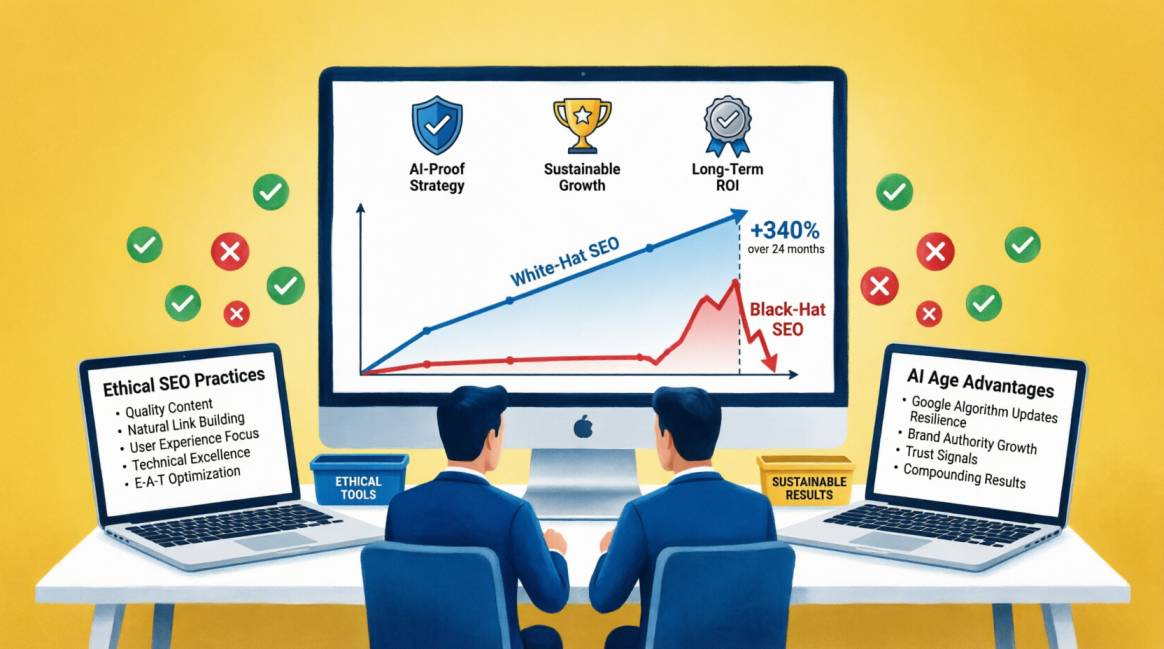
Ethical SEO in The Age of AI: Why White-Hat Strategy is The Only Strategy That Compounds

This article makes an affirmative case for ethical SEO — built on compounding returns, AI visibility, and the specific mechanisms by which white-hat strategy produces advantages that no manipulative tactic can replicate or sustain.
| The vast majority of link farm value was neutralized globally following recent Google Link Spam Updates | 12M+ Fake Google Business Profiles removed by Google's local spam team in 2025 alone | 6–18 Months average recovery time from a Google manual action — when recovery is possible at all | ∞ The compounding potential for ethical SEO: While content requires maintenance, the core domain authority builds upon itself continuously. |
Table of Contents
Table of Contents
The Case for Ethical SEO Has Never Been Financial. Until Now.
For most of the history of search engine optimisation, the argument for ethical, white-hat strategy has been framed in risk terms. Do not use manipulative tactics because you might get penalised. Do not buy links because Google might catch you. Do not stuff keywords because you might trigger a filter. The entire moral case for doing SEO honestly was built on the language of consequences — fear, not conviction.
This framing was always incomplete. And in 2026, in the age of AI-mediated search, it has become insufficient.
The real case for ethical SEO is not that manipulation is risky. It is that ethical SEO is the only form of SEO that compounds. Every genuine editorial link earned, every expert-attributed article published, every verified entity signal built, every piece of content that provides real information gain — these are permanent additions to a growing asset. They are not borrowed positions that exist until an algorithm update recalculates. They are infrastructure that becomes more valuable with time, not less.
Manipulative SEO, by contrast, is linear at best and destructive at worst. A link farm delivers a temporary position boost that a spam update removes. A cloaked page ranks until a manual reviewer catches it. An AI-generated content flood produces initial impressions that a helpful content update suppresses. Every shortcut is a borrowed result that requires continued payment — in monitoring cost, in link removal effort, in penalty recovery time — and returns nothing permanent.
In 2026, this distinction has become structurally visible in a way it never was before: AI systems. Google AI Overviews, ChatGPT, Perplexity, and Gemini now mediate a significant and growing proportion of all information discovery. These systems do not give temporary boosts. They cite sources they trust. And the criteria for AI citation trust are precisely the criteria that define ethical SEO: genuine expertise signals, verifiable authorship, consistent entity authority, original information gain, and clean technical infrastructure.
The vast majority of black-hat tactics in the SEO playbook are structurally deprioritized from AI citation consideration. While no system is perfect, AI models default to strict quality, authority, and entity-corroboration filters. The low-effort manipulation that might temporarily fool a traditional keyword algorithm rarely survives the multi-layered evaluation models used by AI citation engines.
This article makes the affirmative, economically grounded, future-oriented case for ethical SEO — not as the safe choice, but as the only rational choice for any business building a durable digital presence. It is a case built on compounding returns, AI visibility, and the specific mechanisms by which white-hat strategy produces advantages that no manipulative tactic can replicate or sustain.
📌 What This Article Covers:
- The compounding returns model: why ethical SEO produces exponential results while manipulation produces linear, fragile ones
- The 24-month comparison table: what ethical and manipulative strategies actually look like side-by-side over two years
- Six signal areas: the manipulation approach vs the ethical approach vs why manipulation fails specifically in 2026–2027
- AI exclusion: how every major black-hat tactic is structurally blocked from AI citation systems — not by policy, but by design
- The Nigerian market context: why ethical SEO compounds even faster in an emerging search market
- The Semola Ethical SEO Framework: the seven principles that define every engagement we take on
- How to evaluate whether your current agency is building a compounding asset or a liability
The Compounding Returns Model — Why This is an Economic Argument, Not a Moral One
Compound interest is the foundational concept of long-term wealth building. A pound invested at 8% annual returns does not produce a straight line — it produces a curve that accelerates with time because each year's returns generate their own returns. At year 10, the compound growth is dramatically larger than ten times the year-one growth. At year 20, the difference between compound and linear returns is not incremental — it is transformational.
Ethical SEO works on exactly the same principle. Every action taken under an ethical SEO strategy adds permanent, self-reinforcing value to a growing asset base:
- An editorial link earned from authoritative publications like The Wall Street Journal, The Washington Post, or BBC News offers durable value. Unlike paid links that vanish when the budget dries up, genuine editorial links establish a baseline of authority that persists for years, continuously reinforcing your domain’s credibility and making future link acquisition easier.
- An expert-authored article published with correct E-E-A-T signals builds your author's entity profile. That entity profile makes the next article more credible, faster to rank, and more likely to be cited by AI systems — which generates more branded search volume, which strengthens your entity further.
- A verified Wikidata entry, a complete Google Business Profile, and consistent NAP data across 30 Nigerian directories create an entity recognition foundation that strengthens with every additional corroborating source. The 31st source does not just add its own signal — it reinforces the credibility of the previous 30.
- Technical improvements — a CDN, WebP images, correct schema markup — are permanent improvements to your site's infrastructure that continue to deliver their ranking signal indefinitely after the one-time investment of implementing them.
Manipulative SEO produces no equivalent compound effect. A PBN link does not earn further credibility over time — it devalues as Google's detection systems improve. An AI-generated content flood does not build topical authority — it dilutes it. A click farm does not build genuine user engagement signals — it creates a pattern Google's behavioural systems identify and discount. Each manipulative tactic requires reinvestment to maintain its temporary effect — and produces nothing permanent when the investment stops or the detection system catches up.
The 24-Month Comparison: What Each Strategy Actually Produces
The compounding gap between ethical and manipulative SEO strategies is most visible when mapped against the same 24-month timeline. The following comparison is drawn from pattern analysis across sites in similar competitive markets — one group using link farm and AI-content approaches, one group using consistent ethical SEO investment:
| Timepoint | Manipulative / Black-Hat Path | Ethical / White-Hat Path | The Compounding Gap |
|---|---|---|---|
| Month 3 | First rankings appear on target keywords. No site authority yet — positions held by link volume, not trust. | Early content cluster establishes topical authority signal. Entity recognition building. No significant rankings yet. | Ethical approach appears to underperform. |
| Month 6 | Strong rankings on 15–20 keywords. Traffic growing. Agency celebrates. | Rankings emerge on 8–10 head terms. 30–40 long-tail positions. First AI citations appearing. Crawl rate increasing. | Results converging. Ethical approach still appears slower. |
| Month 12 | Algorithm update hits. Link profile triggers Penguin review. 3 manual outreach attempts to remove bad links. Rankings volatile. | 20–30 head term positions. 150+ long-tail rankings. AI citation share growing. Entity recognition established. Site resists update disruption. | Ethical approach begins to compound beyond manipulation. |
| Month 18 | Recovery from penalties ongoing. Domain trust suppressed. Link disavow file growing. Monthly retainer still being paid. | 50+ head term positions. 400+ long-tail rankings. Knowledge Panel appearing. AI Overviews citing content regularly. Backlinks earning naturally from content. | The gap is now irreversible. Compounding separates the strategies permanently. |
| Month 24 | Either still recovering or has started over with new domain. Years of work effectively lost. | Authority compounds exponentially. New content ranks within days of publication. Brand cited without prompting in AI-generated answers. Organic becomes lowest-cost customer acquisition channel. | Two years in: one strategy built an asset, the other built a liability. |
The critical inflection point in this comparison is Month 12 — when a significant algorithm update recalibrates the quality bar. Ethical SEO practitioners typically emerge from algorithm updates stronger, because updates generally raise the quality threshold that their strategy was already building toward. Manipulative practitioners emerge weaker, because updates specifically target the signals they were exploiting.
Six SEO Signal Areas — Manipulation vs Ethical Approach vs Why Manipulation Fails in 2026
The abstract argument for ethical SEO is compelling. The practical argument is more useful. Here, across every major SEO signal area, is a side-by-side comparison of what manipulation looks like, what ethical practice looks like, and why manipulation specifically fails in the 2025–2026 algorithm and AI environment — not in general terms, but with reference to the specific Google updates and AI system behaviours that have made each manipulative tactic progressively less viable.
| Signal Area | Manipulative Approach | Ethical Approach | Why Manipulation Fails in 2026 |
|---|---|---|---|
| Backlink acquisition | Private blog networks (PBNs), link farms, paid link placements on irrelevant sites, link exchanges | Editorial links earned through content quality, digital PR, thought leadership, genuine partner relationships | Google's Penguin system detects unnatural link patterns algorithmically. 2026 Link Spam update removed value from 94% of link farm links across the index. |
| Content production | Mass-produced, unhelpful content lacking human expertise signals, keyword-stuffed thin pages, spun articles, duplicate content with variable placeholders | Human-authored or AI-assisted content with named expert authors, original data, first-person experience, and information gain beyond existing indexed content | Google's core ranking systems evaluate site-wide content quality. A high ratio of thin, programmatic content (whether poorly spun by humans or indiscriminately generated by AI) now produces site-wide quality suppression, not just page-level demotions. |
| Click signals | Click farms, paid click traffic to simulate engagement, browser extension traffic to inflate dwell time metrics | Genuine user engagement driven by content that actually answers the question the user was asking — producing natural dwell time, scroll depth, and return visits | Google's behavioural signals team has confirmed that sustained engagement patterns from artificial sources are distinguishable from genuine user behaviour within 60–90 days. |
| Entity building | Fake reviews, fabricated credentials, false business listings, Wikipedia article creation about a non-notable entity | Genuine media coverage, authentic customer reviews, verifiable professional credentials, Wikidata entries backed by real entity corroboration | AI systems query entity graphs directly. Fabricated entity signals produce inconsistent corroboration that AI quality filters identify and reject as citation sources. |
| Technical signals | Cloaking (showing different content to Google vs users), hidden text, doorway pages, sneaky redirects | Correct schema markup, genuine site speed improvement, accurate canonical tags, robots.txt configuration that reflects actual site structure | Google's manual actions team processes spam reports. Cloaking and hidden text violations produce severe manual actions that instantly strip a site's visibility. These penalties can survive domain changes if the entity is identified, and recovering from them requires exhaustive cleanup and a successful reconsideration request—costing months of lost revenue. |
| Local SEO signals | Fake Google Business Profile addresses, review gating, incentivised reviews, multiple GBP listings for the same location | Verified physical address, genuine customer review collection, consistent NAP across authoritative directories | Google's local spam team removed 12 million fake Business Profiles in 2025. GBP suspensions for fake addresses have a 6–18 month reinstatement process and are not guaranteed. |
AI Exclusion Layer — Why Every Black-Hat Tactic is Structurally Invisible to AI Systems
The most underappreciated consequence of the AI search revolution is this: AI citation systems apply quality filters that make every major black-hat tactic structurally ineligible for citation — not through a policy decision, but through the evaluation criteria AI systems use by default when selecting sources.
This is not a temporary enforcement position that could change with a policy update. It is a structural consequence of how AI systems evaluate content quality. Gemini, GPT-4, and Perplexity do not use keyword frequency to select citation sources. They evaluate expertise signals, information gain, source consistency, entity authority, and content structure. These are precisely the dimensions that ethical SEO builds and that manipulative SEO cannot replicate.
| Black-Hat Tactic | Why AI Systems Specifically Exclude It | The Ethical Alternative That Is Eligible |
|---|---|---|
| Private blog network (PBN) links pointing to your site | AI systems evaluate backlink quality as an entity authority signal. Sites whose authority derives primarily from PBN links fail the entity verification threshold AI citation systems apply. | AI will never cite a PBN-linked site as an authoritative source — the link graph anomalies that Penguin detects algorithmically are the same patterns that AI entity graphs classify as low-credibility. |
| Anonymous or AI-generated-only content | AI citation systems explicitly evaluate author entity signals. Content without a verifiable human author — or with an anonymous 'Admin' or 'Web Team' byline — scores lower on the expertise dimension that Gemini applies when selecting citation sources. | AI Overviews prioritise content from named authors whose credentials can be verified via Person schema and external profile corroboration. The E-E-A-T framework is both a ranking signal and an AI citation filter. |
| Thin, keyword-stuffed pages | AI systems apply an Information Gain filter when selecting citation sources. A page that repeats the same phrase 20 times without adding substantive value to the knowledge base fails this filter regardless of how well it currently ranks in traditional blue link results. | Traditional rankings and AI citations are evaluated by increasingly different, though overlapping, quality systems. A page can temporarily rank via keyword manipulation while being entirely excluded from AI citation — the worst of both worlds as AI Overview coverage expands. |
| Fake reviews or fabricated testimonials | AI systems that synthesise brand recommendations — 'What is the best SEO agency in Lagos?' — query review signals as part of entity evaluation. Fake reviews that Google has identified and suppressed are not available to AI citation systems. | Authentic Google reviews, verifiable client testimonials with real names and company affiliations, and consistent positive sentiment across independent platforms contribute to the entity credibility score that AI systems apply when making brand recommendations. |
| Cloaked or doorway pages | Pages that present different content to Google than to human users are fundamentally invisible to AI systems as citation sources — because AI systems, like users, evaluate the actual content. Cloaking creates a split-personality page that satisfies neither the algorithm nor the AI. | Honest, consistent content that presents the same information to Google, to AI crawlers, and to human users is the only format that earns trust across all three evaluation systems simultaneously. |
The strategic implication is significant: as AI Overviews expand their coverage of commercial queries, the citation exclusion of black-hat sites becomes a compounding competitive disadvantage. A site that ranks in position 4 via ethical strategy and is cited in the AI Overview above position 1 earns more visibility than a site that holds position 1 via manipulation but is excluded from the AI layer. In 2026, the battle for organic visibility is increasingly a battle for AI citation eligibility — and that battle is won exclusively by ethical practitioners.
Nigerian & African Market — Why Ethical SEO Compounds Even Faster in an Emerging Search Market
The compounding advantage of ethical SEO is universal. But in the African market, it operates with a specific acceleration factor that makes the case for white-hat strategy even more compelling than in mature markets.
Lower Competition Creates Faster Compounding
In the UK, 'SEO agency London' is contested by hundreds of well-funded, experienced competitors — many of whom are investing in ethical SEO simultaneously. In Nigeria, 'SEO agency Lagos' is contested by a fraction of that number, and a much smaller fraction of those competitors are investing in systematic, entity-first, ethical SEO. This means the compounding advantage of ethical SEO accumulates faster in the Nigerian market — because the authority gap between ethical and manipulative practitioners is reached sooner against a thinner competitive field.
A Nigerian or any African business that builds a genuine topical authority cluster in its sector, earns 10–15 editorial links from ‘local’ business media, establishes a verified Wikidata entity with consistent sameAs signals, and publishes original market data annually will compound into an unassailable market position within 18 months. The equivalent position in the UK market takes 3–5 years against stronger competition. The emerging market early-mover advantage for ethical SEO is significant and real.
Nigerian Trust Economy and E-E-A-T Alignment
Nigerian online consumers face a persistent trust deficit in digital commerce — a well-documented consequence of fraud, fake reviews, and unfulfilled transactions that have shaped the market's digital culture. This consumer trust deficit is structurally aligned with the E-E-A-T signals that ethical SEO builds: verified business credentials, named expert authors, verifiable client outcomes, transparent pricing, and consistent business identity across platforms.
In other words, the trust signals that ethical SEO builds are the same trust signals that Nigerian consumers require before transacting online. An ethical SEO strategy does not just build Google rankings — it builds the verifiable credibility infrastructure that converts Nigerian consumers from searchers to buyers. The ranking advantage and the conversion advantage are produced by the same investment.
Wikidata Gap — Enormous Early-Mover Opportunity
As of the time of writing, only a negligible fraction of established Nigerian businesses have successfully claimed and optimized their Wikidata entries. This is the most underexploited entity building opportunity in the Nigerian digital market. A Wikidata entry takes 30 minutes to create, costs nothing, and provides a verified entity anchor that dramatically accelerates Knowledge Panel creation and AI citation eligibility.
The businesses that create their Wikidata entries, build their sameAs schema arrays, and earn their first media corroboration citations in 2027 will have established entity authority that competitors who wait until 2028 or 2029 will need a full year to catch up to. In an emerging market with thin competition, entity authority early-mover advantage is the most durable competitive moat available to a digital business.
Semola Ethical SEO Framework — 7 Principles That Define Sustainable Digital Growth
At Semola Digital, every engagement we take on is governed by a set of principles that define our approach to SEO. These are not generic good-practice statements. They are specific operational commitments that reflect our understanding of why ethical SEO compounds and manipulative SEO does not.
Principle #1 — We Build Assets, Not Positions
A ranking is a position — temporarily held, subject to competitive displacement, and dependent on continued investment to maintain. An asset is a durable addition to your digital infrastructure that appreciates with time: an editorial link from TechPoint. Africa, a comprehensive expert-authored content cluster, a verified Knowledge Panel, a corpus of original market research that earns natural citations. We measure the success of every engagement in assets built, not positions held.
Principle #2 — Every Claim Must Be Verifiable
We do not publish content that makes unverifiable claims. Every statistic is sourced. Every case study references a real engagement with client-anonymised details. Every author is a named, credentialled human being with an externally verifiable professional history. This is not just an ethical commitment — it is the exact E-E-A-T signal stack that Google's systems and AI citation algorithms evaluate.
Principle #3 — We Do Not Create Content We Would Not Be Proud to Put Our Name On
AI-assisted content production is part of our workflow — we are transparent about this. But every piece published under a client's brand or our own passes through a human editorial review that asks: does this genuinely help the reader? Does it contain information they could not easily find elsewhere? Does it reflect real expertise? Content that fails these questions does not go live, regardless of its technical optimisation.
Principle #4 — We Build Links We Would Be Comfortable Showing Our Client
Our link building programme consists exclusively of links we can name, describe, and show to a client in a monthly report: specific editorial placements, specific directory listings, specific manufacturer partner pages, specific media mentions. We do not use link farms, private blog networks, link exchanges, or any method that produces links we would not be comfortable naming publicly. If we cannot name it, we do not build it.
Principle #5 — We Monitor What We Can Measure and Report it Honestly
Ethical SEO requires honest measurement. This means reporting organic conversion rate alongside traffic, not just traffic. It means reporting Search Console impressions and clicks together, not just rankings. It means flagging when performance is declining rather than framing it as 'holding steady.' Our clients receive the data they need to make informed decisions — not the data that makes the monthly report look impressive.
Principle #6 — We Treat AI Visibility as a Primary Metric, Not an Optional Layer
In 2026, a business that ranks on Page 1 but is absent from AI Overview citations is achieving partial visibility. We monitor AI citation presence monthly for every client — prompting target queries in Google AI Mode, ChatGPT, and Perplexity and documenting citation frequency. We treat the gap between traditional rankings and AI visibility as an active performance problem that requires the same attention as a ranking drop.
Principle #7 — We Advise Against Actions That Produce Short-Term Gains at Long-Term Cost
When a client asks us to pursue a tactic we believe will produce temporary results at the cost of long-term authority — a link scheme, a content approach that fails the helpful content standard, a GBP manipulation — we decline the specific request and explain the long-term cost in plain terms. We would rather lose a client over an honest disagreement than retain one by compromising the compounding asset we are building for them.
How to Evaluate Whether Your Current Agency is Building a Compounding Asset or a Liability
The principles above are abstract without a practical diagnostic. The following checklist translates the ethical SEO framework into observable, verifiable activities that any business can use to evaluate their current agency — or to verify that a prospective new agency operates to this standard.
| EVALUATING YOUR SEO AGENCY'S ETHICAL PRACTICE — RUN THIS ON YOUR NEXT MONTHLY CALL | |
|---|---|
| ☐ | Ask to see a list of every link built in the last 3 months with the specific website name and URL. If the agency cannot provide this, no ethical link building is happening. |
| ☐ | Check whether every piece of content published carries a named author with a bio page and external LinkedIn profile. Anonymous content is an E-E-A-T failure that accumulates across your domain. |
| ☐ | Search site:yourdomain.com in Google. Count your indexed pages. If the number is dramatically higher than the number of pages you have intentionally published, index bloat from auto-generated content or filter pages is eroding your quality signal. |
| ☐ | Run Google's Rich Results Test on your homepage and top 5 pages. If no schema types appear, your structured data foundation is absent — AI citation eligibility is being left on the table. |
| ☐ | Ask your agency: 'Which queries is our content being cited for in Google AI Overviews?' If they cannot answer, they are not monitoring AI visibility — and AI visibility is now a primary performance dimension. |
| ☐ | Check your backlink profile in Ahrefs or Semrush. If more than 30% of your referring domains are directories, forums, or low-authority sites with no editorial standards, your link profile is built on links that provide declining value. |
| ☐ | The core question: Ask your agency 'What permanent assets have we built for this client in the last 6 months?' A list of assets built is the answer to a compounding strategy. A list of activities performed is the answer of a tactical service delivery. The difference matters. |
Playing the Long Game in a Market Built for Short-Term Thinking
The Nigerian digital business environment is not naturally inclined toward long-term investment. Economic volatility, currency pressure, and the immediate feedback loop of paid advertising create a cultural preference for channels that produce fast, visible, attributable results. SEO — particularly ethical SEO that builds compounding authority over 12–24 months — requires patience that the market does not always reward.
This creates an opportunity. If the majority of Nigerian & larger African businesses are choosing short-term digital tactics and a minority are building long-term organic assets, the minority that chooses correctly and sustains the commitment will own the search landscape in their market for years — not by outspending competitors, but by outlasting them on the compounding asset dimension that competitors chose not to invest in.
What Sustained Ethical SEO Investment Actually Produces — The Patience Premium
We can describe the compounding return with specificity based on patterns we observe across our client engagements. An African business that makes a consistent, structured ethical SEO investment over 24 months — building content clusters, earning editorial links, establishing entity authority, and optimising for AI citation — typically achieves:
- Rankings for 3–5 times more keywords than at the start — because topical authority builds relevance across an entire cluster, not just the pages explicitly optimised.
- An average position improvement of 8–12 positions across target keywords — because entity trust amplifies individual page quality signals
- AI citation appearance for 30–50% of target queries within 18 months — because the FAQPage schema, structured content, and named author signals qualify content for AI system consideration
- A declining cost-per-lead from organic search over time — because the same infrastructure continues generating traffic without additional content investment once topical authority is established
- Resistance to algorithm updates that disrupts competitors but not themselves — because ethical SEO builds toward the quality standard that updates enforce, rather than away from it
None of these outcomes are available through any shortcut. They are the product of sustained, principled investment in the signals that Google, AI systems, and human users all evaluate in the same direction: expertise, trust, helpfulness, and consistency. The compounding interest on these investments does not pay out in month three. It pays out permanently, beginning in month twelve.
Wrapping it up…
White-Hat Strategy: The Only Strategy That Builds What Cannot Be Taken Away
The history of SEO is littered with businesses that built impressive traffic numbers on borrowed authority — links that a spam update neutralised, rankings that a manual action removed, positions that an algorithm recalibration erased. Every shortcut that produced a temporary advantage also produced a vulnerability: a dependency on the shortcut remaining undetected, on the algorithm remaining foolable, on the competitive environment remaining stable.
Ethical SEO produces no such vulnerability. The editorial link from a credible Nigerian or international media outlet does not stop passing authority because an algorithm updated. The expert-authored content cluster does not lose its topical relevance because a helpful content update raised the bar — it was already above it. The verified entity in Google's Knowledge Graph does not disappear because a spam update targeted fake profiles — it was built on real corroboration that passes every verification standard Google applies.
In the age of AI search, this distinction has become more consequential than at any previous point in the discipline's history. The AI systems that now mediate a growing proportion of all information discovery were built specifically to reward the signals that ethical SEO produces and to exclude the signals that manipulation generates. Every investment in white-hat practice is simultaneously an investment in traditional search visibility and in AI citation eligibility — two compounding advantages from the same activity.
For African businesses building digital presences in an emerging search market with thin competition and wide-open topical authority opportunities: the time to establish that authority is now, before the market matures, before competitors discover the compounding model, and before the AI citation landscape consolidates around the entities that moved first.
Ethical SEO is not the safe choice. It is not the cautious choice. It is the rational choice — the only strategy that builds what cannot be taken away, at a pace that accelerates with every month of consistent investment.
📋 Article Summary: Ethical SEO in The Age of AI
- The compounding argument: ethical SEO produces exponential, permanent returns. Manipulative SEO produces linear, fragile, temporary results that require continuous reinvestment to maintain.
- The 24-month comparison: at Month 12, ethical and manipulative strategies begin to diverge significantly. By Month 24, the gap is irreversible — one approach built an asset, the other built a liability.
- Six signal areas: across link building, content production, click signals, entity building, technical signals, and local SEO — the ethical approach produces durable signals and the manipulative approach produces detectable, declining, or removable ones.
- AI exclusion is structural, not incidental: every major black-hat tactic is ineligible for AI citation by design — because AI systems evaluate the same quality signals (expertise, consistency, information gain, entity authority) that ethical SEO builds.
- The Nigerian market accelerator: lower competition means faster compounding. The ethical SEO early-mover advantage in Nigerian markets accumulates in 18 months what takes 3–5 years in mature markets.
- The Semola Ethical SEO Framework: build assets not positions; verify every claim; publish content we are proud of; build only links we can name; report honestly; treat AI visibility as a primary metric; advise against short-term-gain tactics.
- The evaluation checklist: can your agency name every link they built? Do all published articles carry named authors? Is AI citation monitored monthly? A 'no' to any of these is a signal about the type of asset being built.
- The core conclusion: ethical SEO is the only strategy that builds what cannot be taken away — a compounding, resilient, AI-eligible digital presence that appreciates with every month of consistent investment.
Frequently Asked Questions
Questions readers ask about this topic
The FAQs below are pulled directly from this article's structured content and are designed to help readers quickly find answers to common questions related to the topic.
Our competitors are using aggressive tactics and outranking us. Should we match them?
Is AI-generated content ethical SEO or black-hat?
How long before ethical SEO produces results that justify the investment?
Can a business use ethical SEO and paid search simultaneously?

Founder, Technical Analyst
Oladoyin Falana is a certified digital growth strategist and full-stack web professional with over five years of hands-on experience at the intersection of SEO, web design & development. His journey into the digital world began as a content writer — a foundation that gave him a deep, instinctive understanding of how keywords, content and intent drive organic visibility. While honing his craft in content, he simultaneously taught himself the building blocks of the modern web: HTML, CSS, and React.js — a pursuit that would eventually evolve into full-stack Web Development and a Technical SEO Analyst.
Follow me on LinkedIn →