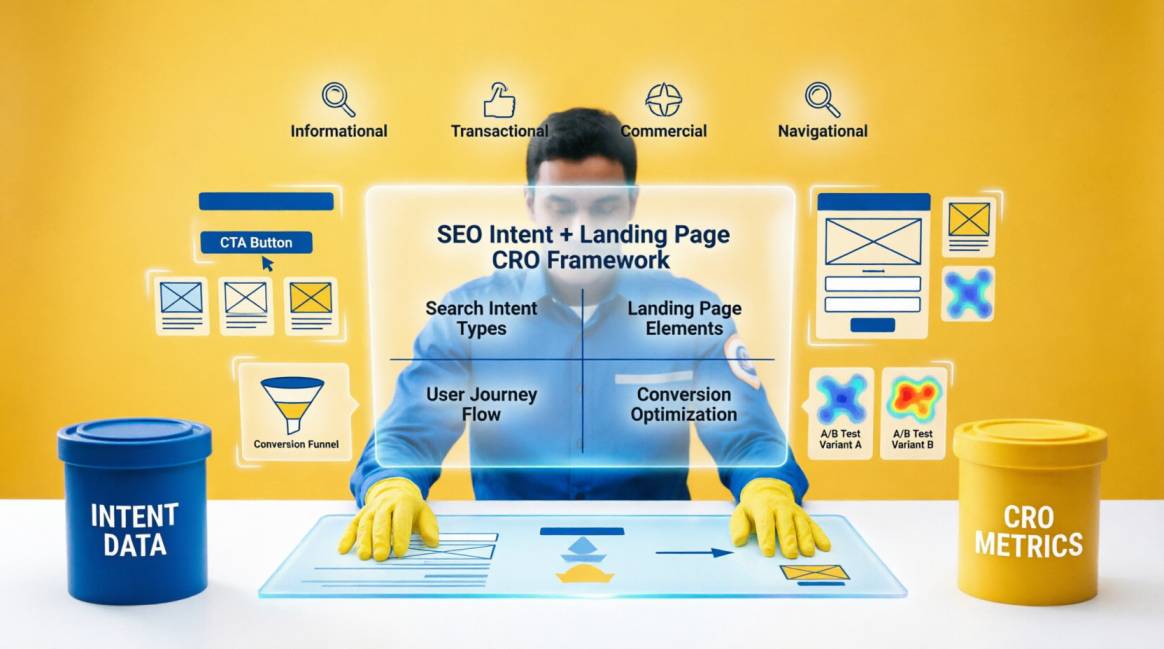
How to Align SEO Intent with Landing Page Design: A Practical CRO Framework

| KEY STATS |
|---|
| 72% — Based on our internal audits, landing pages with mismatched intent experience bounce rates above 70% |
| 3× — Higher conversion rate when page design precisely matches search intent |
| 1.7% — Global average conversion rate — but pages built with intent alignment routinely hit 4–6% |
| 5 sec — Time a visitor takes to decide whether they are in the right place — design must confirm it instantly |
Table of Contents
Table of Contents
Traffic Without Intent Alignment is Just Footfall
You can rank on Page 1. You can drive significant organic traffic. You can reduce your bounce rate slightly with a prettier design or faster loading time. And still — if the page your visitor lands on does not match the psychological state they arrived in, none of it produces conversions at the rate your traffic volume should support.
Intent alignment is the discipline of matching your landing page's design, content, hierarchy, and conversion architecture to the precise mindset of the user who arrived via a specific search query. It sounds obvious when stated plainly. In practice, fewer than 30% of the landing pages we audit for businesses execute it correctly.
The most common failure pattern: a business invests in SEO, earns rankings for commercial keywords, and sends that traffic to a generic homepage or a cluttered service page that was designed to describe the business rather than to convert a visitor in a specific psychological state. The traffic is real. The intent is genuine. The design simply does not meet it where it is.
This guide provides the complete framework: a precise taxonomy of search intent and the landing page design decisions each type demands, the specific page anatomy for each intent category, the eight friction elements that kill conversions regardless of intent alignment, the trust signals that convert a sceptical market, and a practical audit checklist you can apply to any landing page in 20 minutes.
📌 What This Guide Covers:
- The four search intent types and the precise design implications of each — including what never to do on each intent type
- Three full landing page anatomies: one per commercially relevant intent type (informational, commercial investigation, transactional)
- The eight friction elements that destroy conversion rates on otherwise well-designed pages
- Nigerian-specific trust signals: the six credibility markers that overcome the Nigerian consumer trust deficit
- The 5-second intent test: how to evaluate any landing page in five seconds for intent alignment
- A complete Intent-to-Design audit checklist — apply it to your highest-traffic organic landing pages today
- How intent alignment connects to AI Overview eligibility: the structural overlap between converting humans and being cited by AI systems
Section 1: The Four Search Intent Types & Their Design Demands
Search intent is not a classification system invented by SEOs. It is a description of the psychological state a person is in when they type a query into Google. Their mindset, their readiness to act, their information needs, and the evidence they require before they take the next step — all of these are implicit in the query they typed. Matching your landing page's design and conversion architecture to that implicit psychological state is the core discipline of intent-aligned CRO.
Google recognises four intent types. Each has a different query signature, a different user mindset, and a different optimal landing page response. The following matrix maps all four dimensions simultaneously — including the most common design mistake made for each intent type.
| Intent Type | Query Signals | User Mindset | Right Page Format | Right CTA | Wrong Design Choice | Design Principle |
|---|---|---|---|---|---|---|
| Informational | "how to", "what is", "guide to", "tips for" | Learning and understanding — not ready to buy | Long-form guide or article. Depth over conversion pressure. | Content upgrade (checklist, template), newsletter subscription | Single bold CTA above the fold, sticky header, product-push language | Present secondary CTA only after demonstrating value. Primary goal is trust-building. |
| Commercial Investigation | "best", "vs", "review", "alternatives to", "comparison" | Evaluating options — close to a decision | Comparison page, case study, testimonials, specific outcomes | Free trial, free audit, demo booking, consultation call | Generic homepage redirect, thin product page without proof | Show them what others decided. Social proof and outcome specificity are the primary conversion levers. |
| Transactional | "buy", "hire", "get a quote", "price", "agency in Lagos" | Ready to act — needs confirmation and frictionless path | Dedicated service landing page. Short, specific, trust-forward. | Get a proposal, book a call, contact now, WhatsApp us | Blog post, educational article, cluttered homepage | Minimise friction above all else. Every additional step between arrival and conversion costs you enquiries. |
| Navigational | Brand name, "[brand] contact", "[brand] pricing", "[brand] reviews" | Looking for a specific brand or page — high intent, brand-familiar | Direct path to the requested page. No detours. | Contact, pricing page, case studies — whatever they searched for | Forcing users to the homepage when they searched for a specific sub-page (e.g., redirecting a search for '[Brand] Pricing' to the homepage). If they know exactly what page they want, don't make them hunt for it again. | Speed and specificity. They already chose you — don't make them search your site. |
The Intent Mismatch Problem — Why Most Landing Pages Fail
The most damaging search intent mismatch in business SEO is transactional intent sent to an informational page. A user who searches 'SEO agency Lagos' and clicks through to a service page that reads like a 2,000-word Wikipedia article on 'What is SEO?' is experiencing categorical intent mismatch. They came ready to hire, but your page is forcing them to read a textbook.
Approximately 72% of landing pages with mismatched intent have bounce rates above 70%. The intent was real. The conversion opportunity was real. The design simply was not built to receive that specific user.
The second most common mismatch is informational intent sent to a high-pressure transactional page. A user who searches 'how to choose an SEO agency' and lands on a page that immediately pushes a 'Book Now' CTA is being asked to commit before they have been helped. They came to learn, and your page is demanding a purchase decision. The result is the same: a bounced session and a wasted ranking.
Section 2: Three Landing Page Anatomies — Built for Each Intent Type
Abstract alignment principles are useful. Specific page anatomy is more useful. Here are the three landing page structures that correspond to the three commercially relevant intent types — with the SEO and CRO role of each section and the most common design mistake for each.
INFORMATIONAL INTENT — The Trust-Building Architecture
| Above-Fold Section | SEO + CRO Role | Common Mistake |
|---|---|---|
| H1 headline addressing the question directly | Confirms immediately that the page answers the query. Informational visitors are looking for confirmation that they found what they need — give it in the first line. | Starting with the brand name instead of the question answer. The user searched a question; your headline should begin with its answer. |
| Author byline with credentials (visible without scrolling) | Informational intent visitors evaluate source credibility before reading content. A named author with verifiable credentials increases reading time and trust signal simultaneously — both SEO (E-E-A-T) and CRO benefits. | No author attribution or generic 'Admin' byline. Informational content without expert authorship is both an E-E-A-T failure and a trust failure. |
| Structured content with H2/H3 subheadings answering specific sub-questions | Scannable structure matches how informational intent users read. They scan for their specific sub-question before committing to read. Each subheading is a confirmation that their question will be answered. | Wall of text without structural hierarchy. Dense narrative paragraphs lose informational intent readers before they reach the conversion opportunity embedded later in the page. |
| Contextual Soft-CTA embedded within the content (not at the top) | Informational intent users convert after they have received value, not before. The main conversion goal here is capturing an email or lead, not a hard sale. | Primary above-the-fold CTA with product-purchase language on an informational page. The user came to learn; being asked to buy before learning triggers immediate distrust. |
| FAQ section formatted with clear semantic HTML (H3s for questions) | Dual function: answers related queries the user may have (increasing time on page) and provides highly structured, easily parseable text for Large Language Models (LLMs). This direct Q&A format significantly increases your chances of being cited in AI Overviews and traditional People Also Ask features. | No FAQ section on informational pages. This is a missed GEO opportunity and a missed conversion opportunity for the secondary CTA placement. |
| Related articles and content hub links | Internal links to related content keep informational intent users on the site as they move through their learning journey — increasing the probability that they convert on a future commercial intent session. | No internal links to next-step content. Informational visitors who complete one article and find no clear path forward exit the site entirely. |
COMMERCIAL INVESTIGATION INTENT — The Proof Architecture
| Above-Fold Section | SEO + CRO Role | Common Mistake |
|---|---|---|
| Headline that acknowledges the comparison context | Commercial investigation visitors are comparing options. A headline like 'Why Lagos businesses choose Semola Digital over general agencies' meets them where they are — evaluating — rather than pretending they have already decided. | Generic 'About Us' or 'Welcome to [Brand]' headline. The visitor is actively comparing; ignoring that context produces immediate distrust. |
| Specific outcome claims above the fold | The commercial investigation visitor's core question is 'what results have you produced for businesses like mine?' Answer this in the first viewport. Not 'we deliver results' — specific results, specific clients, specific numbers. | Vague, generic value propositions. 'We help businesses grow' tells a commercial investigation visitor nothing they could not read on 50 competitor pages. |
| Comparison or differentiation section | If the user searched '[your brand] vs [competitor]' or 'best [service] in Lagos,' they expect a structured comparison. Provide it. Avoiding the comparison does not make the user forget they were comparing — it just makes your page less useful than a page that addresses it directly. | No competitive differentiation. A page that does not explain why a prospect should choose you over competitors loses commercial investigation visitors to the competitor page that does. |
| Case studies and testimonials with specific outcomes | Social proof is the primary conversion mechanism for commercial investigation intent. The most effective format: named client, their industry, their specific problem, and the specific, quantified outcome. Not a generic five-star review. | Generic testimonials without specificity. 'Great service, very professional' provides zero evidence of outcomes — the only thing a commercial investigation visitor actually needs to see. |
| Soft CTA: free consultation, audit, or trial | Commercial investigation visitors are not yet ready to commit. A no-risk first step — a free audit, a 30-minute consultation, a free trial — gives them a low-friction way to move forward without the psychological pressure of a full commitment. | Hard-sell CTA: 'Buy Now,' 'Get Started,' 'Sign Up' without a free trial option. These are appropriate for transactional intent. For commercial investigation, they create decision anxiety and cause exits. |
| Social proof signals (review count, client logos, awards) | Aggregate social proof — star rating with review count, recognisable client logos, industry awards — provides rapid trust signals that support the detailed case studies elsewhere on the page. | No social proof above the fold. A commercial investigation visitor who does not see immediate evidence of credibility will scroll only briefly before exiting to a competitor with more visible proof. |
TRANSACTIONAL INTENT — The Friction-Elimination Architecture
| Above-Fold Section | SEO + CRO Role | Common Mistake |
|---|---|---|
| Headline: specific service + specific location + primary benefit | Transactional intent visitors searched for a specific solution. The headline must confirm: this is exactly what you searched for, and here is the specific benefit you will receive. 'SEO Agency in Lagos — Rankings That Drive Revenue' is correct. 'Empowering Businesses Through Digital Excellence' is not. | Brand-forward headline that buries the service offering. The transactional visitor knows they want SEO; they need to confirm they are at the right specialist, not read a mission statement. |
| Primary CTA: visible, high-contrast, above the fold | Transactional visitors are ready to act. The primary conversion action must be the most visually prominent element on the page and visible without scrolling. Every millisecond of search time between arrival and the CTA reduces conversion probability. | CTA below the fold. If the primary CTA requires scrolling on mobile (where 67%+ of Nigerian traffic arrives), the conversion opportunity is lost for the majority of visitors. |
| Trust signals: reviews, certification, years in business | Even transactional intent visitors need a final trust confirmation before acting. This is not about persuading them — they already want the service. It is about confirming they are choosing a reliable provider. Three trust signals visible in the first viewport are sufficient. | No trust signals above the fold. Transactional visitors who do not see immediate credibility signals default to 'let me look at a couple more options' — and often do not return. |
| Stripped navigation | Every navigation link on a transactional landing page is a potential exit path. Transactional pages should have minimal navigation: logo, phone number, and the primary CTA. Internal links to case studies or blog posts give a ready-to-act visitor reasons to leave the page before converting. | Full site navigation on dedicated transactional landing pages. This is the most common structural design error we observe on Nigerian service business pages built for paid traffic and organic commercial queries simultaneously. |
| Short, specific form (3 fields maximum) | Form length is the single most controllable conversion rate variable. Every additional field reduces completion rate by approximately 11%. A transactional intent visitor will complete a 3-field form (name, email/phone, project brief). They will not complete a 10-field qualification form before having a conversation. | Long qualification form above the fold. The form is the conversion barrier, not the conversion. Move it after the CTA click, not before it. |
| Response time commitment | A transactional visitor who submits a form needs immediate reassurance that their action was received and will be followed up. 'We respond within 4 business hours' reduces post-form-submission anxiety and improves follow-through rates on WhatsApp conversations and phone enquiries. | No response time commitment near the CTA or form. Visitors who are unsure whether their enquiry will be answered often do not submit — especially in the Nigerian market where follow-up reliability is a legitimate concern. |
Section 3: The Eight Friction Elements That Destroy Conversion Regardless of Intent Alignment
Even a correctly intent-aligned landing page can fail if it introduces friction — elements that slow, distract, confuse, or create anxiety in the user's path from arrival to conversion. The following eight friction elements are the most commonly observed on business landing pages and the most directly impactful on conversion rate. Each is identifiable in a 5-minute page audit and correctable without a full redesign.
| Friction Element | Why It Kills Conversions | The Fix |
|---|---|---|
| Navigation bar with 7+ items | Cognitive overload. Every navigation option is an exit path. Transactional landing pages should have minimal or no navigation. | Minimize distracting links, but keep your core navigation intact. While PPC landing pages strip navigation entirely to 'trap' users, organic SEO landing pages must retain the main site header to allow Googlebot to crawl effectively and to let organic visitors naturally explore your brand. |
| Hero image that loads slowly (LCP > 2.5s) | Industry benchmarks show that mobile bounce rates soar when Largest Contentful Paint (LCP) exceeds 2.5 seconds. A slow hero image is not just a speed problem — it is a direct conversion killer. | Compress hero image to WebP < 80KB. Add fetchpriority='high'. Use a robust Content Delivery Network (CDN) with local African edge nodes (such as Cloudflare or CloudFront) for faster Nigerian mobile delivery. |
| Contact form with 7+ fields | Every additional form field reduces the completion rate by approximately 11%. A 7-field form will see completion rates drop by nearly 40% compared to a streamlined 3-field form | Minimum viable form: Name, Email/Phone, One qualifying question. Everything else is collected post-conversion. |
| Generic hero copy that does not match the search query | The first 5 seconds of a landing page experience are a subconscious trust check. If the headline does not confirm 'you are in the right place,' the user's next instinct is to go back and try the next result. | Match headline language to the query language. If they searched 'SEO agency Lagos,' your headline should reference Lagos and SEO specifically. |
| CTA button with low-contrast text | A CTA button that blends into the page colour scheme is effectively invisible. Low-contrast design is the single fastest CRO fix: change the colour of the button and it takes minutes but the improvement is immediate. | Use high-contrast button colours. Test in greyscale — if the button disappears, the contrast is insufficient. |
| No social proof above the fold | Visitors who see social proof before reading content convert at 28–34% higher rates. A star rating, a client count, or a named testimonial visible without scrolling is a trust accelerant that has an immediate impact on conversion. | Add one trust signal above the fold: star rating from Google, a client count ('Trusted by 50+ Nigerian businesses'), or a single named client quote. |
| CTA that says 'Submit' or 'Click Here' | Generic CTA copy reduces conversion rate by up to 10% compared to specific, benefit-oriented copy. 'Submit' tells the user nothing. 'Get Your Free SEO Audit' tells them exactly what they receive. | Rewrite every CTA button with specific, first-person value language: 'Get My Free Audit', 'Start My Project', 'Speak to an Expert'. |
| Mobile layout that buries the CTA | If a Nigerian mobile user has to scroll more than two screen-heights to reach your primary CTA, most of them will not scroll. Mobile CTA placement must assume the user will not scroll far. | Place the primary CTA within the first viewport on mobile. Add a sticky CTA bar or floating WhatsApp button for mobile users who scroll past the primary CTA. |
Section 4: The 5-Second Intent Test — Your Fastest CRO Diagnostic Tool
The 5-second intent test is a diagnostic technique borrowed from usability testing and adapted specifically for SEO intent alignment evaluation. It works like this: load any landing page fresh (clear cache, private browser), look at it for exactly 5 seconds, then close the tab. Can you answer all five of the following questions from memory?
- What does this business offer?
- Who is this for? (What type of customer or client?)
- What should I do next? (What is the primary CTA?)
- Why should I trust this business? (What credibility signals are visible?)
- Is this page relevant to the query I searched? (Intent confirmation)
If any of these five questions cannot be answered from a 5-second view of your landing page, your page is failing the intent test. Specifically: Questions 1 and 5 are intent alignment failures. Questions 2, 3, and 4 are design failures. In practice, most intent alignment failures are simultaneously question 1 and question 5 failures — the page does not clearly state what it offers (so the user cannot confirm relevance) and does not visually confirm alignment with the query they searched.
Running the 5-Second Test Systematically
For any high-traffic organic landing page, run this protocol:
- Pull the page's primary query from Google Search Console (the query driving the most impressions to this URL).
- Mentally place yourself in the user's mindset for that query. If they searched 'SEO agency Lagos,' they are a business owner considering hiring an agency — what questions are in their mind?
- Load the page fresh and view it for 5 seconds. Close it.
- Answer the five intent test questions. Document any failures.
- For each failure: identify the specific element that should provide the answer but does not. Fix that element first.
Apply this to your top 5 organic landing pages by traffic volume. The results are almost always illuminating — and the fixes are almost always faster than a full redesign.
Section 5: Nigerian, African-Specific Trust Signals — Designing for a Sceptical Market
The consumer trust deficit is a well-documented reality of the African digital commerce environment, particularly in Nigeria. Fraud, unfulfilled orders, non-existent businesses, and payment failures have collectively created a population of digital consumers who are more cautious before converting than their equivalents in many other markets. This is not a reflection on Nigerian consumers' sophistication — it is a rational response to a market with historically higher deception rates. For businesses operating legitimately, it means trust signals that might be optional in other markets are mandatory in Nigeria and Africa at large.
The following six trust signals are specifically calibrated for the Nigerian-African market context — they address the specific concerns Nigerian consumers and business buyers bring to digital transactions.
| Nigerian Trust Signal | Why It Matters in the Nigerian Context | How to Implement |
|---|---|---|
| CAC Registration Number | Display your CAC registration number visibly on landing pages and in your footer. Nigerian businesses and consumers specifically look for this as the primary business legitimacy signal. | RC 1234567 or BN 1234567 — displayed near your contact information, not buried in terms and conditions. |
| Google Star Rating Widget | Embed your Google review rating using a Review schema or a third-party widget. A 4.8-star rating with 47 reviews displayed on a landing page is more persuasive than any copy you can write about your quality. | Google Reviews widget or a manually displayed star rating with the count — e.g., '4.9 ★ (62 reviews)' |
| Payment Method Logos | For service businesses: Badges for Paystack, Flutterwave, or 'Direct Bank Transfers Accepted' signal that you are a legitimate, operational Nigerian business. | Display payment logos prominently on service pages, near the CTA, and on checkout pages. |
| Named Client References | A testimonial from 'John O., CEO, XYZ Limited, Lagos' converts significantly better than a testimonial from 'John O.' or, worse, an anonymous quote. Nigerian consumers are suspicious of unattributed testimonials. | Full name, job title, company name (with permission), and ideally the city. Photo if the client agrees. |
| WhatsApp Number (not just a form) | The WhatsApp number communicates instant accessibility in a way that a traditional contact form does not. A Nigerian consumer who sees a WhatsApp contact option immediately understands: there is a real person on the other end who can be reached instantly if something goes wrong. Add a floating WhatsApp widget or display the number directly next to your primary CTA. | Floating WhatsApp button on mobile, a 'Chat on WhatsApp' link near every CTA, and a WhatsApp number in the footer. |
| Physical Address (even for digital businesses) | A physical address — even if it is a virtual office or co-working space — signals to Nigerian consumers that a business is real and accountable. Digital-only businesses that fail to list a physical footprint often struggle to convert high-value leads, as local buyers fear they have no recourse if a transaction goes wrong | Display a Nigerian address in your footer and on your Contact page. Include it in your LocalBusiness schema. |
Section 6: Intent Alignment and AI Visibility — The Structural Overlap
One of the most practically useful insights in the intersection of SEO and CRO is this: the structural elements that align a landing page with search intent are largely identical to the structural elements that make a page eligible for AI citation. Optimising for intent alignment is not a separate activity from optimising for Generative Engine Optimisation (GEO) — they are the same optimisation viewed from two angles.
Consider the structural requirements of a well-aligned informational landing page: answer-first headings, named expert author with credentials, FAQ section with specific Q&A pairs, structured content hierarchy, original data or insight. Now consider the CITE Framework requirements for AI citation eligibility: Citability (named author), Information Gain (original data), Trustworthiness (expert credentials and sources), Extractability (answer-first structure and FAQ blocks). They are the same list.
The practical implication: when you audit a landing page for intent alignment failures and correct them — adding the named author, restructuring the headline to answer the query directly, adding the FAQ section with FAQPage schema — you are simultaneously improving its AI citation eligibility. The investment produces dual returns: better conversion rates from your human visitors today, and a higher likelihood of being cited as a trusted source by AI search engines tomorrow.
The Three-Way Alignment Test
For any significant landing page, run this three-way alignment test:
- SEO alignment: Does this page's content, structure, and keyword targeting match the intent of the queries driving traffic to it? (Search Console → Performance → filter by this page's URL → review top queries)
- CRO alignment: Does this page's design, hierarchy, and conversion architecture match the psychological state of a user who just typed one of those queries? (5-second intent test + friction audit)
- GEO alignment: Is this page structured for AI citation eligibility? (CITE Framework audit: named author, original data, FAQPage schema, answer-first structure) [See our CITE Framework guide for the complete audit]
A page that passes all three tests is a fully optimised asset: it attracts the right traffic, converts that traffic at a high rate, and earns AI citations that expand its visibility above the organic blue link layer. A page that fails any of the three tests is leaving performance on the table across at least one dimension.
Section 7: The Complete Intent-to-Design Audit Checklist
Apply this checklist to any high-traffic organic landing page. Complete it in sequence — the order reflects the priority of impact, with the highest-impact items first.
| STEP 1 — IDENTIFY THE INTENT (5 MINUTES) | |
|---|---|
| ☐ | Pull the page's top 5 queries from Google Search Console (Performance → filter by page URL → Queries tab) |
| ☐ | Classify the dominant intent: Informational (how, what, guide, tips) / Commercial Investigation (best, vs, review, comparison) / Transactional (hire, buy, price, agency in [city]) |
| ☐ | Identify the secondary intent (if any): does a meaningful portion of traffic arrive with a different intent than the dominant one? |
| ☐ | If the page's content architecture does not match the dominant intent: that misalignment is your highest-priority fix. Correct it before addressing any design or friction elements. |
| STEP 2 — RUN THE 5-SECOND TEST | |
|---|---|
| ☐ | Load the page fresh (private browser, cleared cache). View for exactly 5 seconds. Close it. |
| ☐ | Without looking at the page again: answer the five intent test questions (What is offered? Who is it for? What do I do next? Why trust this? Is this relevant to my query?) |
| ☐ | Document any question that could not be answered — these are your design failures |
| ☐ | For each failure: identify the specific element that should provide the answer. Prioritise fixing the intent confirmation failure (question 5) before any other design failure. |
| STEP 3 — FRICTION AUDIT | |
|---|---|
| ☐ | Navigation: does the page have full site navigation? For transactional intent pages: remove or minimise to logo + phone + CTA only |
| ☐ | Hero image/page weight: run PageSpeed Insights mobile test. LCP above 2.5 seconds is a conversion liability — fix image weight and CDN before any copy or design changes |
| ☐ | Form length: count the fields. More than 3 fields on an initial enquiry form requires justification. Every field above 3 costs approximately 11% of completions. |
| ☐ | CTA visibility: is the primary CTA visible without scrolling on mobile? If not: move it up. Add a sticky CTA bar or floating WhatsApp button. |
| ☐ | CTA copy: does the button say 'Submit,' 'Click Here,' or 'Contact Us'? Rewrite with specific value: 'Get My Free Audit,' 'Speak to an Expert,' 'Start My Project' |
| ☐ | Social proof above fold: is there at least one trust signal (star rating, client count, testimonial) visible without scrolling? If not: add one this week. |
| ☐ | Button contrast: screenshot the page in greyscale. If the CTA button disappears, increase its colour contrast. |
| STEP 4 — NIGERIAN TRUST SIGNALS | |
|---|---|
| ☐ | CAC registration number displayed near contact information or footer |
| ☐ | Google star rating or third-party review widget visible on key service pages |
| ☐ | Payment method logos (Paystack, Flutterwave, bank transfer) on service pages and near CTAs |
| ☐ | At least one named testimonial with full name, company name, and city |
| ☐ | WhatsApp click-to-chat button on mobile (floating or inline above the CTA) |
| ☐ | Physical Nigerian address displayed in the footer and on the Contact page |
| STEP 5 — INTENT CONTENT ALIGNMENT | |
|---|---|
| ☐ | Informational intent pages: does the H1 directly answer the question implied by the primary query? Is there a named author with credentials visible above the fold? Is there a FAQ section with FAQPage schema? |
| ☐ | Commercial investigation pages: does the page include specific outcome claims, case studies with named clients and quantified results, and a soft CTA (free audit, free consultation)? |
| ☐ | Transactional intent pages: is the headline specific (service + location + benefit)? Is the navigation stripped? Is the form 3 fields or fewer? Is there a response time commitment near the form? |
| ☐ | GEO alignment: does the page have a named author with Article schema? An answer-first opening paragraph? A FAQ section with FAQPage schema? If not, the page is failing the CITE Framework and missing AI citation eligibility. |
| ☐ | Final test: Give the page URL to someone unfamiliar with your business and ask them to tell you what the page is offering and what they should do next. If they cannot answer in 10 seconds, the intent alignment work is not done. |
Summing it up…
Intent Alignment is Not a Design Improvement — It is a Strategy Decision
The conversion rate gap between a well-intended but misaligned landing page and a precisely intent-aligned page can be 3–5× — from a 1% conversion rate to a 3–5% conversion rate from the same volume of organic traffic. That gap does not require a full redesign, a larger budget, or a more aggressive CTA. It requires understanding the psychological state of the user who searched the query that brought them to your page, and building a page experience that meets them precisely where they are.
For Nigerian businesses investing in SEO: the return on intent alignment work is faster and higher than the return on additional traffic acquisition. Doubling your conversion rate from existing traffic is typically faster and cheaper than doubling your traffic volume — and it requires no additional backlinks, no additional content, and no additional technical SEO. It requires only a clear-eyed diagnosis of what your organic visitors expected to find and an honest assessment of whether your current pages deliver it.
Apply the intent alignment framework in this guide to your top five organic landing pages this month. Run the 5-second intent test on each. Complete the friction audit. Add the Nigerian trust signals that are missing. The result, in most cases, is a measurable conversion rate improvement within 30 days — from the same traffic you already have.
📋 ARTICLE SUMMARY: SEO INTENT × LANDING PAGE DESIGN
- The four search intent types: Informational (learn), Commercial Investigation (compare), Transactional (act), Navigational (find). Each demands a completely different page architecture, CTA type, and design hierarchy.
- 72% of landing pages with mismatched intent have bounce rates above 70%. Intent mismatch is the most common cause of high traffic with low conversion.
- Three landing page anatomies: Informational (trust-building, content-first, secondary CTA), Commercial Investigation (proof-forward, comparison context, soft CTA), Transactional (friction-free, stripped navigation, hard CTA above fold).
- The 5-second intent test: five questions that must be answerable from a 5-second page view. Any question that cannot be answered is a design failure requiring immediate attention.
- Eight friction killers: full navigation on transactional pages, slow LCP, long forms, mismatched headlines, low-contrast CTAs, no social proof above fold, generic CTA copy, buried mobile CTA.
- Nigerian trust signals: CAC number, Google star rating, payment method logos, named client testimonials with company, WhatsApp button, physical Nigerian address.
- Intent alignment and GEO are structurally the same optimisation: answer-first headings, named authors, FAQ sections with FAQPage schema — these improve human conversion rate and AI citation eligibility simultaneously.
- The 5-step audit: identify intent → 5-second test → friction audit → Nigerian trust signals → intent content alignment. Run it on your top 5 organic landing pages this week.
Frequently Asked Questions
Questions readers ask about this topic
The FAQs below are pulled directly from this article's structured content and are designed to help readers quickly find answers to common questions related to the topic.
Should every page on our website have a different design based on its intent?
We have one homepage that receives a mix of all four intent types. How do we align it?
We changed our CTA copy and button colour but conversion rate did not improve. What else should we try?
How do we measure whether our intent alignment improvements are working?

Founder, Technical Analyst
Oladoyin Falana is a certified digital growth strategist and full-stack web professional with over five years of hands-on experience at the intersection of SEO, web design & development. His journey into the digital world began as a content writer — a foundation that gave him a deep, instinctive understanding of how keywords, content and intent drive organic visibility. While honing his craft in content, he simultaneously taught himself the building blocks of the modern web: HTML, CSS, and React.js — a pursuit that would eventually evolve into full-stack Web Development and a Technical SEO Analyst.
Follow me on LinkedIn →